Ayurveda Initiative for Global Health

Tag: Anxiety

  • How Yoga and Meditation Can Help You Overcome Depression?

    Transforming Your Energy Rise Above the Darkness

    Depression is a pervasive and debilitating mental health condition that affects millions of people worldwide. While conventional treatments like medication and therapy can be effective, many people are turning to alternative approaches like yoga and meditation to help manage their symptoms. But can these practices really help transform your energy and overcome depression?

    The Science Behind Yoga and Meditation’s Impact on Depression

    Research has shown that yoga and meditation can have a profound impact on both physical and mental health. These practices have been shown to:

    1 Reduce symptoms of anxiety and depression

    2 Improve mood and overall sense of well-being

    3 Enhance cognitive function and concentration

    4 Boost self-esteem and body image

    5 Improve sleep quality


    How Yoga and Meditation Can Help You Overcome Depression?


    How Yoga and Meditation Can Help Transform Your Energy

    Yoga and meditation work on multiple levels to help transform your energy and overcome depression. Here are some key ways in which these practices can help:

    1 Reduce stress and anxiety: Yoga and meditation have been shown to reduce stress hormones like cortisol, leading to a decrease in anxiety and depression symptoms.

    2 Increase positive energy: Yoga and meditation can help increase feelings of positivity and well-being, which can help counteract the negative energy of depression.

    3 Improve mood regulation: Yoga and meditation can help improve mood regulation by increasing the production of neurotransmitters like serotonin and dopamine.

    4 Enhance self-awareness: Yoga and meditation can help increase self-awareness, allowing you to better understand your thoughts, emotions, and behaviors.

    Simple Yoga and Meditation Techniques to Get You Started

    Here are some simple yoga and meditation techniques you can try to help transform your energy and overcome depression:

    A Deep breathing exercises: Take slow, deep breaths in through your nose and out through your mouth, focusing on the sensation of the breath.

    B Body scan meditation: Lie down or sit comfortably, bringing your attention to different parts of your body, starting at your toes and moving up to the top of your head.

    C Yoga poses for depression: Try poses like downward-facing dog, child’s pose, and warrior II, which can help reduce symptoms of depression.

    Depression is a complex and multifaceted condition that requires a comprehensive treatment approach. While yoga and meditation should not be used as a replacement for conventional treatment, they can be a powerful adjunct therapy to help transform your energy and overcome depression. By incorporating these practices into your daily routine, you can take the first step towards healing and recovery.

    Frequently asked questions on Yoga, Meditation, and Depression
    Q: What is the concept of “particles of depression” and how does it affect our environment?
    A: The concept of “particles of depression” refers to the idea that our emotions and
    can affect the environment around us.
    When we feel depressed, we create a negative energy field that can attract similar
    energies and stick to our surroundings. This can affect not only
    our own mood but also the mood of others who enter that space.
    Q: How can yoga and meditation help in transforming our energy and overcoming depression?
    A: Yoga and meditation are powerful tools that can help transform our energy and
    overcome depression. By practicing yoga and meditation,
    we can reduce stress and anxiety, increase positive energy, improve mood regulation,
    and enhance self-awareness.
    These practices can also help us develop greater resilience
    and coping skills, making it easier to manage depressive symptoms.
    Q: What are some simple yoga and meditation techniques that can help with depression?
    A: Some simple yoga and meditation techniques that can help with depression
    include deep breathing exercises, body scan meditation, and
    yoga poses like downward-facing dog, child’s pose, and warrior II.
    These techniques can help reduce symptoms of depression, improve mood,

    and increase feelings of relaxation and calm.
    Q: Can yoga and meditation replace conventional treatment for depression?
    A: No, yoga and meditation should not be used as a replacement for conventional treatment
    for depression. While these practices can be a powerful adjunct therapy,
    they should be used in conjunction with other treatments, such as medication and therapy,
    under the guidance of a qualified healthcare professional.
    Q: How can I incorporate yoga and meditation into my daily routine?
    A: Incorporating yoga and meditation into your daily routine can be simple.
    Start by setting aside a few minutes each day to practice deep breathing exercises,
    meditation, or yoga. You can also try incorporating yoga and meditation into your daily activities,
    such as taking a few deep breaths before a meeting or practicing yoga poses during
    commercial breaks while watching TV.
    Q: What are some common misconceptions about yoga and meditation?
    A: Some common misconceptions about yoga and meditation include the idea
    that you need to be flexible or athletic to practice yoga, or that meditation is only for spiritual
    or religious purposes. In reality, yoga and meditation are accessible to anyone, regardless of age,
    ability, or background, and can be practiced in a variety of ways to suit your individual needs
    and goals.
    Q: How can I find a qualified yoga or meditation instructor?
    A: Finding a qualified yoga or meditation instructor can be easy.
    Look for instructors who have completed a reputable training program
    and have experience teaching students with needs similar to yours.
    You can also ask for referrals from friends, family, or healthcare professionals,
    or search online for qualified instructors in your area.
    References:
    1. “Yoga and Meditation for Depression” (Harvard Health Publishing, 2019)
    2. “The Effects of Yoga on Mental Health” (Journal of Clinical Psychology, 2018)

  • Anxiety disorders

    Worry Creates many Problems…….A man having stomach pain went to his doctor. The doctor asked if he was having trouble in his personal life or at his job.

    The man explained that he was worried about some incidents that had happened at work with his boss and his co-workers. Was there something the man could do to change what had happened? ”No,” responded the man. ”But it continues to bother me.” The doctor said, ”There is nothing you can do about the past. Close the chapter and move on. You are upsetting yourself and your stomach over something you cannot change.” The doctor prescribed some medicine, and advised him to forget the past to help expedite the cure of his stomach aches.
    The next patient was a woman with migraine. She explained that she was afraid of making a wrong decision about her future. Sensing that this was causing her headaches, he told her, ”If you make a decision that turns out all right, there is nothing to worry about. If you make a decision that turns out wrong, you still have the option to rectify matters. No decision is irreversible. Make a list of your options; make a counter-plan for each option and then act. Analyse the situation, and then act. Then take each step as it comes.”
    People either worry about a past that they cannot change, or they worry about a future that has not yet happened. Many worry over problems they anticipate or fears that never materialise. Many of our stress-related illnesses are due to problems that we face mentally, psychologically or emotionally. What is certain is that there are always going to be problems.
    Murphy’s Law says that if anything can go wrong, it will. There does not seem to be anyone who has not experienced problems in life. Every time we solve one problem, a new one springs up. After a while we begin to wonder if there will be a time in life when we can be free of problems.
    Nobody said that life was going to be easy or that everything was going to be perfect. The question is, how do we handle our problems? Do we face them as a challenge and try to solve them, or do we fret and worry about them? We compound our problems by worry and fretting because this added stress can make us physically sick.
    The pressures of life are so great that they affect us physically and mentally. We find that people undergo anxiety, fear, depression and phobias. Offices of psychiatrists, psychologists and therapists are filled with normal, everyday people who cannot cope with life’s struggles.
    If our mind is positive and happy, we may feel physically better than when our mind is troubled and anxious. Our mental state can cause stress-related illnesses.
    Studies have shown that when we are angry or emotionally upset, chemicals released in our body prepare us for ”fight or flight”.
    We need to find some acceptable way to prevent the mental, emotional and physical effects of stress which are making us ill.
    Meditation has numerous benefits for our physical and mental well-being. It is safe, effective and does not cost anything. Once we learn how to meditate, we carry within us a ready remedy which we can use at any time and any place.
    Om Namah Shivay
    ***Write ” Om Namah Shivay ” if you ask for God’s blessing on your life today. 

    – Sri Eswaran


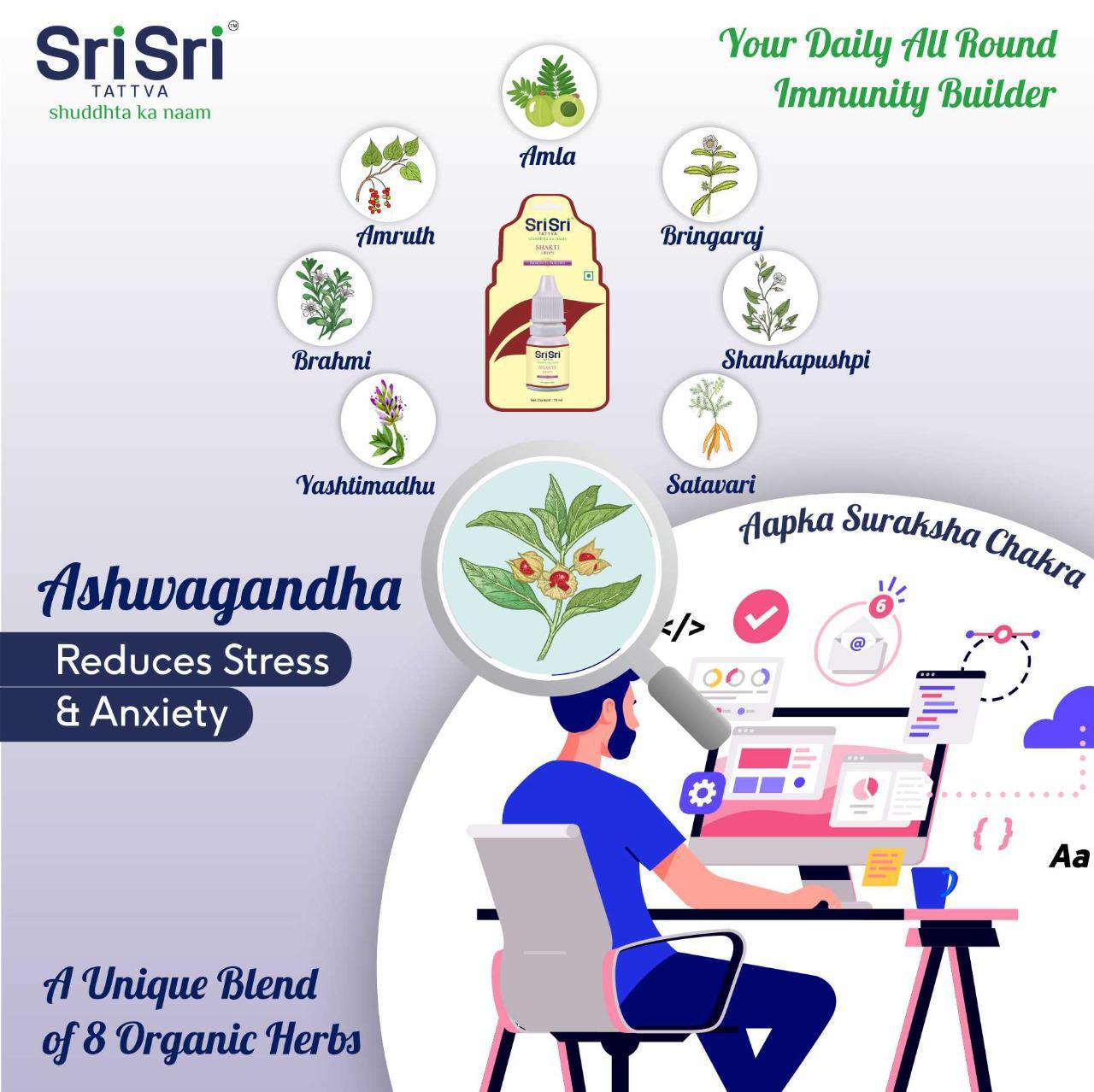
  • Ashwagandha | Reduces Stress | Anxiety | *Your Daily All Round Immunity Builder* | Shakti Drops

    *Ashwagandha | Reduces Stress | Anxiety | *Your Daily All Round Immunity Builder* | Shakti Drops 

    Ayurveda Initiative for Global Health