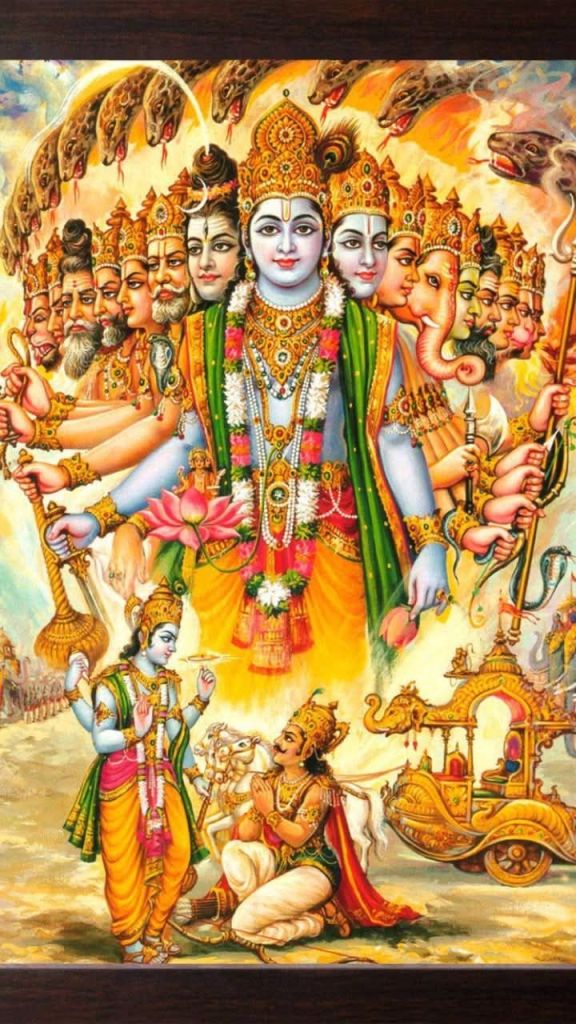
Ayurveda Initiative for Global Health

Tag: Bhagavad Gita

  • Transform your life by applying the timeless teachings of the Bhagavad Gita.

    *Shrimad Bhagavad Gita: The Conclusion of the Teachings*


    In Chapter 18, verses 72-78, of the Shrimad Bhagavad Gita, Lord Krishna asks Arjuna if he has understood the teachings. Arjuna confirms that his delusion has been dispelled, and he is ready to execute Krishna’s command. Sanjaya, the narrator, expresses his wonder and joy at hearing the conversation between Krishna and Arjuna.


    The conversation between Krishna and Arjuna can be broken down into several key aspects:

    1. *Krishna’s Query*: Krishna asks Arjuna if he has understood the teachings with a concentrated mind.
    2. *Arjuna’s Response*: Arjuna confirms that his delusion has been dispelled, and he is ready to execute Krishna’s command.
    3. *Sanjaya’s Reflection*: Sanjaya expresses his wonder and joy at hearing the conversation between Krishna and Arjuna.


    This conclusion of the Bhagavad Gita emphasizes the importance of understanding and applying the teachings in one’s life. Arjuna’s transformation from a state of delusion to clarity and determination serves as a model for spiritual growth.

    *Key Points*

    1. Lord Krishna asks Arjuna if he has understood the teachings.
    2. Arjuna confirms that his delusion has been dispelled.
    3. Sanjaya expresses his wonder and joy at hearing the conversation.
    4. The conclusion emphasizes the importance of understanding and applying the teachings.


    “Transform your life by applying the timeless teachings of the Bhagavad Gita.”

    *Source*

    Shrimad Bhagavad Gita (18.72-78)


    The Bhagavad Gita is a sacred Hindu scripture that provides spiritual guidance and wisdom. It is a dialogue between Lord Krishna and Arjuna, and it explores themes such as duty, devotion, and spiritual growth. The Gita emphasizes the importance of selfless action, meditation, and devotion to achieve spiritual liberation.

    Bhagavad Gita
  • Share spiritual knowledge with care, and reap the rewards of devotion.

    *Shrimad Bhagavad Gita: The Importance of Discipleship and Devotion*


    In Chapter 18, verses 67-71, of the Shrimad Bhagavad Gita, Lord Krishna emphasizes the importance of imparting spiritual knowledge only to those who are truly devoted and qualified. He also highlights the rewards of sharing and studying this sacred doctrine.


    Lord Krishna’s words can be broken down into several key aspects:

    1. *Restricted Sharing*: Krishna advises Arjuna to share this profound doctrine only with those who lead an austere life, have devotion to Him, and are devoid of caviling.
    2. *Rewards of Sharing*: Krishna promises that whoever teaches this doctrine to His devotees shall come to Him alone and be dear to Him.
    3. *Rewards of Studying*: Krishna declares that whoever studies this conversation between Him and Arjuna shall be regarded as adoring Him with a sacrifice of knowledge.
    4. *Liberation through Listening*: Krishna assures that even a man who listens to this holy conversation with deep faith and receptivity shall attain liberation and the happy regions open to righteous men.


    Krishna’s words highlight the importance of discipleship and devotion in spiritual growth. He emphasizes that spiritual knowledge should only be shared with those who are truly qualified and devoted, lest it be misused or disrespected.

    *Key Points*

    1. Impart spiritual knowledge only to those who lead an austere life and have devotion to Lord Krishna.
    2. Sharing this doctrine with devotees leads to rewards and closeness to Lord Krishna.
    3. Studying this conversation is regarded as a sacrifice of knowledge and leads to liberation.
    4. Listening to this conversation with faith and receptivity leads to liberation and happiness.


    The moral of this topic is that spiritual knowledge should be shared responsibly and only with those who are truly devoted and qualified.


    “Share spiritual knowledge with care, and reap the rewards of devotion.”

    *Source*

    Shrimad Bhagavad Gita (18.67-71)

    Lord Krishna
  • Surrender to the ultimate refuge, and find peace and liberation.

    *Shrimad Bhagavad Gita: The Ultimate Refuge*


    The Shrimad Bhagavad Gita is a sacred Hindu scripture that provides spiritual guidance and wisdom. In Chapter 18, verses 63-66, Lord Krishna imparts his supreme word, emphasizing the importance of surrendering to Him as the ultimate refuge.


    Lord Krishna’s words can be broken down into several key aspects:

    1. *Reflect and Act*: Krishna advises Arjuna to reflect on the teachings and act according to his own judgment.
    2. *Supreme Word*: Krishna shares his supreme word, which is the profoundest of all spiritual teachings.
    3. *Surrender to Me*: Krishna asks Arjuna to let his mind be engrossed in Him, offer worship, and be resigned to Him.
    4. *Abandon Dependence on Dharmas*: Krishna advises Arjuna to abandon dependence on all human efforts at moral and spiritual upliftment and come to Him as the only refuge.


    Krishna’s words emphasize the importance of surrendering to a higher power and abandoning dependence on human efforts. This surrender is not a sign of weakness but rather a sign of strength, as it requires humility and trust.

    *Key Points*

    1. Reflect on the teachings and act according to your own judgment.
    2. Surrender to Lord Krishna as the ultimate refuge.
    3. Abandon dependence on human efforts at moral and spiritual upliftment.
    4. Let your mind be engrossed in Lord Krishna.


    The moral of this topic is that true refuge and peace can be found by surrendering to a higher power and abandoning dependence on human efforts.


    “Surrender to the ultimate refuge, and find peace and liberation.”

    Lord Krishna
  • Bhagavad Gita 3.38

    भगवद्गीता– अध्याय ३, श्लोक ३८ 

    धूमेनाव्रियते वह्निर्यथादर्शो मलेन च |
    यथोल्बेनावृतो गर्भस्तथा तेनेदमावृतम् ||
    अनुवाद: 
    जैसे आग धुएं से, दर्पण धूल से और गर्भ गर्भाशय से आवृत होता है, वैसे ही ज्ञान कामना से आवृत हो जाता है।
    Bhagavad Gita 3.38: 
    As fire is covered by smoke, a mirror by dust, and the fetus by the womb, likewise, knowledge is shrouded by desire.
  • Bhagavad Gita 1.40

    भगवद्गीता– अध्याय १, श्लोक ४० 

    कुलक्षये प्रणश्यन्ति कुलधर्मा: सनातना: |
    धर्मे नष्टे कुलं कृत्स्नमधर्मोऽभिभवत्युत ||
    अनुवाद: 
    अर्जुन ने कहा, “कुल के नष्ट होने से सनातन कुलधर्म का नाश हो जाता है। धर्म का नाश होने से अधर्म संपूर्ण कुल पर हावी हो जाता है।”
    Bhagavad Gita 1.40: 
    Arjuna said, “When the family line is destroyed, the eternal family dharma perishes. With the perishing of dharma, adharma dominates the entire family line.”
  • Bhagavad Gita 7.3

    भगवद्गीता– अध्याय ७, श्लोक ३ 

    मनुष्याणां सहस्रेषु कश्चिद्यतति सिद्धये |
    यततामपि सिद्धानां कश्चिन्मां वेत्ति तत्त्वत: ||
    अनुवाद:
     हजारों मनुष्यों में से कोई एक सिद्धि के लिए प्रयत्न करता है, और उन प्रयत्नशील मनुष्यों में भी कोई एक ही मुझे तत्व से जानता है।
    Bhagavad Gita 7.3: 
    Among thousands of humans, scarcely one strives for perfection, and even among those striving, scarcely one knows Me in essence.
  • Bhagavad Gita 13.16

    भगवद्गीता– अध्याय १३, श्लोक १६ 

    अविभक्तं च भूतेषु विभक्तमिव च स्थितम् |
    भूतभर्तृ च तज्ज्ञेयं ग्रसिष्णु प्रभविष्णु च ||
    अनुवाद: 
    अविभक्त होते हुए भी वह समस्त भूतों में विभक्त के समान विद्यमान हैं। उन्हे समस्त भूतों के पालनकर्ता, संहारक और निर्माता के रूप में जानो।
    Bhagavad Gita 13.16: 
    Although undivided, it exists in every being in divided form. Know it as the sustainer, destroyer, and creator of all beings.
  • Bhagavad Gita 18.66

    भगवद्गीता– अध्याय १८, श्लोक ६६ 

    सर्वधर्मान्परित्यज्य मामेकं शरणं व्रज |
    अहं त्वां सर्वपापेभ्यो मोक्षयिष्यामि मा शुच: ||
    अनुवाद: 
    सभी धर्मों का परित्याग करके केवल मुझमें शरण लो। मैं तुम्हें समस्त पापों से मुक्त कर दूंगा; चिंता मत करो।
    Bhagavad Gita 18.66:
     Abandoning all dharmas, take refuge in Me alone. I shall liberate you from all sins; do not worry.
  • Bhagavad Gita 2.47

    भगवद्गीता– अध्याय २, श्लोक ४७ 

    कर्मण्येवाधिकारस्ते मा फलेषु कदाचन |
    मा कर्मफलहेतुर्भूर्मा ते सङ्गोऽस्त्वकर्मणि ||
    अनुवाद:
     तुम्हें केवल अपने कर्म पर ही अधिकार है, उसके फल पर नहीं। कर्मफल को कभी भी अपना उद्देश्य बनने न दो और न ही अकर्म में आसक्त हो।
    Bhagavad Gita 2.47: 
    You have the right to your action alone, not to the fruit thereof. Never let the fruit of action be your motive, and do not be attached to inaction either.
  • Bhagavad Gita 9.29

    भगवद्गीता– अध्याय ९, श्लोक २९ 

    समोऽहं सर्वभूतेषु न मे द्वेष्योऽस्ति न प्रिय: |
    ये भजन्ति तु मां भक्त्या मयि ते तेषु चाप्यहम् ||
    अनुवाद:
     मैं समस्त भूतों के प्रति समभाव रखता हूँ, न कोई मुझे घृणित है और न ही प्रिय। परन्तु जो भक्तिपूर्वक मुझे भजते हैं, वे मुझ में हैं, और मैं भी उन में हूँ।
    Bhagavad Gita 9.29:
     I am equanimous to all beings; there is none hateful or dear to Me. But those who worship Me with devotion are in Me, and I am in them as well.
  • Bhagavad Gita 12.12

    भगवद्गीता– अध्याय १२, श्लोक १२ 

    श्रेयो हि ज्ञानमभ्यासाज्ज्ञानाद्ध्यानं विशिष्यते |
    ध्यानात्कर्मफलत्यागस्त्यागाच्छान्तिरनन्तरम् ||
    अनुवाद: 
    ज्ञान अभ्यास से श्रेष्ठ है, और ज्ञान से श्रेष्ठ है ध्यान; ध्यान से श्रेष्ठ है कर्मफल का त्याग, और त्याग के पश्चात शांति प्राप्त होती है।
    Bhagavad Gita 12.12: 
    Knowledge is superior to practice, and superior to knowledge is meditation; superior to meditation is renunciation of the fruit of action, and after renunciation, peace is attained.
  • Bhagavad Gita 5.27-28

    भगवद्गीता– अध्याय ५, श्लोक २७–२८ 

    स्पर्शान्कृत्वा बहिर्बाह्यांश्चक्षुश्चैवान्तरे भ्रुवो: |
    प्राणापानौ समौ कृत्वा नासाभ्यन्तरचारिणौ ||
    यतेन्द्रियमनोबुद्धिर्मुनिर्मोक्षपरायण: |
    विगतेच्छाभयक्रोधो य: सदा मुक्त एव स: ||
    अनुवाद: 
    बाहरी आनंद के सभी विचारों को बंद करके, भौहों के बीच की जगह पर दृष्टि केंद्रित करके, नासिका में आने वाली और जाने वाली श्वास के प्रवाह को बराबर करते हुए इंद्रियों, मन और बुद्धि को नियंत्रित करके जो मुनि कामनाओं और भय से मुक्त हो जाता है, वह सदा के लिए मुक्त हो जाता है।
     
    Bhagavad Gita 5.27-28: 
    Shutting out all thoughts of external enjoyment, with the gaze fixed on the space between the eyebrows, equalizing the flow of the incoming and outgoing breath in the nostrils, and thus controlling the senses, mind, and intellect, the sage, who becomes free from desire and fear, always lives in freedom.
  • Bhagavad Gita 3.6

    भगवद्गीता– अध्याय ३, श्लोक ६ 

    कर्मेन्द्रियाणि संयम्य य आस्ते मनसा स्मरन् |
    इन्द्रियार्थान्विमूढात्मा मिथ्याचार: स उच्यते ||
    अनुवाद: 
    जो व्यक्ति कर्मेन्द्रियों को नियंत्रित करते हैं, परन्तु मन में इंद्रिय विषयों का चिंतन करते रहते हैं, वे मूढमती होते हैं और मिथ्याचारी कहलाते हैं।
    Bhagavad Gita 3.6: 
    Those who restrain the organs of action but continue to ponder over sense objects in the mind are deluded and are called hypocrites.
  • Bhagavad Gita 8.5

    भगवद्गीता– अध्याय ८, श्लोक ५ 

    अन्तकाले च मामेव स्मरन्मुक्त्वा कलेवरम् |
    य: प्रयाति स मद्भावं याति नास्त्यत्र संशय: ||
    अनुवाद: 
    जो व्यक्ति मृत्यु के समय मेरा ही स्मरण करते हुए शरीर त्याग देते हैं, वे निःसंदेह मेरे स्वरूप को प्राप्त होते हैं।
    Bhagavad Gita 8.5: 
    Those who depart from the body, remembering Me alone at the time of death, undoubtedly attain My state.
  • Bhagavad Gita 6.2

    भगवद्गीता– अध्याय ६, श्लोक २ 

    यं संन्यासमिति प्राहुर्योगं तं विद्धि पाण्डव |
    न ह्यसंन्यस्तसङ्कल्पो योगी भवति कश्चन ||
    अनुवाद: 
    हे पाण्डव! जिसे संन्यास कहते हैं, उसी को तुम योग समझो, क्योंकि कामनाओं का त्याग किये बिना कोई भी योगी नहीं बन सकता।
    Bhagavad Gita 6.2: 
    O son of Pandu! What is called renunciation, know that to be Yoga, for no one can become a Yogi without relinquishing desires.
  • Bhagavad Gita 14.8

    भगवद्गीता– अध्याय १४, श्लोक ८ 

    तमस्त्वज्ञानजं विद्धि मोहनं सर्वदेहिनाम् |
    प्रमादालस्यनिद्राभिस्तन्निबध्नाति भारत ||
    अनुवाद: 
    हे भरतवंशी! तमोगुण को अज्ञान से उत्पन्न जानो जो देहधारियों को मोहित करता है, तथा उन्हें प्रमाद, आलस्य और निद्रा के माध्यम से बांधता है।
    Bhagavad Gita 14.8: 
    O descendant of Bharata! Know that tamas is born from ignorance, which deludes the embodied beings and binds them through negligence, laziness, and sleep.
  • Bhagavad Gita 18.68-69

    भगवद्गीता– अध्याय १८, श्लोक ६८-६९ 

    य इदं परमं गुह्यं मद्भक्तेष्वभिधास्यति |
    भक्तिं मयि परां कृत्वा मामेवैष्यत्यसंशय: ||
    न च तस्मान्मनुष्येषु कश्चिन्मे प्रियकृत्तम: |
    भविता न च मे तस्मादन्य: प्रियतरो भुवि ||
    अनुवाद: 
    जो भी मुझमें परम भक्ति के साथ इस परम गोपनीय ज्ञान को मेरे भक्तों को सुनाएगा, वह निस्संदेह मुझे प्राप्त करेगा। मनुष्यों में उस से अधिक मेरा प्रिय कार्य करने वाला कोई भी नहीं है, और भूमंडल में उस से अधिक मेरा प्रिय दूसरा कोई भी नहीं होगा।
    Bhagavad Gita 18.68-69:
     Whoever, with supreme devotion to Me, imparts this supreme secret to My devotees will undoubtedly attain Me. There is no one among humans who performs a service dearer to Me than they, and there will never be anyone dearer to Me on earth.
  • Bhagavad Gita 10.32

    भगवद्गीता– अध्याय १०, श्लोक ३२ 

    सर्गाणामादिरन्तश्च मध्यं चैवाहमर्जुन |
    अध्यात्मविद्या विद्यानां वाद: प्रवदतामहम् ||
    अनुवाद: 
    हे अर्जुन! मैं सभी सृष्टियों का आदि, मध्य और अन्त हूँ। मैं विद्याओं में अध्यात्मविद्या और शास्त्रार्थ करने वालों में तर्क हूँ।
    Bhagavad Gita 10.32:
     O Arjuna! I am the beginning, the middle, and the end of all creations. Among all knowledge, I am the knowledge of the self (atman), and I am the logic among the debaters.
  • Bhagavad Gita 15.15

    भगवद्गीता– अध्याय १५, श्लोक १५ 

    सर्वस्य चाहं हृदि सन्निविष्टो
    मत्त: स्मृतिर्ज्ञानमपोहनं च |
    वेदैश्च सर्वैरहमेव वेद्यो
    वेदान्तकृद्वेदविदेव चाहम् ||
    अनुवाद: 
    मैं सभी प्राणियों के हृदय में विराजमान रहता हूँ और मुझसे स्मृति, ज्ञान तथा अपोहन (उनका अभाव) भी उत्पन्न होता है। वस्तुतः, मैं ही वेदों का ज्ञान, वेदांत का प्रवर्तक, और वेदों का ज्ञाता हूँ।
    Bhagavad Gita 15.15:
     I remain seated in the hearts of all beings, and from Me come memory, knowledge, as well as their absence. Indeed, I am the knowledge of the Vedas, the originator of Vedanta, and the knower of the Vedas.
  • Bhagavad Gita 11.10-11

    भगवद्गीता– अध्याय ११, श्लोक १०–११ 

    अनेकवक्त्रनयनमनेकाद्भुतदर्शनम् |
    अनेकदिव्याभरणं दिव्यानेकोद्यतायुधम् ||
    दिव्यमाल्याम्बरधरं दिव्यगन्धानुलेपनम् |
    सर्वाश्चर्यमयं देवमनन्तं विश्वतोमुखम् ||
    अनुवाद: 
    उस दिव्य विश्वरूप में, अर्जुन ने अनेकानेक मुखों और नेत्रों को देखा, जिनमें अनगिनत अद्भुत दृश्य थे और वो कई दिव्य आभूषणों से सुशोभित तथा कई दिव्य आयुधों को धारण किए हुए थे। दिव्य मालाओं तथा वस्त्रों को परिधान किए हुए दिव्य गंधों से लिपित होकर उन्होंने स्वयं को सर्वाश्चर्यमय, प्रकाशमान, और अनन्त के रूप में प्रकट किया था, जिनके मुखें सभी दिशाओं में थे।
    Bhagavad Gita 11.10-11: 
    In that divine cosmic form, Arjuna beheld numerous mouths and eyes, possessing countless wondrous sights adorned with many celestial ornaments and wielding a multitude of uplifted divine weapons. Wearing heavenly garlands and garments anointed with divine fragrances, He revealed Himself as the all-wonderful, resplendent, and boundless one, having faces in all directions.
  • Bhagavad Gita 18.63

    भगवद्गीता– अध्याय १८, श्लोक ६३ 

    इति ते ज्ञानमाख्यातं गुह्याद्गुह्यतरं मया |
    विमृश्यैतदशेषेण यथेच्छसि तथा कुरु ||
    अनुवाद: 
    इस प्रकार, यह गोपनीय से भी अधिक गोपनीय ज्ञान मेरे द्वारा तुम्हें प्रदान किया गया है। इस पर पूरी तरह से विचार करने के पश्चात्, जैसी इच्छा हो, वैसा ही करो।
    Bhagavad Gita 18.63: 
    Thus, this knowledge, the most profound secret of all secrets, has been imparted to you by Me. After deeply reflecting upon it, do as you wish.
  • Bhagavad Gita 2.12

    भगवद्गीता– अध्याय २, श्लोक १२ 

    न त्वेवाहं जातु नासं न त्वं नेमे जनाधिपाः |
    न चैव न भविष्याम: सर्वे वयमत: परम् ||
    अनुवाद: 
    ऐसा कभी कोई समय नहीं था जब मैं नहीं था, न तुम नहीं थे, न ये सभी राजा नहीं थे; और न ही भविष्य में ऐसा होगा कि हम में से कोई भी न रहे।
    Bhagavad Gita 2.12: 
    Never was there a time when I did not exist, nor you, nor all these kings; nor in the future shall any of us cease to exist.
  • Bhagavad Gita 14.9

    भगवद्गीता– अध्याय १४, श्लोक ९ 

    सत्त्वं सुखे सञ्जयति रज: कर्मणि भारत |
    ज्ञानमावृत्य तु तम: प्रमादे सञ्जयत्युत ||
    अनुवाद: 
    हे भरतवंशी! सत्त्वगुण सुख में लगाता है, रजोगुण कर्म में, जबकि तमोगुण ज्ञानको ढककर प्रमाद में लगाता है।
    Bhagavad Gita 14.9: 
    O descendant of Bharata! Sattva attaches to happiness, Rajas to action, while Tamas veils up knowledge and attaches to negligence.
  • Bhagavad Gita 12.8

    भगवद्गीता– अध्याय १२, श्लोक ८ 

    मय्येव मन आधत्स्व मयि बुद्धिं निवेशय |
    निवसिष्यसि मय्येव अत ऊर्ध्वं न संशय: ||
    अनुवाद: 
    अपने मन और बुद्धि को मुझमें ही स्थिर कर दो, तत्पश्चात तुम मुझमें ही निवास करोगे, इसमें कोई संदेह नहीं है।
    Bhagavad Gita 12.8: 
    Fix your mind and intellect solely on Me, and there is no doubt that you will live in Me afterwards.
  • Bhagavad Gita 4.11

    भगवद्गीता– अध्याय ४, श्लोक ११ 

    ये यथा मां प्रपद्यन्ते तांस्तथैव भजाम्यहम् |
    मम वर्त्मानुवर्तन्ते मनुष्या: पार्थ सर्वश: ||
    अनुवाद: 
    हे पार्थ! जिस प्रकार से लोग मेरी पूजा करते हैं, मैं उन्हें उसी प्रकार अनुग्रह करता हूँ; क्योंकि सब प्रकार से वे मेरे ही मार्ग का अनुसरण करते हैं।
    Bhagavad Gita 4.11: 
    O Partha! In whatever way people worship me, I favour them accordingly, as they follow My path in every way.
  • Bhagavad Gita 7.4-6

    भगवद्गीता– अध्याय ७, श्लोक ४-६ 

    भूमिरापोऽनलो वायु: खं मनो बुद्धिरेव च |
    अहङ्कार इतीयं मे भिन्ना प्रकृतिरष्टधा ||
    अपरेयमितस्त्वन्यां प्रकृतिं विद्धि मे पराम् |
    जीवभूतां महाबाहो ययेदं धार्यते जगत् ||
    एतद्योनीनि भूतानि सर्वाणीत्युपधारय |
    अहं कृत्स्नस्य जगत: प्रभव: प्रलयस्तथा ||
    अनुवाद: 
    पृथ्वी, जल, अग्नि, वायु, आकाश, मन, बुद्धि और अहंकार – यह आठ प्रकार से विभक्त हुई मेरी प्रकृति है। यह मेरी अपरा प्रकृति है, परन्तु हे महाबाहु अर्जुन! इसके अतिरिक्त जीवन तत्वरूपी मेरी परा प्रकृति को जानो जिससे संपूर्ण ब्रह्मांड धारण किया जाता है। यह समझो कि सभी प्राणियों की उत्पत्ति इन दोनो प्रकृतियो से हुई है और मैं ही समस्त ब्रह्माण्ड का मूल तथा प्रलय भी हूँ।
    Bhagavad Gita 7.4-6: 
    Earth, water, fire, air, ether, mind, intellect, and ego—these are the eight parts of My Nature (Prakriti). This is My Inferior Prakriti; but, O mighty armed Arjun! Besides this, know that My Superior Prakriti is the very life element by which the whole universe is upheld. Understand that all beings are born from these two Prakritis, and I am the source as well as the dissolution of the entire universe.
  • Bhagavad Gita 10.20

    भगवद्गीता– अध्याय १०, श्लोक २० 

    अहमात्मा गुडाकेश सर्वभूताशयस्थित: |
    अहमादिश्च मध्यं च भूतानामन्त एव च ||
    अनुवाद: हे अर्जुन! मैं सभी प्राणियों के हृदयों में स्थित सार्वभौमिक आत्मा हूँ; अत: मैं ही समस्त प्राणियों का आदि, मध्य तथा अन्त हूँ।
    Bhagavad Gita 10.20: 
    O Arjuna! I am the universal self (atman), seated in the hearts of all living beings. I alone am the beginning, the middle, and the end of all beings.
  • Bhagavad Gita 2.50

    भगवद्गीता– अध्याय २, श्लोक ५० 

    बुद्धियुक्तो जहातीह उभे सुकृतदुष्कृते |
    तस्माद्योगाय युज्यस्व योग: कर्मसु कौशलम् ||
    अनुवाद: बुद्धियुक्त व्यक्ति इस जीवन में अच्छे और बुरे दोनों प्रकार के कर्मों को त्याग देता है। इसलिए, योग में रत हो जाओ, क्योंकि कर्मों में कुशलता ही योग है।
    Bhagavad Gita 2.50: 
    Endowed with wisdom, one relinquishes both good and evil deeds in this life. Therefore, immerse yourself in Yoga, for Yoga is indeed proficiency in actions.
  • Bhagavad Gita 6.19

    भगवद्गीता– अध्याय ६, श्लोक १९ 

    यथा दीपो निवातस्थो नेङ्गते सोपमा स्मृता |
    योगिनो यतचित्तस्य युञ्जतो योगमात्मन: ||
    अनुवाद: वायुरहित स्थान पर दीपक की लौ झिलमिलाहट नहीं करती। इस तुलना का प्रयोग आत्मयोग में लीन योगी के नियंत्रित मन के लिए किया जाता है।
    Bhagavad Gita 6.19: 
    The flame of a lamp in a windless place doesn’t flicker. This comparison is used for the controlled mind of a yogi absorbed in the yoga of the self (atman).
  • Bhagavad Gita: 12.9

    भगवद्गीता– अध्याय १२, श्लोक ९ 

    अथ चित्तं समाधातुं न शक्नोषि मयि स्थिरम् |
    अभ्यासयोगेन ततो मामिच्छाप्तुं धनञ्जय ||
    अनुवाद: हे धनञ्जय! यदि तुम अपने मन को मुझमें स्थिर करने में असमर्थ हो, तो अभ्यासयोग के माध्यम से मुझे प्राप्त करने का प्रयत्न करो।
    Bhagavad Gita: 12.9:
     O Dhananjaya! If you are unable to focus your mind steadily on Me, seek to attain Me through the yoga of practice.
  • Realisation of the Self, Realisation of God

    Meditation Yoga

    Chapter 6, Verse 44
    pūrvābhyāsane tenaiva
    hriyate hyavaśo’pi saḥ
    jijñāsur-api yogasya
    śabda-brahmātivartate
    By that former practice he is irresistibly carried on. The seeker after the knowledge of yoga goes beyond the range of the Vedas and Upanishads.
    The one who takes birth in a spiritually oriented family, is drawn to serving God. One is drawn to God due to one’s past lives. In this life, through sadhana, through following the words of the Master, the one who has faith in one’s practice, who has faith in God, transcends the enjoyment of this world, as well as the next one. And due to the fruits of past good punya, one continues practising and advancing on the path to Enlightenment. One rises in the true “knowledge of yoga” and “goes beyond the range of the Vedas and Upanishads.”
    They go “…beyond the range of the Vedas and Upanishads.” This means that in a past life, they had laid a Vedic foundation, they had practised the Vedic precepts, and ‘how to do this’ and ‘how to do that’. However, one continues from life to life, and if one longs for the Divine, one rises above even that foundation; and what lies beyond that foundation is the supreme ultimate reality: the Realisation of the Self, the Realisation of God, attaining the Divine vision of the Lord within oneself.
    Bhagavad Gita 
  • Receiving advice from the Master and serving the Master, is a very rare opportunity

    Meditation Yoga

    Chapter 6, Verse 42
    athavā yoginām eva
    kule bhavati dhīmatām
    etaddhi durlabhataraṁ
    loke janma yadīdṛśam
    Or he may be born in the family of a wise yogi; indeed, such a birth is rare to obtain in this world.
    Here the merciful Lord says that a man of dispassion is “born in the family of a wise yogi.” The children of those who practise spirituality are high souls. Because of your practise, you have become a beam of light. Because of their longing for the Divine, your children are great souls who incarnate through you. They choose to be born through you, so that their spiritual advancement can continue.
    “Indeed, such a birth is rare to obtain in this world.” Many are born and get attached to the world, but how many are born in a family where they are pushed on the spiritual path? Here Krishna is also talking about your children. If you are spiritual and give your children a good spiritual education, this helps them advance towards God-Realisation. This spiritual education is for the advancement of the soul.
    In these two verses, Krishna is saying to Arjuna that these souls are born again here in this world. Even if they have enjoyed divine celestial realms, there they can’t advance to other higher states. So they are born again in this world, because only in this world can unity with the Divine be achieved. The ones who are born in the families of yogis, bhaktas, and devotees, find themselves placed, from the beginning itself, in the service of the Lord; from the beginning they find themselves hearing and chanting the Divine Names. This is a great blessing! Lord Krishna emphasises that it’s a very rare opportunity to surrender to the Guru. In such a birth, when you have found your Satguru, do everything to not let go. In verse 40, Lord Krishna says that one never loses anything. Here Krishna speaks about the glory and greatness of attaining the Lotus Feet of the Master. He says that receiving advice from the Master and serving the Master, is a very rare opportunity. “Such a birth is rare to obtain.” One cannot even estimate the great value of such a birth.
    Bhagavad Gita 
  • Absolute Self See within his own Self, he will enjoy in higher state.

    Meditation Yoga

    Chapter 6, Verse 41
    prāpya puṇya-kṛtāṁ lokān
    uṣitvā śāśvatīḥ samāḥ
    śucināṁ śrīmatāṁ gehe
    yoga-bhraṣṭo ‘bhijāyate
    Having attained the realms of the righteous and dwelt there for many long years, one who has fallen from yoga is born again in the house of the pure and prosperous.
    The devotees, the bhaktas who received the Grace to follow the path of devotion, meditation, and Atma Kriya Yoga, but whose minds are still restless, go away. What will happen to them? Here again Lord Krishna says that if people have received the Grace and have let go of that Grace, if they have let go of their spiritual path for any reason and have fallen, they will incarnate many times into this plane so that they can cleanse themselves. Many people who start on the spiritual path are still so attached to the outside world, that they find it difficult to follow a Guru. At the beginning they say, “Yes, yes, yes!” Later, they run away, quietly, they leave and then it’s finished! Or even more terrible than that – they go and say many bad things about the Guru. Krishna says, “It doesn’t matter.”
    “… attained to the realms of the righteous and dwelt there for many years…” Krishna says that the one who has advanced towards God Consciousness, who has prayed to the Lord, who has loved the Lord, yet has not achieved the oneness, has not seen the oneness with Him, has not realised the Absolute Self within his own Self, he will enjoy in another higher state. He will dwell in other lokas and enjoy many long years there.
    Let’s say a bhakta came here on Earth in this life and tried his best to sing the glory of the Lord, but his voice was not nice! So he is born in another higher rhythm and there Goddess Saraswati will teach him how to train his voice, and then he is reborn with a special gift which will enable him to sing beautifully. Why do you see people born with certain gifts in life? Because of their past life. They are sent back again, not to entertain human ears, but to praise the Lord, to sing the glory of the Lord. And in this life, if they do not do this, they will be born again and in their next life, they will have the Grace to praise the Lord, to achieve Him. Here I have taken one example, but there are so many examples of realised souls.
    Krishna says that the surroundings, the environment are very important! The surroundings create an effect on people. Even if one has Grace, it can stay dormant inside one’s heart. Deep inside one has the feeling, “I am incomplete.” However, due to the environment, due to the surroundings, due to the mind’s activities, they only get drawn to the outside reality. They get tempted and controlled by the outside reality, and then they don’t have the Grace to find their path in this lifetime. However, through the Grace that they received, through the punya that they accumulated, they are born again on this Earth in spiritual families which will contribute to their spiritual growth. They are “born again in the house of the pure and prosperous.” Nothing will be lacking for them. So from this it shows that even if they had fallen from yoga, they don’t go to Hell, nor do they take birth in a lower species, because they tried their best. This means that the ones who try their best, never lose. They enjoy celestial regions for long years and are born again on Earth to continue their spiritual advancement.
    Bhagavad Gita 
  • You don’t lose anything when you love God

    Meditation Yoga

    Chapter 6, Verse 40
    śrī bhagavān uvāca
    pārtha naiveha nāmutra
    vināśas tasya vidyate
    na hi kalyāṇa-kṛt kaścid
    durgatim‌ tāta gacchati
    The Lord says: O Arjuna, neither in this life nor hereafter is there destruction for him; never does anyone who practises good, O beloved, come to woe.
    The merciful Lord, the Lord of the universe answers Arjuna, “O Arjuna, neither in this life nor hereafter is there destruction for him”. Can you see, how wonderful and merciful He is? “Never does anyone who practises good, O beloved, come to woe, or
    meet any evil destiny.”
    Arjuna is worrying, “If I don’t do my duty, will I lose all my good punya or the opportunity to advance?” Bhagavan Krishna replies that one doesn’t fall: no matter to which heavens or lokas one goes, one never falls. One always move forward. Such is the state of a bhakta who always continues on his spiritual journey. Wherever one abides, wherever one is after death, one continues to steadily advance towards God- Realisation. So it’s a continuation. Even if you have started practising, but you have not yet achieved this state which Lord Krishna spoke of, you don’t lose anything. Even if you die and at the time of death, you have not reminded yourself of the Divine Names nor have the concentration, through meditation, to consciously leave the body as He explains earlier, you don’t lose anything. You are incarnated in other spheres, in other lokas; and if you are not advancing towards other lokas, you will be born again on this Earth. You will always find yourself where you finished in your last life, and you will advance from there.
    The ones who are on the spiritual path, who have accumulated good punya, who have done good things to merit being born on Earth; who have the Grace in life to long for God; the Grace to hear how to attain Him, the Grace to receive the blessing of Shaktipat, with which Mahavatar Babaji said that you can achieve God-Realisation, they are never deprived of anything. The ones who have the Grace to serve Him, to think of Him, to love Him, will enjoy God-Realisation in the next life or they will go to other dimensions. And in their next life, due to their good punya in this life, they will be born enjoying both worldly existence and a spiritual life. They will be free. They will have everything. God will provide for them! They will not be deprived of any gifts from the Divine, or of God-Realisation. God will guide them to the Guru’s Feet, and through the Guru they will again be reminded of the spiritual way.
    “Never does anyone who practises good, O beloved, come to woe.” So the practise doesn’t disappear. Life changes, you move from one body to the other, but you don’t lose. You are not doomed. The good that you have done in this life will continue in the next life, until you have full Realisation of God, until you attain Him fully. Is it not beautiful? You don’t lose anything when you love God. You just carry on, growing, as you are growing now.
    Bhagavad Gita 
  • You are the sole Lord of this universe

    Meditation Yoga

    Chapter 6, Verse 39
    etan-me saṁśayaṁ kṛṣṇa
    chettum arhasy-aśeṣataḥ
    tvad-anyaḥ saṁśayasyāsya
    chettā na hy-upapadyate
    O Krishna, please completely dispel this doubt without leaving any residue,for there is none else than You who can destroy this doubt.
    “O Krishna, please completely dispel this doubt without leaving any residue.” Here Arjuna is showing his willingness to completely surrender to Lord Krishna. He is asking Krishna, “Dispel all my ignorance! Dispel it to the state where there is none left, so that there isn’t ‘any residue.’ Wash me completely clean!” It’s like when you have butter in a bowl. Even if you wash the bowl, if you put your hand in it, you can feel some residue. You can still feel the grease. Arjuna says, “Krishna, wash me completely clean! There is no one else who can do that but You!” He was well aware that Krishna was the Supreme Lord, Narayana Himself. He had realised that life after death was a mystery and that didn’t have any idea what would happen after death.
    “There is none else than You who can destroy this doubt.” Even if people talk about death using all kinds of arguments, all kinds of reasoning, they can’t take away the effect of karma. That’s why Arjuna says, “O Krishna, no one else can do that!” The devas are busy with their own things. They can give certain gifts, but they can’t completely cleanse the karma so that there is no residue left from past and present karma.
    Arjuna says to Lord Krishna, “You are the full embodiment of the secret knowledge that You have given me. You are the sole Lord of this universe!” Arjuna was fully aware that Krishna was the most Sublime One, the most wonderful One, beyond everything! He was God Himself. He says, “You are the Supreme Lord, the Supreme Compassionate One! Who else can cleanse me? Who else can reveal such mystery? I am humbly asking You, I am humbly praying to You, Lord, the revealer of this Truth, please destroy this doubt. Clear my mind completely of this doubt! I can’t do it by myself. If I had time, I could practise what You have taught me right now. But I don’t have much time, Lord. If I sit and practise meditation now, the war will be longer. So I fully surrender, I throw myself at Your Feet. Cleanse me, remove this doubt from me!”
    Lord Krishna replies to Arjuna, “Yes, I perceive your doubt. You are hanging onto it. And that’s why I am repeating Myself! Everything that I am saying right now, is just the same thing! I see your eagerness, you are willing to hear it and you are absorbed in what I am saying to you. But I want you to also make an effort.”
    Bhagavad Gita 
  • When one receives Diksha in one’s life, it is a great blessing

    Meditation Yoga

    Chapter 6, Verse 38
    kaccin-nobhaya-vibhraṣṭaḥ
    chinnābhram iva naśyati
    apratiṣṭho mahābāho
    vimūḍho brahmaṇaḥ pathi
    Does he not, O mighty-armed, lose this life of human activity and Brahman Consciousness to which he aspires, and falling from both, perish like a dissolving cloud?
    Ay yi yi! Imagine, what the state of Arjuna is! See what he is already creating in his mind? It’s catastrophic, it’s apocalyptic!
    Arjuna wants to understand what would happen at the time of death to the bhakta, to the devotee who had done his duty, with full faith and love, doing what he had to do, without being attached to the fruits of his actions, yet he became diverted from his practise.
    Arjuna also wanted to know what would happen to the one who received Diksha from a Guru, but did not utilise it in a proper way during his life. The one who let go of the spiritual path due to worldly attachments, even if he had this deep feeling that God had guided him on the spiritual path and had led him to his Guru, strayed away and didn’t practise, didn’t make use of the blessing he had received. When one receives Diksha in one’s life, it is a great blessing! But what happens if, even at the time of death, this one fails to focus the mind on the Guru and on God?
    “Perish like a dissolving cloud.” When all the clouds are together, they appear very mighty, ready to strike lightning and burst into a storm. Whereas when a little cloud gets separated from the group and stands by itself, it becomes weak, and after some time it dissolves and it disappears. This is similar to what happens when someone lets go of the spiritual path. Being deprived of both Heaven after death and God-Realisation while alive, this bhakta gets lost and suffers a spiritual downfall.
    Here the mind of Arjuna is thinking, “If I don’t listen to what Krishna is saying, if I don’t lift up my bow and fight, I will probably be doomed. Let me ask Him, maybe He has a sideways solution.”
    Bhagavad Gita 
  • The one ‘who takes up yoga’

    Meditation Yoga

    Chapter 6, Verse 37
    arjuna uvāca
    ayatiḥ śraddhayopeto
    yogāc-calita-mānasaḥ
    aprāpya yoga-saṁsiddhiṁ
    kāṁ gatiṁ kṛṣṇa gacchati
    Arjuna says: He who takes up yoga with faith, but cannot control himself with the mind, wandering away from yoga, failing to attain perfection in yoga, what is his end, O Krishna?
    Here Arjuna is enquiring, “What will happen to me if I try to follow Your instructions, but I don’t achieve that state? The one ‘who takes up yoga’, who is on the spiritual path and has faith, but can’t control one’s wandering mind, what will happen to one’s soul?” Arjuna asks Lord Krishna, “What will happen when such a person dies Even if one makes an effort to control the mind, but the mind is not balanced and is not constantly remembering the Divine at the time of death, what will happen to this person?” Arjuna was thinking like everybody else, “I don’t think that I will attain Realisation in this life. So, what will happen to me if I don’t achieve ‘perfection in yoga’? We hear these beautiful words that You are saying, but due to the outside reality, it could be very difficult. We will try our best, but if we don’t succeed, what will happen at the time of death?”
    Arjuna is getting very worried and asks, “If I die now in the war, what will happen? There is not much time to achieve that state! I am standing here in between two armies, that are ready to fight and shoot at each other and you are talking so much! It could be difficult! If I start meditating here, for sure they will shoot arrows at me! The Kauravas will say, ‘Look at this one. Shoot him!’”
    Arjuna is already creating all this in his mind. At the beginning, in Chapter 1, we see how he has this image in his mind about what would happen to his ancestors and
    how they would all be doomed somewhere in Hell. And he created all these images in his mind of not fighting. Now He is asking, “How can I practise all these spiritual techniques that You are teaching me in such a short time? And how can I achieve the goal?” His eagerness was there, but he was wondering what would happen to him.
    Actually, it is beautiful to see this state that he is in, the state where everyone in life asks these questions. For example, when an Atma Kriya teacher is teaching Atma Kriya Yoga to his or her students, they see all the exercises and then the mind starts thinking, “Oh my goodness! Will I have time to do all this practise? The day is too short for all this! If I do all these exercises tonight, it will soon be the next day.” Here Arjuna is asking Krishna, “What will happen if the sadhak has practised, but has not yet reached that level of Realisation? What will happen if one has no control over the mind, yet one has faith, which means that one has tried one’s best? One has faith because one has received Diksha, one has received instruction from the Guru, from the Master. What will happen to this person at the time of death and after death?”
    Bhagavad Gita 
  • One becomes a living deity

    Meditation Yoga
    Chapter 6, Verse 36
    asaṁyatātmanā yogo
    duṣprāpa iti me matiḥ
    vaśyātmanā tu yatatā
    śakyo’vāptum upāyataḥ
    If one is not self-controlled, yoga is difficult to attain; but if one is self- controlled, yoga is attained by properly directed efforts.
    “If one is not self-controlled, yoga is difficult to attain…” Here again Krishna repeats that if you don’t have control over the mind and the senses, it’s very difficult to practise yoga. It is very difficult because your mind will always drag you, will always pull you towards the outside world, so yoga becomes very difficult! The union between you and the Divine becomes difficult, but not impossible.
    “…If one is self-controlled, yoga is attained by properly directed efforts.” So when a sadhak is sitting for meditation, trying to become immersed into his Self, into the Divine Self, he should control his mind. He should not let the mind run left, or right or towards any object. When the mind is subdued, all its turbulent nature, its restlessness, disappears. A controlled mind is easily attained through practise. It is only due to the mind, that one sees the complication of attaining such a state. When the mind is so deeply attached to outer enjoyment, the intellect remains unstable and scattered in all directions, uncontrolled. Then this yoga that Lord Krishna is teaching to Arjuna appears very difficult to do. But if one’s mind is focused on the Divine, through chanting, through continuous repetition of the Divine Name, then this yoga becomes easier. A bhakta, a devotee should try to see the One all-pervading God, the embodiment of eternal knowledge and bliss, as the whole universe. He should not only see God outside of himself, but see the whole universe, all the animate and the inanimate, within his own Self. This is what we do in meditation. We start meditation with visualising. We tell you to imagine something, because imagination is a natural function of the mind, isn’t it? That’s why we tell you to imagine the light. So what do you do? You imagine the light. You create an image of the light. You give the mind a
    toy to play with.
    Lord Krishna says that it’s easy to control the mind. It’s easy to make the mind renounce all objects of enjoyment and desire. It’s easy to cleanse the mind and fix it on God. It’s not difficult! When the mind is set in a proper direction, through practise, a devotee’s mind instantly becomes calm. First you tell the mind, “O mind, you always create things and run after the things that you create. So, create a Divine image and focus on that!” God manifested Himself in many forms and Names, so that He can allow the mind to focus on His beauty: on the beautiful form of Krishna, on the
    beautiful form of Narayana, on Lakshmi Devi, on Jagadamba, on Jesus and on His beautiful Name.
    He has given so many beautiful Names – Krishna, Rama, Shiva, Allah, Yahweh – all these are His beautiful Names. And when one is fully absorbed in His Name, one goes beyond the judging mind. Then one will see what will awaken inside one’s heart. One will witness in all hearts the all-pervading, omniscient, all-powerful, supreme, compassionate One; and one will feel the love within the Divine image which is inside oneself. So one becomes a living deity. In this way, one should mentally realise God and see Him within one’s own Self. Then it becomes easy and effortless to always focus the mind on God. If you love someone, is it difficult for you to visualise that person? No. You close your eyes and the person is there in your mind. Even if you don’t want it, the image of that person will be there. So if you love God, in any of His forms, you must reach a stage where the moment you close the eyes, you see Him. The moment you enter the heart, you see Him. The moment a person is in front of you, you perceive the Supreme Lord in that person. In the form of Love, He is present in every part of His creation. Then it will not be difficult to see Him everywhere, in
    everything, it will be easy!
    When one installs in the mind an image of the Divine, according to one’s choice, and sees Him within one’s heart, and prays to Him ‌ mentally doing Manasa Puja –then one is free! You will then see that there is no point in the mind running elsewhere. When someone is in love, the mind always runs towards the beloved: when the mind is trained to see the Lord, it will always run to the Lotus Feet of the Lord. Nowhere else. And automatically one will develop all the divine qualities. Krishna says, “It’s difficult, but it is not impossible! Do it! All you need is effort and constant practise!”
    Bhagavad Gita 
  • A hero like you should not feel afraid, should not have fear in the mind

    Meditation Yoga 

    Chapter 6, Verse 35
     
    śrī bhagavān uvāca 
    asaṁśayaṁ mahābāho 
    mano dur-nigrahaṁ calam 
    abhyāsena tu kaunteya 
    vairāgyeṇa ca gṛhyate
     
    The Lord says: Without doubt, O mighty-armed, the mind is restless and very difficult to restrain; but, O Kaunteya, it may be controlled by constant practise and non-attachment.
     
    Here the Lord addresses Arjuna as Kaunteya, to remind him of his mother, Kunti. Kunti was fully absorbed in the Divine. She was a warrior, a controlled woman, dispassionate, not easily perturbed. Krishna says, “Remind yourself, O Kaunteya, of the qualities of your mother!” 
     
    Bhagavan Krishna tells Arjuna that even if it is difficult to restrain the mind due to its flickering state, nevertheless, “O Kaunteya, it may be controlled by constant practise and non-attachment.” How strong is the mind? The mind can appear very powerful and make life difficult, but it is also very easy to control. How? By constant practise! You shouldn’t weaken yourself. Whenever you practise, don’t expect quick results. Keep practising! And don’t let yourself down! Krishna says, “Be non-attached!” 
    Whatever you focus the mind on, the mind takes the shape of that object. The mind is like water: into whatever object or form you pour water, the water automatically takes that form; such is the state of the mind. If one’s mind is always running towards the outside world, towards illusion, it will create that illusion in the mind. Then one will be completely deluded by that. That’s why Krishna emphasises “constant practise”. If people are deluded by the mind and they sit and cry, “Oh, I can’t! I can’t. It’s too complicated,” then it becomes complicated. That’s why He says, “Practise repeatedly! Don’t laze yourself! Don’t find thousands of excuses for not doing your sadhana, for not doing your Atma Kriya Yoga.” No! It has to be constant practise. And one should practise with firm conviction that God is Supreme and Almighty and the Lord of all. He is the highest Truth and the supreme object of life to realise. 
     
    The scriptures talk of different aspects of the Divine, but all these aspects lead to only One Reality. With the help of faith and reverence, the mind should repeatedly be concentrated on God. If people’s minds are running towards Mona Lisa, during their practise, of course, Mona Lisa will appear very quickly, without any effort! But if you can train your mind to see your Ishtadev in whatever form you are attracted to, then you’ll see that He is beyond Mona Lisa. Nevertheless, He is also seated in Mona Lisa’s heart. So one should practise Manasa Puja, which means to let the mind worship God: always do mental worship of the Lord, or mental repetition, continuous chanting of the Lord’s Name. When people sit in meditation or when they are doing their japa, while they are chanting the Name of the Lord, whatever Divine Names they are chanting – Rama, Krishna, Vishnu, the Name of the Divine Mother, Jesus or any Divine Name – it shouldn’t be just mere mechanical chanting. The mind should be focused at the same time on an image of the Divine. Like that, one will develop non-attachment to the outside figure or object, and the mind will focus on the Ishtadev, on the Divine aspect, which they have seen beyond the object. 
     
    In this way, by constant practise, one will automatically develop dispassion. And when there is dispassion, the mind will be completely under control; there will also be patience and humility; automatically there is a flow of energy between you and God. When you are doing your service, when you are doing seva, there will be an automatic flow of positive energy flowing through you. And you will perceive the Lord. 
    Here Bhagavan Krishna is saying to Arjuna, “A hero like you should not feel afraid, should not have fear in the mind! You shouldn’t feel faint-hearted, you should be courageous, O mighty-armed!” Here “mighty-armed”, doesn’t mean to only have great physical strength, it also refers to the inner strength.
    Bhagavad Gita 
  • He will give. He will release. He will manifest.

    Meditation Yoga
    Chapter 6, Verse 34
    cañcalaṁ hi manaḥ kṛṣṇa
    pramāthi balavad-dṛḍham
    tasyāhaṁ nigrahaṁ manye
    vāyoriva suduṣkaram
    Restless indeed is the mind, O Krishna; it is vehement, strong and unconquerable; I see it as hard to control as the wind.
    The word cañcalaṁ means something that is always jumping and moving. When someone is not stable, we say, “This person is cañcala.” Arjuna says, “Restless indeed is the mind. Indeed I perceive it, I can see it. My mind is always cañcalaṁ, even when You are telling me that the mind should dwell in the Supreme Being. I know that what you are saying is right, there is no doubt. Because You are the Lord Himself, You are the One who can change that and transform it.”
    Here Arjuna says to Lord Krishna that the mind is truly unsteady, turbulent, powerful, and very difficult to control as is the wind. One can’t control the wind, where it comes from, where it goes, no one knows. Christ says in the Bible that the wind blows wherever it pleases. You hear its sound, but you cannot tell where it comes from or where it is going. So it is with everyone born of the Spirit. The mind is as powerful as a mad elephant.
    The story is told of the mad elephant Kuvalayapida that Krishna killed:
    The evil king Kamsa ordered Akrura to bring Krishna and Balarama from Vrindavan to Mathura. Kamsa had a plan to kill Krishna. He thought, “Krishna and Balarama are only two boys. I will put this mighty elephant in front of the wrestling arena and as soon as Krishna comes, the mahout who controls the elephant, will make the elephant catch Krishna and crush Him under its feet. If by some miracle they survive, I also have my mighty wrestlers, Chanura and Mustika, who will kill both of them.”
    Kamsa was very eager to watch this scene, so he sat there in the arena with all his court, waiting to see what would happen. When Krishna and Balarama arrived at the entrance to the wrestling arena, Krishna killed that elephant, ‘Pow!’ like nothing. Then Krishna entered the arena like a triumphant winner, carrying one of the elephant’s tusks on His shoulders. Next, Krishna and Balarama easily killed the mighty wrestlers Chanura and Mustika. Afterwards Krishna also killed Kamsa.
    You see, a mighty mad elephant resembles the mad, turbulent mind. The mind is not only unsteady and restless, it is also as turbulent and powerful as a mad elephant. Arjuna says, “The mind is hard to control and we don’t know what will emerge from such a mind, what kind of commotion will arise from such a mind.”
    In this verse, Arjuna says, “O Krishna.” Addressing Krishna in this way, he means, “You who attract the hearts of all. You are the Lord, You can change this! Even for me, it is very difficult.” Arjuna is praying that his mind could be drawn and attracted to the Lord. How difficult could that be? Here it means complete surrender. Arjuna says, “I surrender my mind, because I can’t control it by myself. I am listening to You and You are trying to enlighten me…” He says ‘trying’, because he is still asking questions. If he was enlightened, he wouldn’t have any questions. That’s why I said that Lord Krishna is going slowly with him, step by step. Krishna has taught him how to meditate, how to concentrate the mind and focus it on the Lord within himself. However, Arjuna is still asking the Lord to help him. “My turbulent mind is so powerful, so restless. Oh Krishna! Please, save me!”
    Kamsa had that mighty elephant stationed there, at the entrance to the arena, to kill Krishna, but Krishna killed the turbulent, powerful mind, the big elephant in one blow, “Pow! Finish!” When one’s heart fully opens up to the Lord through bhakti, through loving and surrendering to Him, like that the Lord, with one blow, “Pow!”, the mind is subdued straight away. It is possible! But the state of complete surrender must be there. Without complete surrender, why would He do that? When He sees that ʻyesʼ, then whatever you are asking for, if there is a valid reason for it, if there is sincerity, if pride will not awaken, if depression or confusion will not awaken, then He will give. He will release. He will manifest.
    Bhagavad Gita 
  • Yoga of equanimity

    Meditation Yoga 

    Chapter 6, Verse 33
     
     arjuna uvāca  
    yo’yaṁ yogas-tvayā proktaḥ 
    sāmyena madhusūdana 
    etasyāhaṁ na paśyāmi 
    cañcalatvāt sthitiṁ sthirām
     
    Arjuna says: This yoga of equanimity, which has been taught by You, O Krishna, I cannot imagine its steady continuance, because of the restlessness of the mind.
     
    Arjuna’s mind was still very active. He says, “I hear what you are saying, but in my mind it doesn’t make any sense! I can’t grasp what you are saying due to this restlessness of the mind, this lack of concentration.” So what causes this lack of concentration? It’s due to attraction and repulsion. When there is constant judgement in the mind, one doesn’t perceive this equanimity. In the mind of such a person, there is always movement, restlessness. 
     
    Arjuna is really interested in understanding this. It’s like when you are reading a wonderful novel and wondering what will come next, what will happen in the next chapter, what will be the next big drama. Arjuna wants to understand something that everybody would like to understand. He says, “My mind is so restless, so clouded, that even though I hear you speak, I can’t image this equanimity!”
    Bhagavad Gita 
  • Supreme Yogi.

    Meditation Yoga

    Chapter 6, Verse 32
    ātmaupamyena sarvatra
    samaṁ paśyati yo’rjuna
    sukhaṁ vā yadi vā duḥkhaṁ
    sa yogī paramo mataḥ
    He, O Arjuna, who sees with equality everything in the image of the Self, whether it be grief or happiness, I hold him to be the supreme yogi.
    Here Lord Krishna uses the expression ‘supreme yogi’, to show that there are different levels of Realisation. The one who has reached the ultimate Realisation, who has perceived God Himself within his own Self, and has attained complete unity with God, doesn’t have any will of his own: for him it is only, “Thy Will be done!” Christ prayed in the garden of Gethsemane, “Let not my will be done, but Thy Will be done!” One is completely surrendered to the Will of God! This ‘supreme yogi’, this Maha Yogi, knows that all is only Him. The supreme yogi, Christ, came to remind mankind
    of this truth.
    A man who dwells in the outside reality, identifies himself equally with every limb of his body – my leg, my feet, my arm, my head and so on. The yogi who has reached the level of identifying himself with the Body of the Lord, the cosmic Body of the Lord, identifies everything, the animate and the inanimate, within his own Self. So he looks at everything equally! He performs all actions in the most efficient way, and does everything perfectly! He does everything, even though he has no selfish interest in anything. A normal person with a human mind very attached to the outside reality will say, “Oh, I don’t care!” The supreme yogi won’t say, “I don’t care,” or “Finish with it,” or “Do it quickly!” Even though he is not attached to anything, he does everything in the most perfect way.
    Bhagavad Gita 
  • The yogi who is established in unity

    Meditation Yoga
    Chapter 6, Verse 31
    sarva-bhūta-sthitaṁ yo māṁ
    bhajaty-ekatvam-āsthitaḥ
    sarvathā vartmāno’pi
    sa yogī mayi vartate
    The yogi who is established in unity, worships Me dwelling in all beings; he abides in Me, howsoever he may live.
    The devotee, the bhakta who has realised God, actually perceives himself as God. When I say that the bhakta perceives himself as God, this doesn’t mean that he is arrogant or proud. It may sound like he is very arrogant and proud. No! In this context, a bhakta is devoid of arrogance and pride! He is devoid of greed and of all negative qualities! The bhakta’s mind is always focused on the Lord Himself! Such a bhakta has realised God and sees everything as God Himself, perceiving that it is only God in the core of the heart of all.
    “The yogi who is established in unity, worships Me dwelling in all beings.” Here Krishna says that once the bhakta has realised this oneness with Him, he sees that there is no difference anywhere, and worships the Supreme Being in all. How does a saint see? He first perceives the Supreme Lord, the Lord of lords in his own being. That’s a true bhakta! A bhakta doesn’t only see God in the outside reality or in the deities’ statues. You constantly carry Him within your heart. Wherever you are, whatever you do, you are always absorbed in Him and He is absorbed in you. The yogic ethical precepts of Yam and Niyam – ʻyou should do thisʼ, ʻyou should not do thatʼ – are not for the bhakta who is completely surrendered! When one perceives the Lord within
    one’s own Self, there is no place within one for pride or arrogance. There is only place for humility. In one’s body, mind, and speech, one is doing everything only in relation to God. In such a state of complete surrender, whatever action is performed by the bhakta is perfect! Even if outwardly the action appears imperfect, even if it appears very atrocious or terrible, it is sanctified.
    A realised soul perceives that there is no difference anywhere, so when he is engaged in service to others, he is rendering service to God. Christ says in the Bible, “Truly I tell you, whatever you do for even the least of my brothers and sisters, you do it for me.” This also means, “I am this Eternal Soul which is manifested in everything and in everyone. There is no difference.” Normal, worldly people only see the differences, they only see the limitations, but in reality there are no differences. Everything is this cosmic Christ! Everything is this cosmic Reality! It is this Christ Consciousness, or Krishna Consciousness, which pervades everything. The one who finds the Lord within one’s own Self, sees in others the Supreme Lord that one has seen inside oneself. One knows no difference between oneself and others. One is piercing the duality and seeing the Supreme Lord everywhere, in every being. So one is free in one’s action, one is free in whatever one does! In such a state, one is also beyond the scriptures, beyond the ‘dos’ and the ‘don’ts’. As long as one has a limited, worldly mind, one must follow certain rules and injunctions; but the devotee, who is completely surrendered to the Lord, rises above that.
    You see this very often in the lives of the ‘fools’ for God. Here I mean the ‘fools’ for Christ, the ‘fools’ for Krishna, the ‘fools’ for Allah. If you read about their lives, you see that they have reached the state of oneness with the Divine. Even if outwardly they act in a very crazy, mad way, they are free from karma, because they are always seated in the wisdom of God Consciousness within themselves. This kind of saints appear in all the religions of the world. They have completely surrendered to God. For them, there is no judgement! There is only the Love of God. They perceive that there is only God who is playing different roles and that God dwells in each person. You will notice that no matter which part of the world they are in, they are very similar to each other. One can be in India, another can be in Egypt, another can be in South Arabia or Russia, yet they all speak one universal language, because there is only One Reality. They don’t have any judgement of others because God is speaking through them. God is acting through them and they are fully aware of that.
    In such a state of Realisation, when such a realised one worships, for instance a Krishna deity, even if it is made of stone, He becomes alive in the stone. When one gives water to Him to drink, He is drinking, and when one offers food to Him to eat, He is eating. Paramahansa Ramakrishna was feeding Mother Kali. Meerabai was feeding Krishna and was singing to Krishna. Krishna was dancing around her, because He was constantly dancing in her heart. Like that, one perceives beyond the external reality and sees the Truth, that it is only God Consciousness pervading everything. In such a devotee, there is no trace of attachment to the outside reality. Whatever he does, he always does it in accordance with the Will of God. However he lives his life, wherever he is, whatever he is doing, walking, eating, drinking, or sleeping, he is ever free.
    Bhagavad Gita 
  • You are the eternal bliss Satchitananda

    Meditation Yoga
    Chapter 6, Verse 30
    yo māṁ paśyati sarvatra
    sarvaṁ ca mayi paśyati
    tasyāhaṁ na praṇaśyāmi
    sa ca me na praṇaśyati
    He who sees Me everywhere and sees all in Me, to him I do not get lost, nor does he get lost to Me.
    Here Lord Krishna says, “He who sees Me everywhere and sees all in Me.” Those who perceive God everywhere in the outside world, knowing that everything forms His cosmic Body, “sees all in Me, to him I do not get lost, nor does he get lost to Me.” A realised soul, a true bhakta sees the Divine everywhere and knows that Krishna is everywhere! One knows that Narayana Krishna is everywhere, in everything, in whatever one does, wherever one goes! There is never separation.
    Bhagavan Himself is reminding people, “Why are you running left and right? You should run inside! I am always with you. You are always with Me. We Love each other. We are always in Love! You are Love! This is your true reality. You are the eternal bliss, Satchitananda. Don’t think that I am separate from you. I am always with you in every situation. All is actually only Me. Whoever sees Me everywhere and sees all in Me, knows who I am. Then one perceives this unity.”
    “He who sees Me everywhere and sees all in Me.” God works in the world through each person, playing different roles, like an actor who wears many different clothes and speaks in many different voices. Nevertheless, the actor remains always an actor. Like this, God dwells in His creation in different forms. Because humans are so focused on their humanhood, they don’t recognise God in His creation, they don’t see Him, so they feel separation from God. In such a state, they have so many outer distractions and are so busy dealing with different things, they forget that deep within the core of the heart, in the heart of hearts, it is only Him who is the Reality.
    Goswami Tulsidas said, “Knowing the whole creation to be a manifestation of Rama and Sita, joining the palms, I offer my salutations to all.”
    Do you know the story about Lord Krishna as a boy in Vrindavan and Brahma? After killing the demon named Aghasura, Krishna was sitting with the boys, the young cowherds, and they were enjoying themselves. Each one had a little pack of lunch with him which included cold rice, curd and chapati. They were eating and sharing
    their food with Krishna.
    At that time, Krishna was only five years old. Lord Brahma had a doubt in His mind. He knew that Krishna was the Lord Himself. But He was wondering if the Lord of the universe was bound by Maya while He was incarnated and if He was fully aware of His divinity. So He decided to test Krishna. While the boys were playing and the calves were grazing on the other side of the field, Brahma, by His power, took all the calves and hid them in a cave. The boys looked all around, but they couldn’t find the calves. Krishna asked them, “Where are the calves?” They started looking everywhere, near and far. Finally, Krishna told them, “Let me go and find the calves. You continue on eating. I’ll go.”
    While He was away, Brahma came, took the boys and also hid them in the cave. Meanwhile Krishna had not found the calves and when He came back, He saw that the boys were also missing. The gopas had disappeared! So He was wondering, “What is this? Where have they gone? What has happened to all the boys of Vrindavan?” Then He smiled, “Ah, I know! This is a game of Brahma. He has played a game on Me, thinking that I am limited by Maya. So now, I will play a game on Him.” Thus the Lord who resides everywhere, who is the Jivatma of all and who pervades the whole creation, decided to teach Brahma a lesson.
    He manifested Himself into as many calves as had been there before and into all the gopas Brahma had taken away. They all behaved exactly like the calves that had been grazing and the gopas that had been playing there before. Later in the evening, when the boys returned home, their parents embraced them and felt great affection towards them. When the calves returned to the stable, the milk of the cows was flowing by itself and the calves could drink milk all the time. This continued for a whole year. Every day it was the same.
    After one year, Balarama started wondering about this and said, “There is something wrong here! Why is everybody loving their own children more than Krishna? They used to love Krishna much more than their own children.” He looked at the cows. The milk was flowing by itself from the cows, and the calves were enjoying the continuous flow of milk. But this would only happen when Krishna was near the cows. So Balarama continued to question this, and think about it. Then He closed His eyes and saw with His divine vision that everything around Him was just Krishna, only Krishna. He looked at the calves and saw that they were all Krishna. He looked at the gopas and saw that they were all Krishna. Then, He knew that everything around Him was only Krishna, nothing else.
    Balarama approached Krishna and said, “Krishna, I know who all of them are!” Of course, Krishna was very quiet, listening to Him. Finally, He said, “Well, it has been like this for a while.” Then Balarama realised what Brahma had done and how Krishna had masqueraded Himself as the gopas and the cows to teach Brahma a lesson.
    After a year had passed, Brahma started wondering what was happening in Vrindavan and said, “I will go and visit.” It is important to note that divine time is different from human time. A whole human year had passed, since Brahma had taken the boys, and hidden them in the cave. When He arrived in Vrindavan, He was shocked to see that everything was back in its normal place. He saw that the gopas and the calves were all there as usual. He said, “I just took them all away! Why are they here?” Then, as He was looking at them, he saw that all of them were Maha Vishnu Himself: they all had four arms that were holding the Shankha, the Chakra, the Gada and the Lotus. So He became even more shocked and confused. Then He realised His great mistake in doubting the Lord. How could Maya act on Him, the One who pervades everything? How could He be limited?
    Brahma felt this great sadness inside of Himself, so He went to Krishna, fell at His Feet, and asked for forgiveness saying, “Lord, please forgive me! I had a doubt and You have cleared up this doubt. Let me praise You! Let me sing Your glory!” Then Brahma returned all the boys and the calves. The boys said to Krishna, “You went looking for the calves and you have not eaten any lunch!” For them also, the period of time that Krishna had been gone was very short. They were clouded by Maya, so they didn’t realise what had happened. Then Brahma sang His praises to Krishna, the Brahma Samhita: īśvaraḥ paramaḥ kṛṣṇaḥ sat-cidānanda vigrahaḥ…
    Krishna is sat-cidānanda vigrahaḥ, the embodiment of supreme bliss! He is īśvaraḥ, the Supreme Reality! He is God manifested. In the Brahma Samhita, Brahma praises Krishna, “You are the Lord of lords. You are the whole manifested creation.” All is only Him! A true yogi perceives the whole manifestation as īśvaraḥ paramaḥ kṛṣṇaḥ sat-cidānanda vigrahaḥ. Each one is the sat-cidānanda vigrahaḥ of Lord Krishna Himself! Krishna Himself is in each person, just like an actor in different costumes playing different roles.
    Krishna also showed to His mother, Yashoda, that He was in everything and that everything was in Him. It happened when He was a little child and He ate some soil. The gopas went to complain to Yashoda saying, “Yashoda, your son has eaten soil!” Of course, Yashoda got worried and asked Him, “Have you eaten soil?” Krishna replied, “I have never eaten soil, soil is always inside of Me!” So Yashoda forced Him to open His mouth, and what did she see? She saw this entire universe and many other universes inside of little Krishna’s mouth! She even saw both of them sitting there in Vrindavan inside His mouth. At that moment, Krishna allowed Maya to cover this Realisation of Yashoda, because otherwise He would not have been able to play His Leela. So the same truth was also revealed in this story: everything is only Him! The true yogi perceives that everyone is only Satchitananda Krishna, nothing else. This supreme reality, Narayana Krishna is the One who is playing every role, in different forms with different names.
    In the Ramacharitamanas, there is a story of a saint by the name of Kakabhushundi. When Maha Vishnu incarnated as Rama, Kakabhushundi was there, happily enjoying the Leela of the Lord, in the form of the little Rama. There was a moment when little Rama noticed Kakabhushundi and started running after him, trying to catch him. Of course, he played with Rama, but at a certain point he saw that Rama was not running after him. Only the hand of Rama was running after him! Wherever he went, the hand of Rama was there chasing him! So he changed his aspect; he became a crow and flew to Brahma Loka. And there he also saw the hand of Rama behind him. He flew to Vishnu Loka and Rama’s hand chased him there. He flew to Shiva Loka, to Mount Kailash and Rama’s hand pursued him there. Kakabhushundi ‌ still in the form of a crow ‌ panicked. He closed his eyes and when he opened them, he saw that he was again back in Ayodhya. The same river, Saryu, was flowing there as before. He was shocked, because he saw that he was still in the form of a crow! Little Rama got hold of him, opened His mouth and swallowed him. When he was swallowed by Rama, he went into His belly.
    So what was he doing in the belly of Rama? Kakabhushundi later revealed to Garuda all that happened. He said that when Rama swallowed him, he went into Lord Rama’s abdomen. “Inside His belly, I saw a multitude of universes. There were different spheres. They were all wonderful and each one surpassed the other in beauty. There I found millions of Brahmas and Shivas, countless of suns, moons, and stars, and millions of deities presiding over all religions. Each universe had all kinds of devas, and Indras; all the rishis and siddhas were there and also all the human beings were present. Each universe had all the four seasons. I saw and heard everything. I visited hundreds of universes and sometimes I spent hundreds of years in a universe. Each universe had its own Brahma, Vishnu and Shiva. It had its own Manu – the giver of the laws of dharma. Each universe had all the demigods, the animals, the oceans and all the creatures. And in each universe, I saw myself. I saw that each universe had its own Ayodhya, its own men and women; each one had its own Dasharath, Kaushalya, Bharata and all Rama’s brothers. However, each person had a different form in each universe, they didn’t always look the same. For instance, Bharata in our universe was fair, thin, elegant, and beautiful, whereas in another universe, he was big, fat, and heavy.”
    Kakabhushundi recognised each person, but in each universe that he found inside the belly of Rama, they were all different. He witnessed the Leela of Rama, the sport of the child Rama, in each universe. “However, there was one thing that I noticed in all these universes: although everything was completely different in each universe, the Dasharath was different, the Kaushalya was different, the Bharata was different, the Shatrughna was different, the Lakshman was different, Rama was not different. In all the universes, in all the Ayodhyas, in all the yugas, only Rama was the same everywhere. I saw great festivities. And all that I saw inside the Lord’s belly was marvellous. Then my mind started to think and confusion arose inside me upon seeing such great wonders.”
    As soon as Sri Rama realised the confusion in Kakabhushundi’s mind, He started to laugh in all the universes! Each Lord Rama in every universe was looking at him and laughing; all the Ramas were laughing very loudly. Kakabhushundi became even more confused since he could not understand what was happening. At that moment, as Lord Rama was laughing so much, Kakabhushundi was thrown out of His mouth, and he came out very confused. Such is the state of all human beings. Everything comes from His cosmic Body, from His stomach. When one is thrown out of the union with the Divine, due to the confusion and delusion of the mind, one doesn’t perceive the Reality. When Krishna says, “He who sees Me everywhere and sees all in Me, to him I do not get lost, nor does he get lost to Me,” it means that in this state, there is no separation from the Divine. One sees this Narayana Swarupa everywhere. God is never far away. He is in the core of each being.
    Sa ca me na praṇaśyati: He says, “One never gets lost to Me”. In the lives of many saints like Meerabai, Chaitanya Mahaprabhu, Tukaram, Namdev and many others, due to their love and devotion, due to their bhakti, the Lord manifested Himself in a different form to each of them. A form, an image of the Lord is the Lord Himself, there is no difference. So when one has the inner vision of the Lord within oneself and perceives that vision of the Divine within all the creation, one attains this ocean of beauty, Love, and glory; one realises, one becomes this embodiment of sweetness and bliss. And one doesn’t fall back! Once one beholds such a transcendental form within one’s own Self, the bond between one and the Lord becomes indissoluble and permanent.
    During the Raas Leela in Vrindavan, Lord Krishna said to the gopis, “Go away!” The gopis replied, “How can we go away? If You are the source of everything, where can we go that You are not present? You are the core of our lives. How can we live without You?” Then Krishna disappeared and they went into a deep depression. Their depression symbolises the state of human beings, who are always in depression when they don’t perceive the Divine, until their hearts awaken and this longing for God is manifested through seeking reunion with Him. When you go into deep meditation, you perceive that there is no difference between you and the Divine, that He is the only One, the only Reality. There is no other Reality but Him.
    In the story of Kakabhushundi, Lord Rama revealed His omnipresence, showing the crow saint that He was the manifestation of everything. In a similar way, Lord Krishna also revealed His omnipresence to Balarama, Yashoda and many others. He revealed that He is the Soul of all, the Master behind everything, that everything is only Him, nothing else. The yogis, the bhaktas, who are serving the Lord and acting with the aim of attaining Him only, become realised.
    Bhagavad Gita 
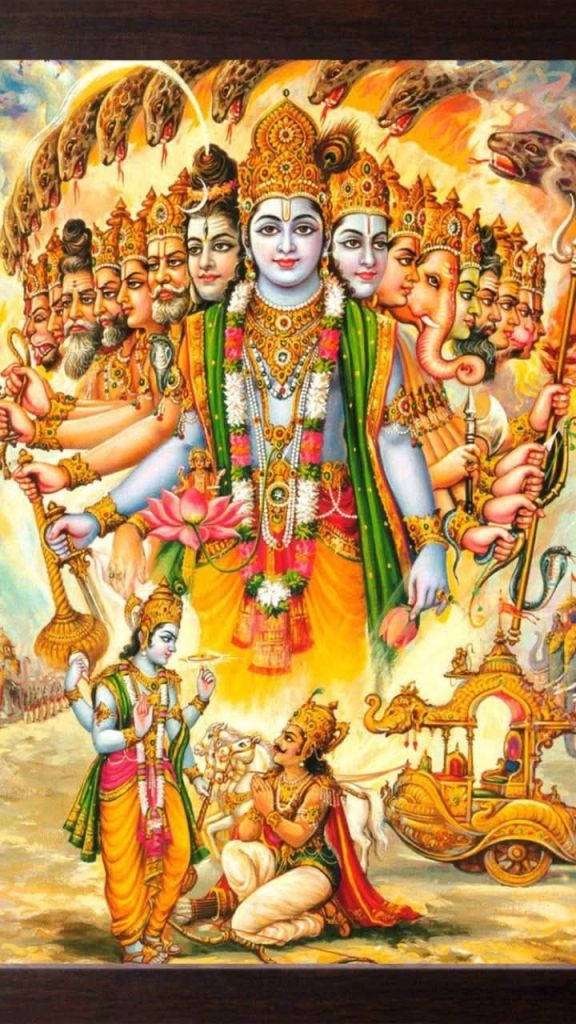
  • Self in all beings and all beings in the Self

    Meditation Yoga

    Chapter 6, Verse 29
    sarva-bhūtastham ātmānaṁ
    sarva-bhūtāni cātmani
    īkṣate yoga-yuktātmā
    sarvatra sama-darśanaḥ
    The man whose Self is in yoga, sees the Self in all beings and all beings in the Self, is equal-visioned everywhere.
    “The man whose Self is in yoga”, in union with the Divine, “sees the Self in all beings”. So the one who is in complete unity with God sees God in all beings and all beings in God, he is equal-visioned everywhere. There is no limitation. The true yogis who have established their identity in the Absolute Brahman, in the form of Satchitananda, have this quality of bliss inside them.
    Through meditation, one perceives that what one has inside of oneself is equally present everywhere: there is no difference between the inner and the outer. In the Atma there is no difference between the inner and the outer because Narayana Krishna, the cosmic Self, the true Self, which the yogis perceive, is within themselves and everywhere else. They attain the state of equal-vision. The entire creation, whether it is animate or inanimate, is Narayana. The yogis see no difference anywhere, because there is nothing which is not Him. They see everything within their own Self, so they identify themselves completely with Narayana and see Narayana everywhere. They perceive unity everywhere. That’s why when people sit for meditation, it is said, “See everything inside of you.” In meditation one “sees the Self in all beings and all beings in the Self.” The Self is the connection between all beings. In Chapter 5 we talked about this truth: if we are one with each other, we are constantly in connection, with each other, we are never far away from each other.
    Bhagavad Gita 
  • One becomes serene, sinless, and passionless

    Meditation Yoga

    Chapter 6, Verse 27
    praśānta manasaṁ hyenaṁ
    yoginaṁ sukham-uttamam
    upaiti śānta rajasaṁ
    brahma-bhūtam akalmaṣam
    When the mind is completely quieted, then there comes upon the yogi the stainless, passionless, highest bliss of the soul that has become Brahman.
    By constantly revolving in the mind the idea that one is not the body, that one is Brahman; by constantly remembering that one is not what one sees externally, and instead one sees the Divine residing within, the sadhak, the bhakta gets firmly established in the identity of the Divine. Like this, the sadhak, the bhakta reaches an advanced stage in the path of union with the Divine. Such a bhakta rises above the gunas.
    “… the highest bliss of the soul that has become Brahman.” In this state, there is only the reflection of God, nothing else. There is no doubt, there is no judgement, there is nothing which will keep one imbalanced or in duality. One is fully absorbed in the Divine Self, so nothing can move the devotee, the bhakta. One finds the supreme happiness, experiences it and spreads it. The mind is fully absorbed in eternal knowledge and bliss.
    When through meditation, one gets completely absorbed in Brahman and freed, one becomes serene, sinless, and passionless, and many other divine qualities awaken. Many different gifts get awakened, but one is completely untouched by anything.
    Bhagavad Gita 
  • This is will power, the strength of the mind

    Meditation Yoga

    Chapter 6, Verse 26
    yato yato niścarati
    manaś-cañcalam asthiraṁ
    tatas-tato niyamyaitad
    ātmanyeva vaśaṁ nayet
    Whenever the restless and unquiet mind goes forth, it should be controlled and brought into subjection in the Self.
    The mind is always restless, always jumping from one thought to the other, from one ‘want’ to the other. When the mind focuses on a particular object, it’s only for a short period of time. It doesn’t last long.
    When one wants something, one has already created it in the mind; and when it is created in the mind, automatically, with determination, it gets manifested outwardly. This is will power, the strength of the mind. But whatever is created from the mind’s wants, doesn’t satisfy one for long. The enjoyment is only for a short time. For instance, somebody buys a nice car. For one month, they will treat the car like nothing else they’ve had before. They will clean it and keep it so beautiful! But after sometime, when the mind gets bored with it, the desire for a new thing will appear in the mind and the mind will want that.
    An “unquiet mind goes forth” from one thing to the other. “It should be controlled and brought into subjection in the Self.” When one tries to fix the mind on God with great effort, one should imagine that one has succeeded in one’s effort. When you first create something in the mind, the mind will make it happen. It’s the same when you do your spiritual practices: in the mind, you should already make it happen. You should not feed weakness saying, “Oh my goodness! Swamiji is talking so much! This is too much for me! I’m far away from doing that, I can’t reach there.” The moment you say that you can’t reach there, there is a barrier, a big wall which is created. Of course, then you will not reach there. Whereas when you put in the mind that you have already reached there, then everything will become balanced and easy.
    “It should be controlled and brought into subjection in the Self.” Krishna says that when your mind is jumping from one thing to the other, don’t run into your weakness, don’t run into your fear! Don’t think that your desire for God is too much or too far away. One should always be alert and not allow the mind to think about anything but God. He has given so many Divine forms, He has given so many Divine Names to enable mankind to completely focus on Him. When you sit for meditation, if you perceive your mind going somewhere else, let it go, but then bring it back. Show your power over it through the intellect. Show that the Great Observer is more powerful than the mind. That’s why you can bring back your thought and control it. Remind yourself continuously, even if you don’t notice when the mind ran away and slipped out. When it slips out, don’t dwell on the object that has attracted the mind: instead bring the mind back and fix it “in the Self.” Fix it on God! God dwells in the identity of the soul, as the Oversoul. Here Lord Krishna uses the word ‘ātmany’: it means Atma, but refers to the Paramatma, the Oversoul, which resides within the soul.
    Bhagavad Gita 
  • Become single-pointed and identify itself with God

    Meditation Yoga

    Chapter 6, Verses 24-25
    saṅkalpa prabhavān kāmān
    tyaktvā sarvān-aśeṣataḥ
    manasaivendriya-grāmaṁ
    viniyamya samantataḥ
    śanaiḥ śanairu-paramed
    buddhyā dhṛti-gṛhītayā
    ātma-saṁsthaṁ manaḥ kṛtvā
    na kiñcid-api cintayet
    Renouncing without reserve all desires born of the imagination, and completely restraining all the senses by the mind from all directions; very gradually, one should attain tranquillity, with the help of the intellect held by a firm resolution. Having focused the mind on the Self, one should think of nothing else.
    Here Lord Krishna explains how to control the senses and the mind and fix the mind on God. The nature of the senses is to run after sense objects. However, the senses can only apprehend an object when they succeed in carrying the mind with them. When the mind is weak, the senses easily succeed in dragging the mind with them and the mind easily gets lost. But, when the mind attains single-pointedness with the help of the meditation of a purified and resolute intellect, “with the help of the intellect held by a firm resolution,” the senses are unable to run after the objects of enjoyment.
    When the intellect is focused on the Divine, the mind is silent and still and in this state of stillness, the senses lose their capacity to control the mind. Therefore, one should sit daily in dhyaan, in meditation, withdrawing the senses from all external, gradually emptying the mind of all worldly thoughts with the help of the intellect’s discrimination and dispassion. Then one should turn one’s attention inwardly and strongly fix the mind on God.
    “…with the help of the intellect held by a firm resolution.” When the intellect has a glimpse, an insight into the truth and the secret of God, through good association, it becomes focused and automatically there are no doubts nor attachments. Through the association with good company, engaged in the thought of God, the steady intellect, “held by a firm resolution,” leads the mind to become single-pointed and identify itself with God. In that state, the mind automatically stops indulging in thinking about worldly objects and dwells only on God.
    Bhagavad Gita 
  • All boredom and judgement will automatically disappear

    Meditation Yoga 

    Chapter 6, Verse 23
    taṁ vidyād duḥkha saṁyoga 
    viyogaṁ yoga saṁjñitam 
    sa niścayena yoktavyo 
    yogo ‘nirviṇṇa cetasā
    It is the putting away of the contact with pain, the divorce of the mind’s marriage from grief. The firm winning of this spiritual bliss is yoga, divine union. This yoga is to be resolutely practised without yielding to any discouragement by difficulty or failure.
    Even if a yogi has attained God-Realisation, his body, senses and mind still carry on doing all their activities. The body appears the same, but in one’s consciousness, deep within, one is not attached to anything; this is the divorce of the mind from grief. One doesn’t perceive the duality and by winning “this spiritual bliss”, one enters into the supreme state of divine union, where the soul is marrying Narayana, where the soul perceives Him as the only Man. The gopis told Krishna, “You are the only Man. There is no other Man but You. Everything else is just your creation, your Prakriti.” The Lord is the only real Male, everything else is Prakriti, everything else is female. So don’t be deluded by these two aspects, male and female. Through this deep inner perception, the realised one is not touched by the qualities of feminine or masculine, but is ever free, established in the Self. Like that, there is a divine union, a divine marriage. Your soul marries Krishna. That’s what all the wives of Krishna represent: everybody, the whole creation is feminine, as everything is created by Prakriti. A yogi rises above this and sees that one is Maha Lakshmi to Narayana; and when this fusion happens, one is above failure or success.
    “This yoga is to be resolutely practised without yielding to any discouragement.” So don’t weaken yourself! At the beginning of your spiritual practices, you may feel that you are losing heart, or find your spiritual practices too difficult. Or you may feel that there will be no end to all your effort and wonder if you’ll be crowned with success or not. Krishna says that you shouldn’t give way to all this doubting. The ones whose minds are free from boredom, and full of zeal and enthusiasm to achieve the state of surrender, persevere with eagerness. They should not get attached to doubt or run away from progressing. Through faith, reverence, resolution, and patience, they should surrender to the Feet of the Guru. They should devote themselves with firm determination and application to the duty which has been given to them, bearing constantly in mind the goal of their life. When they attain such a divine union, all boredom and judgement will automatically disappear. However, if they still feel discouragement, they should do their practices under the supervision of their Guru, with love and enthusiasm.
    Bhagavad Gita 
  • Who realises God, becomes like a rock, firm and unshaken

    Meditation Yoga 

    Chapter 6, Verse 22

    yaṁ labdhvā cāparaṁ lābhaṁ
    manyate nādhikaṁ tataḥ
    yasmin sthito na duḥkhena
    guruṇā’pi vicālyate
    That is the greatest of all gains and the treasure beside which all things lose their value. Established therein, he is not disturbed by the assault of mental grief.
    The greatest enjoyments in the world and the greatest glories in the world appear tasteless and insignificant to a realised soul. One perceives God as everything, “the treasure beside which all things lose their value.” One is not shaken from the state of equilibrium if the world brings one failure or success, pain or pleasure. Therefore, God-Realisation is the greatest gift, the greatest of all gains. And when one gains God-Realisation, everything else becomes secondary or tertiary.
    “Established therein, he is not disturbed by the assault of mental grief.” When the mind of normal worldly people gets disturbed, when the mind says, “What am I getting, what am I not getting?” They are shaken from all the sides, no? Left and right! Whereas the ones who are completely absorbed in the Self, enjoying the great Leela of the Lord, are unshaken in the face of the greatest trials and tribulations of life. The yogi, the bhakta who realises God, becomes like a rock, firm and unshaken; even if everything is turbulent all around, nothing affects them.
    Bhagavad Gita 
  • Everlasting bliss

    Meditation Yoga

    Chapter 6, Verse 21
    sukham-ātyantikaṁ yat-tad
    buddhi-grāhyam-atīndriyam
    vetti yatra na caivāyaṁ
    sthitaś-calati tattvataḥ
    That in which the soul knows its own true and everlasting bliss, which is perceived by the intelligence and is beyond the senses, established therein, the soul can no longer fall away from the spiritual truth of its being.
    When through deep meditation, one has perceived the true reality, “which is perceived by the intelligence and is beyond the senses”; when one has perceived and attained this bliss through meditation on God; when God has revealed this supreme aspect of Himself within oneself, “established therein, the soul can no longer fall away from the spiritual truth of its being.” In this state, one perceives this oneness and the everlasting, imperishable joy and bliss emanating from God within oneself. One is God-realised, one is a true yogi and one is never disunited from God. Whatever one does in life, whether it is having children, eating, drinking, or sleeping, if one is centred in that state, nothing can touch that person. One stays ever free. That’s why you see that in ancient times, the sages were all karma yogis, they were all married, even the gurus, and their wives were supporting their work. All those greater mothers also attained the same state of God-Realisation as their husbands, due to their surrender, their service, their bhakti and the dedication that they had to their husbands.
    Lord Krishna says that the ones who have attained this supreme state, whatever they do in the outside world, they are completely free, even if it may appear that they are limited. One might ask, “If you are a yogi, why do you need to sleep? If you are a yogi, why do you need to eat?” But as they are established in the Self, they are beyond duality, they are beyond the judgement of right and wrong, they are beyond the judgement of being husband and wife, they are beyond the duality of man and woman, they are beyond heat and cold, they are beyond ‘good’ and ‘bad’ and other opposites.
    “That in which the soul knows its own true, and everlasting bliss.” Here Lord Krishna says that the soul perceives within itself Narayana. The soul perceives no difference between itself and Narayana, “I am a little Narayana and You are a big Narayana, and we are both Narayana.”
    That’s what Goswami Tulsidas said to his wife, “You are the one who led me to see Sita and Rama everywhere. It was you, the driving force. If you wouldn’t have acted in that way, where would I be? For sure, I would have been doomed somewhere. But due to the Grace by which you acted, I was freed.”
    Bhagavad Gita 
  • When the mind restrained by the practice of yoga attains that infinite bliss

    Meditation Yoga 
    Chapter 6, Verse 20
    yatroparamate cittaṁ
    niruddhaṁ yoga-sevayā
    yatra caivātmanā’tmānaṁ
    paśyann-ātmani tuṣyati
    When the mind, restrained by the practice of yoga, attains that infinite bliss, and when seeing the Self by the mind, one is satisfied by the Self alone.
    The mind of a yogi, who is fully established in God, naturally withdraws itself completely from the outside world. In that state, the outside world no longer finds its place in the mind of a yogi. This is the state of Samadhi. Samadhi is not only achieved in meditation. Once one has attained Samadhi in meditation, even if one dwells in the outside world, one is always fully in Samadhi. One does all one’s actions, whatever one needs to do, in the same state of Samadhi. One doesn’t run away from doing outer action, but one is also fully absorbed in God. Even if it appears on the outside that one is a normal human being, in reality one is not normal, one is fully in God Himself. He does everything in a state of complete detachment at all times. Such a mind is said to be still and in “infinite bliss.”
    When one is sitting in meditation and attains God-Realisation, “seeing the Self by the mind,” the mind is not dwelling on the outside reality anymore, it is not dwelling on the objects of the senses. Here the Self reveals to the mind who He is: “one is satisfied by the Self alone”, because one perceives the Divine Light. When Bhagavan Krishna says that “one is satisfied by the Self alone,” He means that one perceives one’s unity with God: one perceives that one’s own Atma is the Paramatma; one sees that there is no difference between the Atma and Narayana. The Atma has all the qualities of Narayana; only the quantity is different. The Supreme has limited Himself to be present in the Atma. Within the Atma, one perceives all the divine qualities, one perceives God. For such a yogi, there is no difference between the Atma and God. The mind is completely settled, purified and the soul rejoices in God only. The mind also doesn’t rejoice elsewhere, only in the Self, in the Divine.
    In your sadhana, when you are fully concentrated on a certain deity, on your Ishtadev for example, the deity reveals that there is no difference between the deity and you. This is their duty, their connection with you. So if you are fully absorbed in Krishna, you won’t see Krishna as separate from you. He is the core of everything. He is the Ultimate. The mind doesn’t rejoice anywhere else. If you have seen the most wonderful thing of your life only one time, just by closing your eyes, you will always see it, no? Your mind will never forget about it. Have you seen the Mona Lisa?Everybody whose mind is focused on the outside reality will say, “How beautiful! How beautiful! How beautiful!” But if one has seen something much more beautiful, then the Mona Lisa will be put away, thrown in a corner somewhere. Then the supreme beauty will be ever-present. That’s what happened in the life of Annamacharya.
    Annamacharya was always looking at the eyes of his two wives, praising them and singing their glory, “How beautiful are your eyes! How beautiful are your eyes! Such beautiful eyes do not exist anywhere else in the world! I have never seen such almond-shaped eyes in this world…”
    Up in Vaikunta, the Lord was looking at him saying, “My goodness! I did not send you there for that!” Imagine what the Lord is going through in the Vaikunta deep inside your heart. He is saying, “My goodness! I have sent you to Earth to realise Me. Why are you looking outside yourself? Why are you looking at ‘Mona Lisa’ out there? Look inside! The beauty that you have inside you is much more beautiful!” Looking at the state of Annamacharya, the Lord said, “Oh my goodness! I have to go down there and remind this poor guy.” The Lord left Vaikunta in a rush and manifested Himself in this world.
    Annamacharya was taking a walk with his wives. Do you know how he was walking? His two wives were walking side by side and he was walking backwards so that he wouldn’t lose sight of his wives’ eyes. The Lord said to Himself, “My goodness! My dear Annamacharya, I sent you there to spread My Love and look at what you are doing. I must remind you who you are.” Annamacharya was in reality the incarnation of the sword of Narayana. In truth, everybody is an incarnation of Narayana, a manifestation of Narayana. The Lord says, “By listening to the Gita, I am reminding you who you are. You are here listening to the Gita. Awake!”
    The Lord came to Earth and appeared to Annamacharya disguised as a Brahmin. Since Annamacharya was walking backwards, he could not see who was behind him, so the Lord purposely stood behind him. Annamacharya bumped into Him, turned and said, “Oh! Sorry! I didn’t see where I was walking!” The Lord said, “Of course you didn’t! You were walking backwards! How could you see? You don’t have eyes in the back of your head! What are you doing, My dear?” Annamacharya replied, “I am looking at my beautiful wives.” The Lord said, “What are you looking at that is so beautiful? These are just two bags of bones.’ Annamacharya was shocked!
    The Lord continued, “The body is made of panchatattva, the 5 elements. Nothing else. Once it is burned, it becomes ash. It decays. There is nothing permanent in it. You are praising your wives, right? How beautiful are their eyes! How beautiful are their faces! But when these get old, what will you do? Will you still praise them? The eyelashes will probably not even open? Will you still praise those eyes then? No, you won’t praise them.” Who praises an old lady? Nobody! It’s true! This is the reality! Who praises an old man? Nobody! You only praise an old man when he is a Guru. When the Guru gets old, it doesn’t matter: the Guru is centred in the Divine, so you praise him. Lord Krishna says to Arjuna, “Everybody looks at the one who has achieved the Divine state, and they also try to be like that. But nobody cares about the ones who have doomed themselves.” You come here, you live your life, you die, and nobody even remembers you. What have you done in life? Nothing! But, it’s not about whether people remember you or not. It’s about if you have done your dharma while you were here. When you do your dharma, you will achieve the Lord; then you will be eternally with Him.
    The Lord said to Annamacharya, “What a waste of time, My dear! Why are you praising these bags of bones, which will only last for a limited time and then…be finished? When their eyes drop…finish!” Then He said, “Come! I will show you a pair of eyes which are even more beautiful than these eyes. Here you are looking at four eyes. I will show you only two.”
    So the Lord took Annamacharya to the Lord’s Balaji Temple in Tirupati. The temple was closed, so Annamacharya waited outside. When the temple doors opened, Annamacharya’s eyes and Lord Balaji’s eyes met, and Annamacharya perceived the whole universe in Lord Balaji’s eyes, just by looking at Him. At that moment, he received full Realisation: his eyes had turned from the outside perception to the cosmic eyes of the Lord.
    Lord Krishna says in the Gita, “Don’t let yourself be fooled by outside appearances. You have to first perceive the Lord within the core of yourself. Once you have perceived that beauty within yourself, then you will look at the whole creation of God with the eyes of knowledge. The Supreme Being will be visible in all His creation. Then you will not just look at perishable matter, but you will look at the imperishable One, the ever-existing One, the Ultimate, the One who pervades everything, man and woman, the trees, the animals, the whole of creation. This is the state of a yogi. This is the state Krishna referred to when He says, “…seeing the Self by the mind, one is satisfied by the Self alone,” because one perceives that reality within oneself and in everything.
    After the Lord showed Annamacharya His Divine eyes, Annamacharya perceived the Reality beyond the outer reality. His perception of the four eyes of his wives completely changed. He perceived the Lord, who is the Supreme, in his own wives. He saw the divinity not only in himself, but he also saw the divinity in them. He said, “Mothers, I worship you! You have relieved me from the bondage of suffering and made me see the Lord.”
    The same thing happened with Goswami Tulsidas and his wife. Tulsidas was a saint who lived in India in the 16th century. His love for Lord Rama was so great that, wherever he looked, he would see only Rama. At that time in India, as now, people followed the caste system. There was the Brahmin caste, the highest caste, and the Shudra caste, the lowest caste. When Tulsidas’ parents died, nobody looked after him: wherever he went, people would go away from him, because he was from a low caste. But Tulsidas’s love for Rama was so great that he always carried a small statue of Lord Rama with him.
    One day Tulsidas’ Guru took him to his ashram and said to the people there, “You always think that you know God, but you only know Him through scriptures, only through what is said in the books. But the Lord Sri Hari is above all this. He loves everybody and everybody is equal to Him. He is with anybody who calls Him with sincere heart.” So the Guru took Tulsidas under his care and looked after him. Tulsidas grew up and became well-versed in Sanskrit. His main aim was to give the Ramacharitamanas, “The Story of Lord Rama”, to the people in their own language.
    He started to compose poems and sing the Ramacharitamanas in Awadhi, a local dialect of Hindi. The Brahmins didn’t like this at all, because they said that Sanskrit was the language of the devas, of the gods. Well, that’s what they said. Similarly, some people think that God only speaks Latin. Tulsidas’ main aim was to write the “The Story of Lord Rama” into Awadhi and give it to the people, to everybody, equally. But because of that, he had many enemies.
    When the time came for Tulsidas to get married, one of his brothers who was against him said “I will marry the girl you have chosen. Not you!” But the girl’s father wanted Tulsidas to get married to his daughter, Ratnavali. Finally, they married and were very happy. They went to get the blessing of the Guru. The Guru gave Tulsidas the small statue of Rama which he had brought to the ashram when he was very small and told him, “I don’t have anything to give you on this special day, but take this statue of Rama and never forget about Him!” Tulsidas replied, “Guruji, how could I ever forget about Rama?” He took the statue of Rama home, put it on the altar and from that moment on, he completely forgot about Rama, because his mind was focused only on his wife. He got so obsessed with his wife that she became everything to him.
    Every moment, day and night, he only wanted to be next to his wife.
    Tulsidas and his wife had a clothing shop which was given to them as a wedding present by his wife’s father. One day Tulsidas had to go to another town to get some clothes for the shop. In the morning he said goodbye to his wife and went to the other shops to buy his things. During the day, his wife got a message that her father was not well and he asked to see her for the last time before he died. She quickly rushed to her father’s bedside. When Tulsidas came home and didn’t find his wife, he became angry. He found a note on the bed saying, “I have gone to my father’s place. I need some time for myself, because I have seen how obsessed you are with me and because my father is ill.” Tulsidas could not bear this and went to his father-in-law’s place. On the way, there was a big storm and he had to swim across a river. When he finally arrived, he saw that the door was locked and wondered how to go inside. So he started climbing over the wall of the house.
    On the wall there was a snake. He pulled the snake, thinking that it was a rope. He took it with him inside the house and then realised that it was a snake! His wife said, “Look at what you have done because of the obsession that you have for this bag of bones! If you would have had the same obsession for Rama, He would have delivered you and you would have attained Him by now.” At that moment, the truth of those words hit Tulsidas and he remembered that his Guru had told him to always look after Rama. He had told him to never let go of the Name of Rama. But due to delusion, he had forgotten about it and his wife had acted as a guru, reminding him of his dharma.
    At that moment, Tulsidas let go of everything and surrendered to Rama. He started looking for Rama everywhere saying, “What is the use of not finding you. You are the Lord of the universe. Let me see You! What is the use of life, if I don’t see You? Praised be my wife who has reminded me of Your Love.” Later on, the wife of Goswami Tulsidas became one of his greatest devotees.
    Such a wife is worthy to be praised, because she supports her husband. She forgets about her own personal wishes or desires. Sri Paramahansa Ramakrishna was always praising Sarada Devi, because in Sarada Devi, a dedicated wife, he would always remember the Divine Mother. This is the greatness of women, when they become a source of support for the spiritual benefit of all.
    Bhagavad Gita 
  • God within oneself starts to shine all the divine qualities.

    Meditation Yoga

    Chapter 6, Verse 19
    yathā dīpo nivātasthe
    neṅgate sopamā smṛtā
    yogino yata-cittasya
    yuñjato yogam-ātmanaḥ
    Motionless, like the light of a lamp in a windless place, is the controlled consciousness of the yogi who practises union with the Self.
    Here Lord Krishna says that when the mind is restrained by the practice of yoga, it becomes “motionless, like the light of a lamp in a windless place.” When people have faith and are surrendered, nothing can move them. No disturbance of the outside reality can deviate them from their aim. They are fully in control.
    Bhagavan Krishna says that the focus and concentration of the disciplined mind of a bhakta, of a devotee, is so fixed on God in meditation that it doesn’t move to anything else. When you are absorbed in that reality, you are not thinking of when you will finish your meditation. And you don’t set your alarm clock next to you, because your mind, even while you’re sitting in meditation, will be sitting on the alarm. You will not be hearing the cosmic sound within you, but you will be waiting to hear the
    alarm ringing. This is not the state of a yogi. Here Krishna makes an analogy between a still mind and an unmoving flame: the mind is “motionless like the light of a lamp in a windless place.” A flame is always moving, but when it is sheltered, blocked from all sides, it doesn’t move, it doesn’t flicker; it is stable, it shines, it radiates light! Like that, when one is fully absorbed in the Divine Self, God within oneself, nothing can deviate one from the path and automatically one starts to shine all the divine qualities.
    Bhagavad Gita 
  • This is yoga.

    Meditation Yoga

    Chapter 6, Verse 18
    yadā viniyataṁ cittam
    ātmany-evāvatiṣṭhate
    niḥspṛhaḥ sarva-kāmebhyo
    yukta ity-ucyate sadā
    When all the mental consciousness is perfectly controlled and liberated from desire and remains still in the Self, then it is said, “He is verily in yoga.”
    “When all the mental consciousness is perfectly controlled…” Then the mind is focused on the Divine and one is free. The mind is not jumping left and right, thinking about what one has to eat; or one is falling down asleep, and so on. The mind is not
    running to the outside reality.
    When one is “…liberated from desire and remains still in the Self, then it is said, ‘He is verily in Yoga.’” When one is absorbed within one Self, within the Divine Consciousness, one’s vibration is changed and one gets exclusively established in Narayana, who is the supreme peace, supreme bliss. In such a state, one overcomes all outer attractions. One is detached from everything which is perishable and from the worldly enjoyment. Therefore, one is free and longs for only one thing: God. One perceives the unity beyond diversity; in all the worldly diversity, one perceives only the Divine, the Love of God. This is truly yoga. If people have not perceived the Divine within the core of themselves and don’t emanate the divine qualities, they are still on the way towards perfection, towards unification with the Divine. They are not yet established in yoga, they are just practising. But the ones who are always fully absorbed in serving, fully absorbed in the Love of God, automatically start to reflect the divine qualities through them. Verily, this is yoga.
    Bhagavad Gita 
  • One attains the supreme peace and bliss

    Meditation Yoga

    Chapter 6, Verse 17
    yuktāhāra vihārasya
    yukta ceṣṭasya karmasu
    yukta svapnāvabodhasya
    yogo bhavati duḥkha-hā
    Yoga becomes the destroyer of sorrow for one who is moderate in food and recreation, who is temperate in actions, who is moderate in sleep and wakefulness.
    “Yoga becomes the destroyer of sorrow for one who is moderate in food and recreation.” When people have control over their diet and their leisure time, this shows that they have control over the senses, the body, and the mind, and so they enter the Samadhi state in meditation. They show their purity, their clarity, their faculty of concentration, their willingness, liveliness, their willingness, excitement, and enthusiasm for doing their sadhana.
    “…temperate in actions…” Controlling the food and the sleep affect what you reflect externally. If people have no control over food, they overeat and get heavy; then they can’t even do any asana postures.
    “…who is moderate in sleep and wakefulness.” Here Lord Krishna emphasises that it is not about stopping sleeping and then afterwards looking like a zombie. He says that there is a time to sleep, a time to rest. There is time to be awake and a time to eat. The whole day is divided into four parts: twenty-four hours divided by four means that there are six hours for each part of the day. Now, you are already wondering, “How will I sit and meditate for six hours?” No. I am sure that you are actually thinking, “How can I eat for six hours?” Some people are probably wondering, “Why is Swamiji telling me to sleep for only six hours? This is terrible! How can I do that?” No, no! You have to sleep according to what your body needs. If you need eight hours, then sleep eight hours. If you need four hours, then sleep four hours. If you need three hours, then sleep three hours. It doesn’t matter. You have to respect what your body needs, so that you don’t ruin yourself and your dhyaan can be done properly. What is the use of not sleeping and then when you sit for meditation, you are falling left and right? It’s useless, isn’t it? What is the use of not eating and then when you sit for meditation, you see a plate of food in front of you? Or when you have eaten too much, you can’t even sit for meditation? If you have slept too much or if you have not slept at all, it doesn’t help, you know? Excesses don’t help one’s meditation. Even if the shastras say that it is good to sleep less and stay awake, one has to observe oneself and see what one really needs.
    “Yoga becomes the destroyer of sorrow…” Success in Dhyaana Yoga elevates one to God-Realisation, and one attains the supreme peace. In that state, one is fully absorbed in the ocean of bliss.
    Bhagavad Gita 
  • Eating too much food induces sleep and laziness and creates various disorders in the body,

    Meditation Yoga

    Chapter 6, Verse 16
    nāty-aśnatas-tu yogo’sti
    na caikāntam-anaśnataḥ
    na cāti svapnaśīlasya
    jāgrato naiva cārjuna
    Verily this yoga is not for him who eats too much or sleeps too much; neither is it for him who gives up sleep and food, O Arjuna.
    Eating too much food induces sleep and laziness and creates various disorders in the body, due to the accumulation of undigested matter. The body only needs a moderate amount of food. When you eat too much, not all of it gets digested and the excess stays in the body and creates imbalance. Then you can’t concentrate while doing meditation. That’s why some people need a siesta after eating. Abstaining from food also acts on the mind, the senses and the vital organs. When the sadhaks, the devotees sit for sadhana, their mind is focusing on food. If you say, “Today I will not eat!” That day the food will look much more appealing than usual, the smell will be stronger than usual, and your stomach will start growling. This will disturb the mind and when the mind gets disturbed, it can’t concentrate, and so this interferes with the practise of meditation. Bhagavan says that when you sit for meditation, your mind should be fixed on God and not on food or on a siesta.
    Lord Krishna also says that one shouldn’t sleep too much. A reasonable amount of sleep helps to rest, refresh and strengthen the body. But as I said before, sleeping too much makes one feel drowsy, lazy, and not well, and due to that, one can’t concentrate in meditation. Then it becomes serious! You lose control, or you go into depression, or you start looking like a vampire with red eyes. Here Bhagavan also says that to abstain from sleep doesn’t contribute to a successful meditation. If you don’t sleep, your body will get exhausted. You will not be refreshed and then there will be complete disorder inside you. So a little bit of sleep is very important so that the body can refresh itself in the divine energy. During sleep, you completely lose your ego identity, and by losing the ego identity, you are fully absorbed into the Divine. Then the Divine energises every cell and every vital organ in the body, so that when you wake up, you feel fresh, you are full of energy, you are ready for another day.
    Bhagavad Gita 
  • If you have control over diet and your sleep, your meditation will be successful and will lead you to God-Realisation.

    Meditation Yoga
    Chapter 6, Verse 15
    yuñjann-evaṁ sadā’tmānaṁ
    yogī niyata-mānasaḥ
    śāntiṁ nirvāṇa paramāṁ
    mat-saṁsthām adhigacchati
    Always putting himself in yoga by controlling his mind, the yogi attains to the supreme peace of Nirvana which has its foundation in Me.
    “Always putting himself in yoga by controlling his mind.” The one who controls his diet, who controls what he puts into his body, who controls his mind, such a yogi “attains to the supreme peace of Nirvana which has its foundation in Me.”
    Here Bhagavan says that the foundation of Nirvana is in Him, but it is not Him! Nirvana is just one state of Realisation. Many people say that the state of Nirvana is the ultimate state, but actually the ultimate state of Realisation, the supreme state, is beyond Nirvana. Nevertheless, Lord Krishna says here that when one has reached a certain purity, by controlling the mind, the diet, the body and the senses, then through meditation one enters into the state of Nirvana. Controlling what you eat, what kind of diet you have, is very important, because it has an effect on your meditation. Plants have a calm, peaceful nature, they are shanti. When you eat vegetarian food, automatically you also become shanti. On the other hand, meat contains the emotion of aggression in it from the animal! If you eat meat, you can’t sit and meditate because this quality will also awaken inside you. That’s why what you eat is very important!
    It is also very important to control your sleep and your wakefulness. How long are you sleeping? Too little is not good! Too much is not good! For a yogi, six hours of sleep is enough. I think that science also says this, no? If people are not doing yoga, they need eight hours of sleep. Yogis need less. If you sleep less, it helps your concentration. Of course, you have to respect your own nature. Imagine that people
    say, “I went to listen to this Swamiji and he said to sleep six hours a night.” Then you try it and wake up in the morning like a zombie. You don’t know what you are doing and nothing works. The scriptures say that you have to control your sleep, but if your body needs seven or eight hours, then sleep seven or eight hours. It’s best to respect your body’s needs: otherwise later, when you sit for meditation, you may fall asleep and be snoring, because you are not fully in control. So, six hours is enough, seven, or eight hours is okay, but much more than that is not good! You will see that when you sleep longer, eleven or twelve hours, afterwards you don’t feel good, your body is drained of energy, you have a headache, you feel lazy, drowsy, and zombified. And when you look in the mirror, you don’t even recognise yourself. You are shocked. You get depressed just by looking at yourself. Then you can’t meditate! And what about God- Realisation? It’s far away! You have to sleep only enough to be able to concentrate and continue your spiritual advancement. But don’t sleep during the day! That’s not good.
    If you have control over your diet and your sleep, your meditation will be successful and will lead you to God-Realisation. It will lead you to supreme bliss, to supreme peace. Having reached a state like this, where one is fully surrendered to the Divine, there is never again suffering or sorrow. Once one has reached this state of Nirvana, there is no way that one will go backwards. When one attains this state of Nirvana, one breaks out of the cycle of birth and death. One doesn’t fall victim to grief, fear, or anxiety; one is always fully merged into this divine, blissful state, which has its foundation in Krishna Himself. In the state of Nirvana, one perceives the Supreme Lord in His glory, within one’s own Self: one also perceives Him in His sagun and nirgun aspects, which are respectively, the Lord with form and without form.
    In the previous verse, Lord Krishna gives instructions about the seat that one should use to perfect one’s meditation. I would like to clarify that the asana Lord Krishna is talking about is your personal asana in your room, in your house or in your private areas. In a temple, you don’t have a specific place just for you. So don’t think that if you used to sit in one place and then somebody else sits there that you should
    go and attack the person saying, “That’s my place! You have invaded my space!” No! In temples, like the Shree Peetha Nilaya Temple, there are no private places. Well, I have one. But apart from my seat and the deities’ seats, no one else has a private place. In the temples or public places, the seats are for everybody. However, when you do your dhyaan, you should be alone. It is better to meditate alone! Because the moment there is somebody else, your mind will be focused on that person.
    Bhagavad Gita 
  • When you sit for meditation, you will perfect yourself.

    Meditation Yoga
    Chapter 6, Verses 13-14
    samaṁ kāya-śiro-grīvaṁ
    dhārayann-acalaṁ sthiraḥ
    saṁprekṣya nāsikāgraṁ svaṁ
    diśaś-cānavalokayan
    praśāntātmā vigata-bhīḥ
    brahmacāri vrate sthitaḥ
    manaḥ saṁyamya mac-citto
    yukta āsīta mat-paraḥ
    Holding the body, head and neck erect, motionless; the vision drawn in and fixed between the eyebrows; not regarding the regions; the mind kept calm and free from fear; the vow of Brahmacharya observed; the whole controlled mentality turned to Me, one must sit firm in yoga, wholly surrendered to Me.
    Here Bhagavan Krishna says that during meditation, one must keep the spine straight, with the neck and the head, all in one line. One has to be “motionless, the vision drawn in and fixed between the eyebrows.” This means that with deep concentration, without following any outward impulse or distraction, one has to focus: the gaze must be “fixed between the eyebrows.” Lord Krishna says that the eyes should not be fully open or closed but semi-closed (like Lord Shiva’s eyes) and focusing on the tip of the nose.
    The purpose of fixing the gaze on the tip of the nose is to avoid outer distractions and avoid falling asleep. Because if you keep the eyes fully open you may suddenly get distracted: “Oh, a fly…”. On the other hand, if the eyes are fully closed, you may fall asleep while meditating. Whereas when you have the eyes semi-closed, you stay focused! You will not fall asleep and you will not get distracted. Nevertheless, the mind should be fixed on God. The eyes are focusing on the tip of the nose, but the mind should not be focused on the nose… okay? Don’t get these two things mixed up. I am telling you to sit in meditation with semi-closed eyes focusing on the tip of the nose. Here I am not telling you to look at your nose, I said for you to fix the gaze on the tip of the nose, but the mind must be focused on God, on Paramatman, Parabrahma.
    If you practise meditation as described in this verse, if the mind is focused, you will have control over it and you will not have a sleep attack, which afterwards you will call ‘meditation’. Fixing the gaze at the tip of the nose also helps to develop firmness within. It helps to overcome the fear of the opposites, the fear of duality, the fear of not doing things properly. By sitting for meditation in a state of fear, you are not free. But if you focus on God within yourself, if you let the mind dwell on the Divine, when you sit for meditation, you will perfect yourself.
    Observing “Brahmacharya” means that for one to fully focus in meditation, one should control and avoid the flow of energy downwards. One should avoid being in a relationship and use this energy for their own spiritual growth. Imagine how much energy there is in it. With this energy one can create another body. The fusion between the sperm and the ovule is like an ‘atomic bomb’. A new body can be created from these two energies. You have this power, but someone who is really longing for God- Realisation will not use this power, this energy, in an outward action. In this verse, Lord Krishna emphasises the importance of observing “the vow of Brahmacharya” during meditation, because if you have not yet developed self-control, you will be controlled by self-enjoyment or lust. However, with self-control a yogi is free. That’s why Krishna is training Arjuna to observe the vow of Brahmacharya. He says, “I am not telling you to fully stop this energy, but during the time of your sadhana, it is very important to keep yourself pure and to restrain yourself, to keep this energy and use it for advancing yourself spiritually.” This will also help the mind to not drown itself in the tendencies of the lower region, but to focus on the higher goal, on the Divine, to make you strong spiritually.
    “The whole controlled mentality turned to Me.” God is present everywhere. If the yogi practising meditation wants to see God, “he must sit firm in yoga.” One should sit fearlessly in meditation, not thinking that one is doing something wrong or right. One should not be looking at the watch asking, “When are these fifteen minutes, which Swamiji told me to do, going to end?” Or set the alarm and then when the fifteen minutes have passed, say, “Ah, finished! I have done it!” On the contrary, when people do their meditation or their Atma Kriya Yoga practice, they should be fully absorbed in it and should love doing it.
    If during meditation one entertains the smallest fear in the mind, one will naturally feel distracted and lonely. When one sits for meditation, one should hold firm and fully trust in God, be “wholly surrendered to Me.” One should not think about one’s limitations, but should fully surrender to the Divine with faith and love. If the mind is disturbed during this time, one should remind oneself that God is there, that in that moment of meditation you are in His presence. That’s why I said that setting a time is very important: it’s like you sent Him an invitation to come and He is present there! You are not alone, you are in His presence! So, there can be no fear at all.
    When yogis sit for meditation and the time for them to leave this plane arrives, they automatically advance to a higher plane. If they are meditating, and then due to samskaras they die, this brings them to their highest good. It can happen and has happened many times: the Atma leaves to the spiritual plane. The ones who have taken the path of meditation on the Absolute Reality, God, will never come back to this same reality, but they will always incarnate to advance spiritually. They will find their way, their spiritual path, and they won’t go backwards. There is a continuation. For example, you are all sitting here because you have done something ‘good’ in your last life. You have some good karma, otherwise you would not be here. In this life, you have received the great punya to be on the spiritual path, to receive Atma Kriya Yoga, and through that, God has manifested Himself in His omnipresence inside each one of you. He is guiding you on your spiritual path, in His nirgun form and in His sagun form. He has a multitude of forms and aspects, like Shiva, Vishnu, Devi, Jesus, and many others.
    Bhagavad Gita 
  • Meditation is the state where one is fully immersed in the Love of God within.

    Meditation Yoga
    Chapter 6, Verses 11-12
    śucau deśe pratiṣṭhāpya
    sthitam-āsanam ātmanaḥ
    nāty-ucchritaṁ nāti-nīcaṁ
    cailājina kuśottaram
    tatraikāgraṁ manaḥ kṛtvā
    yata-cittendriya kriyaḥ
    upaviśyāsane yuñjyād
    yogam-ātma viśuddhaye
    He should set his firm seat in a pure spot, neither too high, nor too low, covered with a cloth, a deer skin, and sacred grass; seated there with a concentrated mind, and with the workings of the mental consciousness and
    the senses under control, he should practise yoga for self-purification.
    In these verses, Bhagavan Krishna explains that it’s important to have a fixed place to meditate and a proper seat, or asana, to sit on.
    “He should set his firm seat in a pure spot.” Even though you should be comfortable, the seat should not be too soft: it has to be firm. In ancient times, yogis used a wooden seat or a stone slate as a base for their asana.
    “… neither too high, nor too low.” The seat should not be too high, because if you are sitting too high and you go into deep meditation or deep sleep, you might fall down! Your meditation will be disturbed or you may fall and get hurt. If you are sitting near the floor or directly on the floor, there will always be an exchange of energy: the heat, or the cold, will have an effect on your body. Furthermore, if there is a small animal crawling around, it will crawl on you! Imagine that you are sitting for meditation, and you have not yet perfected it, you are not yet completely absorbed into the higher Self where you are not aware of the body consciousness. And then
    small flies are flying all around you, or ants are crawling on you! In India, probably even snakes would be crawling on you. All this will disturb you and interfere with your
    meditation.
    “… covered with a cloth.” The purpose of a cloth is to make you feel more comfortable when you are in meditation. Then you won’t end up feeling pains in your legs and say, “I am sitting too long on this hard wood. It’s terrible!” So Krishna says that you can make the seat a little bit softer by putting a piece of cloth over it.
    “…with a deer skin, with sacred grass.” In ancient times, the yogis used to meditate seated on a deer skin. They would not go around killing deer to get the skin, but they would use the skin from an animal which had died naturally. Do you know why they used deer skin? Because it is said that deer skin acts like an insulation which protects the energy that flows through your body when you are absorbed in the Divine rhythm during meditation. During meditation the energy flows through all the chakras, from the base up to the head, and you become like a pillar of energy. You have to utilise this energy for your spiritual growth. You have to sustain this energy inside you and not let it slip away. That’s why Lord Krishna says to place a deer skin on the seat. 
    However, put Kush grass under the deer skin. Kush grass, which we use in prayers, is considered to be the hair of Narayana, so it’s very holy. Then put a piece of cloth over the deer skin, because the deer skin is not that comfy to sit on: it pricks you. The hairs on the deer skin seem smooth when they are all laying in the same direction, but if you move just a little bit, they will prick your behind, which will be very uncomfortable, and then you’ll start scratching and moving even more. So, the cloth over the deer skin will protect you. It will keep the hairs laying in one direction, otherwise they will prick you, then you’ll move, and move and you’ll not be able to concentrate. Furthermore, placing the Kush grass under the deer skin, will protect the deer skin, and prevent its decay.
    Therefore, Lord Krishna advises putting these three layers on the seat: Kush grass, a deerskin, and a cloth. This kind of asana will help the bhakta, the sadhak, to concentrate during meditation.
    But please note very well that the deer skin which the yogis used was from an animal which died naturally. So for the sake of your meditation, don’t buy a skin from an animal that was killed. When somebody kills an animal, he kills it for his own personal pleasure or gain. By buying the skin of that killed animal, you are participating in its killing and taking upon yourself that karma. What good would this bring you? It would not bring you any good. It would be better to have a proper seat made only of Kush grass. Kush grass is very good for meditation!
    Āsanam ātmanaḥ means, “The seat belongs to oneself.” One should not sit on somebody else’s seat when one meditates. Because when you sit on your own asana, there is a certain energy which is emanating from it and this energy is important for your spiritual growth. Your asana becomes a place of concentration of energy. And if you use somebody else’s asana, you don’t know which level of energy or which level of concentration they put in it. By utilising the asana of a person who has a low frequency of energy, you get in contact with that energy and automatically your whole attitude changes. This is why, in these verses, Bhagavan Krishna explains how important it is to keep one’s own asana. 
    When the bhakta has his own asana, his own place, the right timing, and the “workings of the mental consciousness and the senses under control, he should practise yoga for self-purification,” cittendriya kriyaḥ. Here Krishna says that the mind and the intellect have to be under control. You have to concentrate yourself to the point where there is a complete suspension of all activities. In that state, the mind doesn’t run towards the outside world; the mind is stable. So focus the mind on the object of meditation. What is the object of meditation? God. By concentrating the mind on God, by fixing the mind on the Divine, the senses are automatically under control.
    “… he should practise yoga for self-purification.” Here Lord Krishna emphasises that when one practises meditation, it is to purify oneself, so one can reach the state where one is fully immersed in the Love of God within. One should not meditate to attain any worldly glory or worldly object. So you shouldn’t say, “I am meditating. O God, I want something!”
    Bhagavad Gita 
  • When you set a certain time to sit for meditation, you are inviting God to manifest Himself at that moment.

    Meditation Yoga

    Chapter 6, Verse 10
    yogī yuñjīta satatam
    ātma‌naṁ rahasi sthitaḥ
    ekākī yatacittātmā
    nirāśīr aparigrahaḥ
    Let the yogi continually practise union with the Self, sitting apart and alone, with all desire and idea of possession banished from his mind, self- controlled in his whole being and consciousness.
    “Let the yogi continually practise union with the Self.” Here the term ‘yogi’ refers to the bhakta, the spiritual practitioner who is doing yoga, the one who is longing for God. The yogi, who has reached perfection through yoga is seated in the Self focusing on God Himself alone. “Sitting apart and alone, with all desire and idea of possession banished from his mind:” When one has a controlled mind and doesn’t have any sense of possession or any attachment to any kind of desire, then, one is eligible to sit in meditation.
    Here Krishna was talking to people who are on the spiritual path, who are longing for God. He says, “Find a suitable place to practise meditation.” He advised one to withdraw oneself from the world. Those who are on the spiritual path, have to withdraw into themselves from time to time: they have to go within themselves. The spiritual sadhaks who are busy in the world wherever they are, whatever they are doing, should find time, from time to time, to sit down for meditation, dhyaan, to withdraw from the outside world and enter into the inner quietness within the Self. It’s like recharging the batteries! As long as the mind runs towards the outside reality, the battery is discharging. However, it is difficult to sit down for meditation when there are people around, especially if you are just freshly starting on the spiritual path. Once you have mastered meditation, that’s not a problem. But when you have not yet mastered meditation, it’s important to find your own place.
    There are certain rules saying that you should have a fixed place for meditation and a proper asana or seat. In the next verse, Krishna will tell us about the importance of the seat and how important it is to always meditate in the same place.
    “… self-controlled in his whole being and consciousness.” One is self-controlled in the mind, one is self-controlled in the body, one is self-controlled in the breath, through pranayama, the breathing exercises. Practise meditation! Let the mind and the intellect be absorbed in the thought of God! That’s the meditation one should practise and this practise should be unbroken! One must discipline oneself and not find excuses for not doing one’s spiritual practice. You shouldn’t say, “Today there is a nice movie. I am going to watch it at nine o’clock. I should sit down for meditation, but there is this movie, so I will watch it and then afterwards I will sit for meditation.”
    The time and the place of meditation are very important, because when you set a certain time to meditate, you are inviting God to be there with you. It’s like if you invite
    a friend to come to your place and then you are not there to welcome your friend. How would it be? Or you are invited somewhere, you are ringing the bell and you see all the lights off. Then someone turns the light on and you see the person in pyjamas saying, “Ai! I thought it was tomorrow!” How would it be? You would be shocked, no? So, here it is the same thing. When you set a certain time to sit for meditation, you arei nviting God to manifest Himself at that moment. And you can have this expectation that, as you sent the invitation, God will come and be eagerly waiting for you inside yourself at that time. Let’s say you plan to meditate at nine o’clock. In your mind, you have already created this appointment with God, so the Divine will manifest Himself at this appointed time within you. He will be waiting for you, for your consciousness, for your Atma to be completely focused on the meditation. That’s why the time of meditation is also very important.
    Bhagavad Gita 
  • True yogis are here on Earth to love they always stay in that loving state

    Meditation Yoga

    Chapter 6, Verse 9
    suhṛn mitrāry-udāsīna
    madhyastha dveṣya bandhuṣu
    sādhuṣv-api ca pāpeṣu
    sama-buddhir viśiṣyate
    He who is equal and impartial in action to a friend, an enemy and to a neutral person, also to a sinner and a saint, he excels.
    A self-controlled person who is centred in God finds no difference anywhere. Once one has perceived the Divine within one’s own Self, one doesn’t judge anyone, since one is fully absorbed in the service of God, and finding Him everywhere.
    Someone who truly loves, doesn’t see any differences. This happens to people in daily life. When you are freshly in love with someone, even if it is the worst person in the world, everything is perfect! All is good! You are in seventh heaven – I would not say in the seventh heaven, but on the seventh cloud – and there you are so intoxicated with this love, that you don’t see any of the differences between you, so you don’t have any judgements. But when you fall out in love, when you fall down from the seventh cloud, then you see everything completely differently. Then the worldly diversity starts to reveal itself, you become aware of the outer reality and then you suffer. However, it is important to note that it was you who put yourself in such a state, because you let yourself fall into that love. Your suffering is not due to the other person. You didn’t know what was inside the other person, even if the person had said, “I love you!” You didn’t know whether the person truly loved you or not. Words, words! So you can’t just accuse the other person and say, “You are the cause of my misery.” If you looked within, your soul would tell you, “How stupid is this mind! It was listening to mere words and disregarding what the person was doing. How blind!”
    Lord Krishna says that for a true yogi, it doesn’t matter. True yogis are here on Earth to love: they always stay in that loving state and in that loving state, there is no judgement. It’s not like human love, where you put someone high up on a pedestal, and then the moment you hear or see something that you don’t like about the person you think you love, then you become aggressive, and depressive – you become all the ‘sives’ – expansive, expressive, oppressive, and possessive. All kinds of ‘sives’ start ‘to sive’ you. Whereas the ones who excel are above all this, as they look at everything equally and rejoice in God Consciousness. They see that it is God who is doing this multitude of activities through His creation. It is God who has manifested Himself and is enjoying Himself while He is doing everything. Here Bhagavan Krishna says of the one who was in God Consciousness, “He is not a saint! He is not a yogi! He is greater than that! He excels!” These ones perceive the Divine within their own Self. They don’t only perceive the Divine when they are sitting and praying. No! At all times, wherever they go, whoever they meet, they see only God. Whatever they do, it’s only to serve Him. So there is not a moment when the mind is far away from Him.
    Bhagavad Gita 
  • The mind of a true yogi is not attached to anything, so he happily lets go of everything but God

    Meditation Yoga

    Chapter 6, Verse 8
    jñāna vijñāna tṛptātmā
    kūt‌astho jitendriyaḥ
    yukta ity-ucyate yogī
    sama-loṣṭāśma kāñcanaḥ
    The yogi, who is established in the knowledge of the Self, tranquil and self-poised, master of his senses, regarding alike earth, stone and gold, is said to be firmly in yoga.
    For the one who has self-control, who sees the oneness everywhere and perceives the Divine equally, there is no difference between “earth, stone and gold”, because the source of everything is God Himself. One who has conquered oneself is above the duality, heat and cold, honour and dishonour. In such a state of oneness with the Divine, these people live in the world. They see the worldly objects, they experience everything which is connected to the body, the mind and the senses, they experience everything which is coming and going in life, yet they are not touched by anything. Even though they are living amidst the duality and the diversity of the outside world, there are no unhealthy reactions happening in their minds like fear, desire, jealousy, or anger. These people who have a self-controlled mind are always tranquil: they are above all the modifications of the mind, at all times, and in all circumstances. They are realised.
    In this state of oneness, one doesn’t have any attachment to anything, one doesn’t find happiness in worldly objects. The senses don’t run towards the outside reality, but are fully under control. These people regard alike earth and gold, which symbolise attachment and greed. In this verse Lord Krishna says, “For a bhakta, it doesn’t matter! Even if a bhakta earns a whole palace made of gold, it doesn’t mean anything to him.”
    Lahiri Mahasaya had the desire from a previous life to see a golden palace. Just to fulfil and finish that desire, Mahavatar Babaji materialised a golden palace for him. But Lahiri Mahasaya knew that this palace would not make him happy, so he stayed out of it. He didn’t start dancing, saying, “Yippee! Yippee! Now I have a palace”, like Ravana did.
    Demon Ravana was so proud of his golden city that Hanuman burned down to nothing. Hanuman is not attached to anything but Rama. Imagine Hanumanji getting attached to the gold in this city and starting to think, “Why should I burn all this gold? I will take it home! I will make good use of it.” Here Lord Krishna said that a true yogi, a saint, is not fooled by the outer reality or bound by what he has or doesn’t have. It’s equal! The mind of a true yogi is not attached to anything, so he happily lets go of everything but God.
    Bhagavad Gita 
  • Attained the calm of perfect self-mastery

    Dyaana Yoga

    Chapter 6, Verse 7
    jitātmanaḥ praśāntasya
    paramātmā samāhitaḥ
    śītoṣṇa sukha-duḥkheṣu
    tathā mānāpamānayoḥ
    When one has conquered the mind and attained the calm of perfect self-mastery; when one has transcended the dualities of cold and heat, pleasure and pain, as well as honour and dishonour; then one is firmly established in the Supreme Self.
    Here Lord Krishna explains that when one has realised that all sense objects of this world are an illusion, one runs away from such attachment, finding no happiness in it; in this way one controls the senses. When the mind and the senses are controlled, they don’t run after the sense objects, so one can direct the senses to where one wants; this is ʻself-masteryʼ. If the mind and senses are under control, they can be focused on God, on the image of the Divine, which will lead one towards God-Realisation.
    The ones who are completely surrendered to God, the ones who are fully absorbed into Brahman, through the control of the mind, don’t get disturbed by anything. They are not touched by pleasure or pain, honour and dishonour, or anything. These opposites don’t affect them at all, because they see the Divine in everything. This is the quality of someone who has merged into his own Self. He reflects calmness, peace, tranquillity and joy. These qualities emanate from the ones who are not agitated by anything; they are free.
    Bhagavad Gita 
  • The mind is the friend of one who has conquered the mind.

    Meditation Yoga

    Chapter 6, Verse 6
    ndhur-ātmā’tmanas tasya
    yenātmaivātmanā jitaḥ
    anātmanastu śatrutve
    vartetātmaiva śatruvat
    The mind is the friend of one who has conquered the mind. But for one whose mind is uncontrolled, the mind remains hostile, like an adversary.
    So again, Lord Krishna keeps repeating in different ways that one who has conquered the body, and the senses, whose mind is always focused and fully under control, easily redeems himself from worldly existence and attains God-Realisation. Whereas the “…one whose mind is uncontrolled, the mind, remains hostile, like an adversary.” In this state, one is a slave to the mind, the senses and the body. It’s like a person who is sick, because he has lots of poison inside him. These people do everything to oppose their own spiritual growth, because of egoism, sense of possession, attraction and repulsion, lust, anger, and greed: they fall victim to these sinful acts due to the mind. They become their own adversary.
    Nobody can make you unhappy, but yourself. The cause of your happiness doesn’t lie in somebody else, but in you! If you want to be happy, you are happy. And if you want to be sad, you are sad. Very often people say, “I feel very sad, because you have not given me attention.” This is an example of an uncontrolled mind and stupidity. One should face the truth, which is, “I feel sad, but I don’t want to change anything! I am just enjoying feeling sad, because this person has not looked at me and doesn’t pay any attention to me.” You see this happen in daily life, don’t you? Due to this, people become the source of their own misery. Whereas when one doesn’t expect anything, one is free and develops true happiness.
    If you change the mind, if you train the mind to see in a different way, in a positive way, then you will be happy. You will not be miserable. You will not be attached. That’s why the song says, Jiv Jago, Jiv Jago Gorachandra Bole: “Awake, human, awake!”
    Bhagavad Gita 
  • One should raise oneself by one’s own mind and not allow oneself to fall..

    Meditation Yoga 
    Chapter 6, Verse 5
    uddhared-ātman-ātmānaṁ
    nātmānam avasādayet
    ātmaiva hy-ātmano bandhuḥ
    ātmaiva ripur-ātmanaḥ
    One should raise oneself by one’s own mind and not allow oneself to fall; the mind alone is the friend of the conditioned soul, and also its enemy.
    “One should raise oneself by one’s own mind and not allow oneself to fall…”The control of the mind is very important! Because of the mind, people experience limitation in everything and limit their own existence. Here Bhagavan says, “Control the mind, raise the mind! Let the mind be transformed from a lower state into a higher state of consciousness.”
    “… the mind alone is the friend of the conditioned soul, and also its enemy.” Here Krishna reminds Arjuna that a controlled mind is one’s friend, but an uncontrolled mind is one’s enemy. Your happiness or sadness doesn’t depend on anyone else. Don’t think that anyone makes you happy or makes you sad. No one! When the mind is deluded by attachments, wants and desires, one sees imperfections and becomes sad. But through discipline, through Bhakti Yoga, by controlling the mind through Karma Sannyasa Yoga, where one renounces everything in the mind itself, one does everything with an attitude of surrender. In this way, one is lifted, one lifts oneself from the normal mundane reality and attains God-Realisation. On the contrary, the one who is engaged in sinful deeds under the impulse of evils like attraction, repulsion, lust, anger, greed, and infatuation, is deprived of the supreme fruit of human existence, Grace. One doesn’t realise why one has incarnated. So, when the Atma is leaving the body, the Atma realises this and looks back at its life saying, “Oops, I did it again! I have to come back.” At that moment, due to karma, not only the mind, but also the Atma itself goes into a state of depression and confusion. It’s like there is a whirlpool turning around the Atma. The Atma is saying, “Oh my goodness, what have I done? Ay, yi, yi!”
    Krishna says, “A controlled mind will raise itself towards God Consciousness, but it is the opposite for someone who dwells on lust, anger, and greed.” These souls have to sometimes incarnate in a lower species as animals, as swine, goats, and dogs. That’s why sometimes people will meet a dog and feel, “This was my dear friend, my companion!” Why do you think that people feel like this? They meet each other because there is a connection between them. That’s why they resemble each other! If there was no connection, how would they resemble each other? One is a dog and the other one is a human being, but the human starts to drag himself so much down into the ‘dog state’, that he starts to resemble a dog! Whereas, if he could incarnate in a higher state, he would resemble the Divine and express the divine qualities! Imagine what is going on in the dog! The dog is looking at the human, saying, “You fool! In my last life I was also a human. We were close friends. And seeing how well you are treating me now, I am very happy, wag, wag, wag. I will serve you. I will show you that I am faithful, because I want to reach the high state of surrender. But you are a fool. You are always happily looking down at me, not realising that you are dragging yourself down, that you are creating an attachment which will doom you!”
    There is a story I like to tell: One morning, a successful businessman was walking to his shop and on the way he met a saint. As soon as the saint saw him, the saint started laughing crazily. The businessman looked at the saint, but as his mind was so much focused on his business and on how he could get more money, he didn’t think too much about it. He opened his shop and later on, while he was working, a goat ran into the shop and tried to hide itself behind the desk. The owner of the goat arrived and asked him, “Where is my goat? Please give me my goat!” The shop owner said, “Your goat is here, but it doesn’t want to leave.” Then he thought, ‘Well, maybe, this is a sign. Let me try to save this goat and buy it from its owner.’ He asked him, “For how much would you sell this goat?” The goat’s owner said, “I can sell it to you for 500 rupees.” The businessman protested saying, “That’s too much! I will give you only 100 rupees.” The goat’s owner replied, “Are you a fool? I asked you for 500 rupees and you want to give me only 100 rupees? No way, forget about it!” The businessman said, “Okay, I will give you 250 rupees, but no more than that!” The goat’s owner didn’t accept the offer and took the goat to be slaughtered. At that moment, the saint came and again laughed crazily at the businessman. The businessman started getting worried and asked himself, ‘Why is this crazy yogi laughing at me like this?’
    In the evening he was very happy to be back home. There, his wife welcomed him nicely saying, “Hello my dear! Oh, darling, how are you today?” He said, “You know, there was this weird yogi who was always laughing at me. I first saw him while I was on my way to the shop; I saw him again when a man brought a goat to the shop. Again the saint was there laughing crazily at me. I wonder why he was laughing at me like that.” Then the businessman asked, “Where is our baby? Bring the baby!” As he was holding the baby and playing with him, “Ahralarala…”, the baby peed on him. The yogi was outside, looking at this scene, and he started laughing crazily again. The businessman noticed that the yogi was outside laughing like this and he wanted to know why. This was the third time that day that the yogi was laughing at him! He went quickly outside and said, “Please, tell me why you are laughing at me like that? I saw you for the first time when I was walking to my shop. You burst out laughing as soon as you saw me! I saw you a second time during the day; you were laughing at me when a man brought a goat to the shop. And now you are laughing at me again! Please tell me, why? I want to understand. Every time you laugh, it scares me.”
    The yogi said, “You fool! Why was I laughing at you? I was looking at how you are functioning in life, without knowing that you will soon die. As you said, I saw you when you were on the way to open your shop, but your mind was so focused on how much money you will make with the big project that you have in mind, and you don’t even realise that tomorrow is your last day. You are going to die tomorrow. That’s why I was laughing. This is the end! You are making big plans, yet today is your last day on Earth and you don’t realise it. I laughed at you the second time, because that goat, was your deceased father who, due to his sins, degraded himself to the animal level and was born in the form of this goat. This business that you are running was from your father. However, when your father came to you for protection so that he would not be killed by the butcher, you could not even pay 500 rupees to save his life! That’s why I was laughing at you. How unwise you are! I am laughing at you the third time, because this little baby that you are holding in your arms and playing with, used to be your worst enemy and he knows that you will die soon. He is thinking, “Look, I got your wife and I will have her for my whole life. That’s why I peed on you.”
    Such is the state of people who make friends due to attachment and worldly ambitions. These are not real friends. Companions, who we associate with, is very important. Is it a high association or a low association? The saints, the holy men, the bhaktas, the friends of God, the ones who are on the spiritual path, who share the same aim of surrendering to the Lord always associate themselves with people who have the same attitude. They are true friends, they help each other and always work for freedom. They are always aware of God in everything they do, wherever they go. 
    The ones who like to smoke and drink? With whom do they associate? Only with people who smoke and drink, isn’t it true?They don’t make friends with people who don’t smoke and drink. People who have a certain tendency will always be with people who have the same tendency and, in this way, they create more and more bondages and attachments. Whereas true friends help each other to realise God. Within their hearts, they develop true reverence and love for all, and help each other with a genuine heart, not because of any expectations and not because they are pretending.
    Therefore, the surroundings are very important. Friends who sincerely care for your advancement will not do anything to hurt you. Whereas your enemies will do the opposite. They will always say, “O come here! We are doing this or that for your own good.” But, in reality, they are so unscrupulous that they will do everything for their own benefit, and they will not hesitate to put you down. Such is the state of a mind which is not surrendered. And in that state, the mind becomes crazy, and depressed; one feels that, “Oh, I am not loved.” People should try to associate themselves with a sadhu Satsang, with true friends who elevate them.
    Here Lord Krishna says, “The mind itself can be the cause of your salvation. If you train your mind to be your best friend, and your mind dwells on the Divine, it will lead you to freedom. On the contrary, if the mind is full of negativity, it will be the cause of your doom.” One’s mind will be one’s own friend or one’s own enemy, depending on what object the mind dwells.
    Bhagavad Gita 
  • Grace is everything, Kripa is everything.

    Meditation Yoga 

    Chapter 6, Verse 4
     
    yadā hi nendriyārtheṣu 
    na karmasv-anuṣajjate 
    sarva saṅkalpa saṁnyāsī 
    yogārūḍhas-tad-ocyate
     
    When one does not get attached to the objects of the senses or to the fruits of actions and has renounced all desire in the mind, he is said to have ascended to the top of yoga.
     

    “One does not get attached to the objects of the senses or to the fruits of actions and has renounced all desire in the mind…” The mind is not focused on, “If I do this, what will I get out of it?” There is not an expectation. You are not doing business with the Divine. You are not making a deal with God saying, “Oh, I am doing my meditation so I will get this” or “I am doing my japa because Swami said I have to do japa.” You do your japa because through japa you feel the Love of God, you feel that He is with you. You are chanting His Name and you crave for Him! You’re longing for Him! And when you do your seva, when you’re working, you don’t say, “Ah, because this Swamiji has told me to do it, I have to do it quick, quick, quick. It’s a terrible thing!” No! Inside you, there is this joy of doing it, even if no one asks you to do it. Such devotees ascend to the top of yoga; they perfect themselves and achieve the perfection of yoga.
      
    Here Lord Krishna says that if one has this eagerness to surrender, without a sense of possession, attachment or aversion, then one will not feel pressure or pain inside oneself to do something; one will have the joy of doing it. If one renounces the very thoughts of possession, attachment and aversion, one will not perform any action in a pressured way, but in complete bliss. One will not think, “Now I have to do this, then I have to do that.” Those whose minds are continuously focusing on God, for whom there is nothing but God, gain the fruits of yoga. Through the Grace that they receive, they become illumined; they start to reflect the Love that they have inside of them. That’s true yoga! When there is this joy of serving, without putting oneself first, when there is no attachment to anything but God, then one ascends to the summit of yoga. Krishna says, “The true bhaktas, who are completely surrendered and don’t think of themselves, ascend ‘to the top of yoga.’” They don’t need to do much, but Grace, Kripa, carries them, because Grace is everything, Kripa is everything. And through Grace, people who are in a lower rhythm can be placed in a higher rhythm – I would say even in the highest rhythm! Grace can take them from mere human consciousness fully into Divine Consciousness, through just a touch! But to be able to receive this Kripa, people have to perfect themselves and show that they are worthy. That’s why here Lord Krishna says, “Enter the state of perfection in yoga, yogārūḍhas. Let the mind dwell on the Lord at all times.”
    Bhagavad Gita 
  • One attains tranquillity through the control of the mind

    Meditation Yoga 

    Chapter 6, Verse 3
     
    ārurukṣor-muner-yogaṁ 
    karma kāraṇam ucyate 
    yogārūḍhasya tasyaiva 
    śamaḥ kāraṇam ucyate
     
    For a sage who is ascending the hill of yoga, action is the means: for the same sage, when he has attained the summit of yoga, self-mastery is the means.
     

    “For a sage who is ascending the hill of yoga, action is the means…” For a sage who is renouncing all actions, practising meditation, “…when he has attained the summit of yoga, self-mastery is the means.” When the yogi sits in a cave in deep meditation, letting go of the outside world, and focuses through dhyaan on the Divine within, this is called ‘self-mastery’.
     
    In this verse, Krishna is also referring to the one who does his action in the outside world, with an attitude of complete surrender, serving the Lord. A bhakta’s mind is always focused on the Lotus Feet of the Lord. Whatever a bhakta does, be it eating, drinking, dancing, or partying, he does it in a state of surrender. One is not attached to the fruits of one’s action. One is stepping over the stone of perfection and attains the same perfection in yoga as the yogi who is seated in a cave. Here one sees the world itself as a big cave; wherever one sits one finds the same perfection, one finds God everywhere. The mind is not deluded. One attains tranquillity through the control of the mind. The mind is tranquil, which means it becomes free of thoughts. One is calm. Whatever action one does in such a state, one is always in deep union with one’s higher Self, vibrating the Love of God. One vibrates the qualities of the Divine through one’s actions, but one is free from everything. No karma is created. For such a person, the cave and the world appear the same. One rises as the yogi rises, ascending “the hill of yoga”. By having the mind focused on the Lord, a bhakta attains perfection through His Grace. Lord Krishna says, “How easy it is for a bhakti yogi who is truly surrendered!”
    Bhagavad Gita 
  • That’s true renunciation.

    Meditation Yoga 

    Chapter 6, Verse 2
     
    yaṁ saṁnyāsam-iti prāhuḥ 
    yogaṁ taṁ viddhi pāṇḍava 
    na hy-asaṁnyasta saṅkalpo 
    yogī bhavati kaścana
     
    What they have called renunciation (Sannyas), know it to be in truth, yoga, O Pandava, for no one becomes a yogi who has not renounced desire in the mind.
     Here Lord Krishna reminds Arjuna that, “One must know that, in reality, Sannyas, is not different from yoga, it is yoga itself.” The term ‘yoga’ here means the state of inaction, which is the highest form of Karma Yoga: one is doing all action, yet the action is not producing any karma. Lord Krishna says that in such a state, one is a true sannyasin: when one has renounced the sense of possession, attachments and desires, one always dwells in the awareness of the supreme reality of God. That’s true renunciation.
     

    “… for none becomes a yogi who has not renounced desire in the mind.” Here Lord Krishna again reminds Arjuna that, “No one can be a true yogi while having many desires.” When one renounces the thoughts of the world, changing the mind’s focus from the outer reality to the inner reality, focusing it on God within the Self, then one becomes a yogi. Whereas the ones who focus on the outward reality, even if they appear to have renounced, even if they appear to have let go, inwardly in their minds, they have not let go. And if the mind has not let go, they have not let go of anything. On the other hand, if the mind has completely let go, then they are true yogis. Here Krishna says that the true yogis are the ones who have renounced desire from the mind itself and their minds are dwelling completely in the Divine.  
    Some devotees force themselves to run away to a cave, or they say, “Let me go live in the ashram, because everybody is going to live in the ashram.” They make it a trend. They say, “Ah, life will be good there!” However, when they are living in the ashram, their mind is still in the outside world and they think, “Oh my goodness! How is my mother? How is my father? How is my brother? How is my sister? What will I do?” When they first come to the ashram they are very excited, but later if the mind is still running to the outside world, the desires awaken and they start to feel miserable. When you ‘cross the gate’, you have to let go of the outside world. When you take the vow of Brahmacharya, if you have not, from your mind itself, renounced the outside world, it’s very difficult! Then you are not a true sannyasin. You have not renounced the world. You’re still carrying it inside you. This was what happened in the story of the two monks. (Ch. 5, v. 5) Then it’s very difficult, because when you sit down for your meditation or sadhana, the mind is always running towards what is happening outside or to what one needs. Then one becomes a slave to the mind. And when one becomes a slave to the mind, one becomes a slave to the senses. And when one becomes a slave to the senses, one is finished! So it is better if someone is a sannyasin living in the world, doing one’s sadhana with an attitude of surrendering and serving the Lord, than running away from the world.  
    Here Krishna says, “None of those can be called true yogis, because they are not truthful with themselves. They bring the outside world into this path, so they have not renounced anything. But the ones who have truly renounced all thoughts of the outside world and perfected themselves in their sadhana, the ones whose minds are free, can do whatever they want, they are free. God becomes the most important thing in their lives, it doesn’t matter where they are.” That’s why I said that true yogis can sit and meditate in the middle of New York. They don’t need to be in a cave in the Himalayas or the Swiss Alps.
    Bhagavad Gita 
  • What is the enemy of man?

    Karma Yoga

    Chapter 3, Verse 37
     
    śrī bhagavān uvāca 
    kāma eṣa krodha eṣa 
    rajoguṇa samudbhavaḥ 
    mahāśano mahā-pāpmā 
    viddhyenam-iha vairiṇam
     
    The Lord says: It is desire, it is anger, born of the guna of rajas, all devouring, and impeller to sin. Know this to be the foe here.
    The attraction and repulsion to objects of senses are the two thieves which constantly rob man of his spiritual wealth. The force which is behind this is an automatic reaction of the mind. When the mind is not in accordance with the Divine Will, it automatically becomes a rebel. It starts to rebel against the force of Nature itself. When you have a certain desire which is not fulfilled, you get angry, no? Where does this desire come from? It doesn’t come from the Atma, it comes from the mind.  
    The mind is responsible for such a state! 
    Bhagavan Krishna says, “If the desire is removed at the beginning itself, it will not give way to anger. But if the desire is starting to speak loudly, then one becomes one’s own enemy.” If one is not strongly enough into practicing his sadhana, one has not this inner spiritual power. If one doesn’t have the knowledge of the Self, if one doesn’t put God first, then one will always be drawn to these qualities. 
    In the previous verse Arjuna asks, “What is the enemy of man?” And here Krishna answers, “This desire.” But to overcome desire, Krishna says, “You must have knowledge! Without knowledge, this desire will not be controlled. Without knowledge, this desire will make you always sinful. But with the knowledge of the Self, you’ll learn to control desire.”
    Bhagavad Gita 
  • God is giving and knows deeply that everything comes from Him.

    Meditation Yoga

    Chapter 6, Verse 1
     
    śrī bhagavān uvāca 
    anāśritaḥ karma-phalaṁ 
    kāryaṁ karma karoti yaḥ 
    sa saṁnyāsī ca yogī ca 
    na nir-agnir-na cākriyaḥ
     
    The Lord says: Whoever does the work to be done without attachment to its fruits, he is a sannyasin and a yogi, not the man who doesn’t light the sacrificial fire and doesn’t do works.
     

    Here Lord Krishna says that a Karma Yogi who performs every sacrifice, with an attitude of surrender, keeping the mind, the body, and the soul focused on God, serving society, doing seva, and following what He teaches is a true yogi. He says that someone who practises Karma Yoga, who is working with the mind attached to the Lord, having renounced all the thoughts of the world, attains true knowledge of the Self and is regarded as a renunciate and as a yogi. 
     
    Then the Lord continues, saying, “…not the man who doesn’t light the sacrificial fire.” It is important to note that traditionally when a sannyasin truly renounces the world, and enters the order of Sannyas, he should not even light a fire for his own benefit, whether it be a fire for a yagna ceremony or any other kind of fire! If he lights a fire, he will start to think about heat, food, and so on. Very often you see people who call themselves renunciates, who pretend to have let go of everything, saying, “We don’t need anything. Everything is just an illusion.” Yet their minds are fully attached to the fruits of their actions and they always want, want, want. They are always focusing more on the outside world than on the inner Self. They are always identifying with the body and the mind! Even if they appear to be externally renounced, they are not. Here Lord Krishna says that such people are not true sannyasins. On the other hand, there are many people who live in the outside world, but they are not attached to it and they are doing their seva there. A bhakta is not doing anything for his own benefit!
     
    The ones who have truly renounced the mind’s egoism, desires, attachments and serve the Lord with an attitude of surrender, seeing the Lord everywhere, are the true yogis. Bhagavan Krishna says to Arjuna, “Don’t think that you are doing your duty by just saying, ‘I am renouncing, I am letting go’, or ‘I will let go of this war and run away for their sake, so they will be saved.’” He says, “No! Do your duty with an attitude of surrender! Be detached in whatever you do! When you have this Jyaana, when you have this knowledge, you become a true yogi, a true renunciate, even if you are living in the outside world.” Be like a bhakta to whom God always comes first. Whatever bhaktas do, even in their daily life, the image of the Lord is never far away, it is always in their minds. That was what Lord Krishna emphasised in this verse: one can be fully engaged in action and immersed in meditation. The mind is free, undisturbed by likes and dislikes or by ʻWhat am I getting?ʼ, ʻWhat am I not getting?ʼ One just enjoys what God is giving and knows deeply that everything comes from Him.
    Bhagavad Gita 
  • You’ll attain supreme bliss

    Karma Sanyasa Yoga 

    Chapter 5, Verse 29 
    bhoktāraṁ yajña tapasāṁ 
    sarva loka maheśvaram 
    suhṛdaṁ sarva-bhūtānāṁ 
    jñātvā māṁ śāntim-ṛcchati
     
    Knowing Me as the enjoyer of all sacrifices and austerities, as the Supreme Lord of all the worlds, as the Friend of every being, one attains peace. 
    God is the Soul of all beings. Therefore, God Himself is present in the forms of the gods, the brahmins, the saints and the sages. The same God is present in the afflicted and the distressed. And it is He who receives the sacrifices, the service, and the worship of all. 
    Here the Lord refers to Himself as “the Friend of every being.” He is the ‘Dear One’ of the one who sees God within his own Self, the one who is conscious of the Divine presence everywhere, in everything that one does; who helps the afflicted, who does charity, who releases the suffering of others. He says, “Know that these ones are serving Me, the all-pervading.” 
    Jesus Christ identified Himself with the supreme reality of God and could say, “My Father and I are one”; “Whatever you do for the least of my brothers, you do it for Me.” The Truth, the eternal reality, the supreme reality which is in the form of Jesus, is also in all our brothers and sisters. It is in everyone. When serving and loving others, you are serving and loving the all-merciful and Supreme God. This is the highest form of worship and love. Through serving and loving, you will attain supreme peace; you won’t feel tiredness; you will cherish every moment of this Love in your heart, in whatever you do, wherever you are. The ones who do everything in an attitude of surrender, will be ever peaceful and will have more power to serve! They will have the greatest humility; true humility will manifest through them! They will be modest; they will have the highest form of modesty within them! And they will not feel any obligation to do anything. They’ll enjoy every moment serving as a privileged moment. 
    When one has this attitude of serving the Lord, one will have deep veneration for all. When Krishna says to Arjuna, “You are dear to Me, you are My friend”, He was referring to everybody as, “My dear one, My friend. You are a devotee and you are also My dear friend. I care for you”. In this caring, there was no selfish motive. Whereas for the eldest brother of the Kauravas, Duryodhana – his friendship was based only on his own personal gain. Here Krishna says, “Listen, a true friend will give even his life for the sake of a friend.” The Bible says that a true friend is one who can give up his life for a friend. That’s a true friend! This was why the Lord calls Arjuna His friend: “Oh my dear friend! I am here for you, for your salvation! I am giving you the Dhyaana Yoga, showing you how to concentrate, how to focus, how to do your Kriya. I can tell you every day, ‘Do your Kriya! Do your Kriya! Do your Kriya!’ But I can’t do it for you. You have to make the first effort, yourself. Arjuna, do your Kriya! Like that, you’ll perceive Me as the Lord within the core of your Self. You’ll see no difference between you and Me and you’ll attain supreme bliss. And once you attain this supreme bliss, nothing can touch you! Nothing of the outside reality can shake you.” 
    Here ends the fifth chapter of the Shreemad Bhagavad Gita, where the Lord has talked to Arjuna about sacrifice and surrender, about renouncing the outer world, but still doing one’s duty with an attitude of complete surrender to the Divine.
    Bhagavad Gita 
  • Atma Kriya Yoga to humanity

    Karma Sanyasa Yoga 
    Chapter 5, Verses 27-28
     
    sparśān kṛtvā bahir-bāhyān 
    cakṣuś-caivāntare bhruvoḥ 
    prāṇāpānau samau kṛtvā 
    nāsābhyantara cāriṇau
     
    yatendriya mano-buddhih 
    munir mokṣa parāyaṇaḥ 
    vigat-ecchābhaya krodho 
    yaḥ sadā mukta eva saḥ
     
    Shutting out all external sense objects and concentrating the vision between the eyebrows, making the prana and the apana move equally within the nostrils, controlling the senses, the mind and the intellect, the sage devoted to liberation, who has discarded fear, desire, and anger, is ever free.
    The one whose mind is only concentrated on the external reality, dwelling on the sense objects and being charmed and delighted by them, stores those external experiences in his mind. And due to these images which constantly revolve in the mind, one after the other, attachments and desires become more and more intense. Then the mind is never free and depression arises. Memories of the past keep stalking the mind, even when one is sitting and meditating on God; even when one is in a secluded corner at home, or in the most quiet place in the Swiss mountains. 
     
    Krishna says that you should let go of the outside reality and focus “…the vision between the eyebrows, making the prana and the apana move equally within the nostrils, controlling the senses, the mind and the intellect.” Meditating in this manner, “…the sage devoted to liberation, who has discarded fear, desire, and anger, is ever free.” Here Krishna uses the word munir referring to the yoga practitioner. When you do your sadhana, you should let the outside reality stay outside. When you divert your attention inside, you dive within yourself. You can’t say, “I am going to meditate”, and then when you sit for meditation your eyes keep running left, right, left, right, or you keep looking at your watch to check when the meditation will be finished. Krishna says, “Your mind should be focused and not running towards the outer reality. Let the outside reality stay outside!” When you are sitting for meditation, nothing should disturb you. When you do your daily puja, when you are serving the Lord, you need to concentrate! You need to focus! If you are focused and concentrated, then your mind is not flying from left to right and you are not a prey to distraction.
     
    Here Lord Krishna emphasises that one should “…concentrate the vision between the eyebrows.” You all know very well that this point is the Ajna chakra, the third eye. It is here. Lord Krishna says, “Focus in this point where the Ajna chakra is located!” Of all the seven chakras, this chakra is one of the most important. Atma Kriya Yoga teachers explain it this way:
     
    The Ajna chakra is the sixth chakra and is situated in the head; it is a special chakra which has two poles, a negative and a positive pole. The negative pole is in the medulla oblongata at the back of the skull and the positive pole is between the eyebrows.
     
    This chakra is actually the seat of the soul. When it’s time for the soul to leave the body, it leaves through this chakra. If you were pious and righteous in this life, if you were practising your Atma Kriya Yoga properly, practicing level one twice a day, and if you have also received the second level of Atma Kriya Yoga, then at the moment of death, your soul will be able to leave the body through the positive pole of this chakra, which is between the eyebrows. The good news is that if you correctly practise Atma Kriya Yoga at the moment of death, then you’ll receive Realisation. But for worldly people, at the moment of death, the soul leaves the body in pain, during sleep, or according to their karma, through the negative pole of the chakra. The sad news is that they will have to come back again to this cycle of birth and death.
     
    If you practise your Atma Kriya Yoga correctly and your mind is still, and you focus your attention at the point between the eyebrows, the scriptures say that you will see light in this point between the eyebrows.
    In this state, the unsteadiness and restlessness of the mind automatically disappear and this enables one to fully and easily concentrate on God in the meditation. When you learn to do Japa Kriya, you learn to chant the mantra with the breathing. The  
    mental repetition of God’s Name continues along with the breathing. 
     
    When we practise the pranayamas in Atma Kriya Yoga, we do it using the mantra OM. This helps a sadhak to be constantly aware of Brahman, while breathing. Where is the mind when you are breathing in OM? Your mind is focused on OM. So you are focusing your mind on the Absolute while doing your pranayama. If you practise pranayama regularly and gently, this also helps the mind become calm, and one becomes free! 
     
    Therefore, practise your Atma Kriya Yoga every day! This will help you to attain Him. That’s why Mahavatar Babaji said, “I am giving you Atma Kriya Yoga, which is infused with Bhakti.” He didn’t advise to do the practice just mechanically! To do yoga and pranayamas mechanically, won’t give the full benefits! Whereas if you do your Atma Kriya Yoga with an attitude of surrendering to God, putting God first, you will be free. Otherwise you will only attain a low state of evolution and then you’ll take birth again. Lord Krishna emphasises that you can liberate yourself in this lifetime itself. That’s why He gave Atma Kriya Yoga to humanity. Therefore, dedicate yourself!
    Bhagavad Gita 
  • Who are free from desire and anger

    Karma Sanyasa Yoga

    Chapter 5, Verse 26
     
    kāma krodha viyuktānāṁ 
    yatīnāṁ yata-cetasām 
    abhito brahma-nirvāṇaṁ 
    vartate viditātmanām
     
    To those who are free from desire and anger, whose minds are controlled, who have attained self-mastery, who aspire for Realisation – the great Nirvana is close at hand.
     

    The wise ones are completely “…free from desire and anger”. They have a perfectly controlled mind, which is focused on God. They have “…attained self-mastery” through meditation and yoga and are absorbed in the Self. In the eyes of the God-realised souls, there is only God who is the supreme reality.
     
    “…the great Nirvana is close at hand.” They are in the state of supreme bliss. They perceive Brahman everywhere: here, there, in all directions, up, down, left, right, outside, inside. There is no place where Brahman doesn’t exist. They dive into the ocean of Brahman. They dive into the ocean of Narayana. For them, everywhere is just Narayana, and they sing, “Narayana, Narayana, Narayana, Narayana.” Even while here in the body, they enjoy the supreme state of bliss, Satchitananda. There’s not a single moment when their mind is diverted from the Divine form; there’s not a single moment when they are not chanting the praises of Narayana; for them there is no time or place where Narayana is not. There is no other reality, only the Narayana Krishna Reality, without any limitations.
    Bhagavad Gita 
  • The true yogis identify themselves with Brahman and keep themselves naturally engaged in the service of all beings

    Karma Sanyasa Yoga

    Chapter 5, Verse 25
     
    labhante brahma-nirvāṇam 
    ṛṣayaḥ kṣīṇa kalmaṣāḥ 
    chinna-dvaidhā yatātmanaḥ 
    sarva bhūta hite ratāḥ
     
    The sages whose minds are well directed within, who are free from the pairs of opposites, become cleansed of all impurities and attain the bliss of the Brahman; they are devoted to the welfare of all beings.
     

    “The sages who are free from the pairs of opposites…” The sages are free from opposites ‘good’ and ‘bad’, pleasure and pain, free from ignorance, and “…are devoted to the welfare of all beings.” Here again, Lord Krishna reminds Arjuna that when the sages attain Realisation, when they perceive the inner Light of Brahman within their Self, they realise that Brahman is the only reality and become devoted to “the welfare of all beings”. They become a lantern which guides others out of this ocean of misery.
     
    Having perceived the Light of Brahman within, you are “cleansed of all impurities”. You become like a lantern, who can save others, who can cleanse the impurities in others. You don’t only care about yourself, but you radiate this Light to show the way to people who are blinded by ignorance.
     
    The God-realised souls, whose minds are steady, who are absolutely free from evil, are fully merged in God Consciousness, where all the distinctions of ‘mine’ and ‘thine’ disappear. They see all beings in their own Self. That’s why the Guru tells the disciple, “As I find you inside my heart, you should also find me inside your heart. There is no distinction between you and me.” King Ambarisha was a great devotee of the Lord. Once sage Durvasa came to Maha Vishnu saying, “Please save me, Lord!” The Lord said, “No, I can’t save you. Go to King Ambarisha. Only he can save you.” Sage Durvasa said, “Why? You are the Lord of the universe!” Then the Lord explained, “Well, My heart is not with Me, it is with my devotees!”
     
    An ignorant person, who doesn’t have the knowledge of the Self, identifies himself with the body and engages in external activities, seeking external pleasures. The true yogis identify themselves with Brahman and keep themselves naturally engaged in the service of all beings. Even if they are living in the outside world, it doesn’t matter. They can even be in the middle of New York, but this won’t disturb them. They can be in New York and be centred in their Self, in complete equanimity. It’s the same to them if they are meditating in a quiet cave in the Himalayas or if they are on a busy street in New York or Calcutta. Since they are true yogis, they are free!
    Bhagavad Gita 
  • Absolute the One with form and without form, who is ever-peaceful and ever-blissful.

    Karma Sanyasa Yoga

    Chapter 5, Verse 24
     
    yo’ntaḥ sukho’ntarā rāmah 
    tathāntar jyotir-eva yaḥ 
    sa yogī brahma-nirvāṇaṁ 
    brahma-bhūto’dhigacchati
     
    He who has inner happiness, inner ease and repose, and inner Light, that yogi becomes Brahman: he reaches liberation in Brahman, Brahmanirvanam.
     
    ‘Brahmanirvanam’ here denotes God Himself, the embodiment of Satchitananda, peace; the attributeless, formless Absolute. The one who attains Brahmanirvanam directly perceives one’s identity with God. This is the aim of a yogi, to attain the Absolute, to become one with the Absolute. In this state of God-Realisation, one attains eternal peace, eternal bliss; one attains the supreme goal of life.
     
    God is the Supreme Light of all lights. The whole universe is illumined by His effulgence. He is the Supreme Soul in all beings. A true yogi is ever conscious of such a God. He sees the Ultimate as His own Self. He remains constantly absorbed in His Love, His Peace and His Light. Even though the world appears real, the true yogi sees beyond the external reality. He sees beyond what normal people see. He sees the source. He sees within his own Self the Supreme Light, the Light of God, ‘Antaratma Antar jyoti’. ‘Antar jyoti’ is the inner Light; ‘Antaratma’ is the Supreme Light within the core of his soul itself. Then, one starts to emanate the inner Light and becomes a source of salvation, not only for oneself, but for others. The ego self has been completely removed. In the Brahmanirvanam state, only God dwells, the Absolute: the One with form and without form, who is ever-peaceful and ever-blissful.
    Bhagavad Gita 
  • To realise God, to receive the Grace of God, you will rejoice in the supreme bliss.

    Karma Sanyasa Yoga
    Chapter 5, Verse 22
     
    ye hi saṁsparśajā bhogā 
    duḥkha-yonaya eva te 
    ādy-antavantaḥ kaunteya 
    na teṣu ramate budhaḥ
     
    Those pleasures that arise from contact with external factors are sources of suffering. They have a beginning and an end. O Arjuna, the wise do not rejoice in them.
     

    “Those pleasures that arise from contact with external factors are sources of suffering.” Worldly-minded, materialistic people are the cause of their own suffering. The enjoyment of the senses has “…a beginning and an end.” As long as the enjoyment lasts, everybody is happy, happy. However, this happiness doesn’t last long; it has an end. When this happiness ends, people become more than sad, they become depressed and miserable. A person with a mind that dwells on the external reality, can only enjoy short-term happiness.
     
    It is like a moth that sees a light in the window at night: the moth wants to come inside, doesn’t it? Moths try to fly inside and bang themselves on the window to come towards the light. They become bewildered and continue to fly towards this light, not knowing that this light could be a flame that will roast them and be their end. But they continue to fly towards that flame. Such is the state of the mind that runs towards the external and forgets the eternal. When the mind is turned outwardly, this becomes the source of suffering, because one becomes a slave to the senses and develops greed and pride and other negative qualities. Like the moth, one ends up roasted: one brings death upon oneself. That’s why the Lord says to Arjuna, “Be wise and do not rejoice in the outside glory. Rejoice in Brahman.” Rejoice in Narayana. Rejoice in Krishna. Rejoice in God.
    When the Guru tells you, “Do this sadhana and free yourself!”, you should accept his advice happily and wholeheartedly. When you do this with an open heart, you will reap the fruit of your practice. You will be freed from a very limited reality. But when you do this proudly thinking, “Ah, I am best! That’s why Guruji has given this sadhana to me. I am best, that’s why I am always invited to sit at Guruji’s table.” This is ignorance. In such ignorance, you will be like the moth, who doesn’t know that the Guru is like a huge flame that consumes everything. This huge spiritual flame of the Guru is even more dangerous than any little material flame. Therefore, don’t entertain these kinds of egoistic thoughts inside of you. Be humble and don’t let pride arise inside of you, because you’ll bring about your own downfall. 
     
    Here Lord Krishna is also reminding Arjuna that no one is responsible for your happiness or your unhappiness except yourself. You are the cause of your own happiness. When you are surrendered wholeheartedly to God, when your mind, body and spirit are fully in accordance with the Will of God, serving God, meditating on Him, this becomes the source of your true happiness and bliss! But when the mind runs towards the external reality thinking, “Yes, this is it!”, when one is finding great joy in the outside world, this will bring deep sorrow to oneself. The one who enjoys the sense objects, automatically becomes evil-minded, greedy, lustful and angry. One will have to go through enormous suffering in this life and even later on, in future lifetimes. And then one will ask, “What have I done to God to suffer so much? Why me, and not my neighbour?” 
     
    “O Arjuna, the wise do not rejoice in them.” Here Krishna says that the wise ones are above these pleasures. They see all these external pleasures, but they don’t get involved in them. They don’t rejoice in them. The wise ones also don’t participate in the downfall of others. The unwise ones will put their own ‘spice into the soup’. When there is gossip, the moment someone starts talking badly about somebody else, everybody sits up and becomes alert.
    Their ears go up and they ask, “Oh, what is he saying?” Then after listening to the gossip, people will dig out whatever from wherever and add more ‘spice’ into it saying, “Ah, yes! Yes!” And others will also put their spice into it and say, “By the way, you can add this also!” Then they make it even worse! By participating in such things, you are bringing about your own downfall, because you become responsible for the suffering of others. If you don’t help others to advance, this will bring you down. But if you can enlighten someone and bring someone to God Consciousness, to realise God, to receive the Grace of God, you will rejoice in the supreme bliss.
    Bhagavad Gita 
  • You will see only One Reality, the Absolute Reality.

    Karma Sanyasa Yoga

    Chapter 5, Verse 21
     
    bāhya-sparśeṣv-asaktātmā 
    vindaty-ātmani yat sukham 
    sa brahma-yoga-yuktātmā 
    sukham akṣayam aśnute
     
    When the soul is no longer attached to the touch of external things, then one finds the true happiness that exists in the Self. Such a person enjoys an imperishable happiness, because his Self is connected by yoga with Brahman.
     

    “When the soul is no longer attached to the touch of external things…”when the mind remains unattached to the sense objects, “…then one finds the true happiness that exists in the Self.” Through meditation, one continuously enjoys the Divine in everything one does. This is meditation. Meditation is not just sitting down and closing the eyes. No. Meditation is to be in the state of Divine awareness every moment of the day.
     
    “Such a person enjoys an imperishable happiness…” The word, ‘imperishable’, makes it clear that this happiness that the Lord is talking about is actually bliss, ananda. One is in the state of Satchitananda. “…because his Self is connected by yoga with Brahman.” As one is in constant meditation on the Lord, one perceives the eternal Brahman everywhere, at every moment, even with one’s eyes closed. One perceives that the same Lord on whom one is meditating, is present in all His creation – in all the plants, the animals and the people, so there is no judgement of anybody or anything. 
     
    One who takes delight in the sense enjoyment of the outside world, whose mind is always running towards judgement and criticising everything, will never experience this supreme, blissful state. The joy born of dispassion, the bliss which the realised soul attains, is far greater than any so-called joy and happiness of the outside reality. People’s happiness level always varies, doesn’t it? Today they ‘wake up with the right foot’, and they are happy; tomorrow they ‘wake up with the left foot’ and they are not happy. The ones who are constantly awake in the Divine Self, who are constantly in the blissful state, always ‘awake with the right foot’, even if the left foot touches the ground first. They are constantly meditating on God, so they perceive only this One Reality, Narayana. They eat – Narayana. They sleep – Narayana. They talk – Narayana. They dance – Narayana. They laugh – Narayana. There is not a single moment when Narayana is not present, for each breath is Narayana.
      
    Here Krishna tells Arjuna to reach that state where you perceive only Narayana, the Absolute, everywhere. If your reach that state, you will see that all inside of you, in front of you, and around you is just Him; is only this Reality. Such is the state of a realised soul: Narayana, Narayana, nothing else. Narada Muni is constantly singing the glory of Lord Narayana. He doesn’t know anything else. Wherever he goes, he only chants the Name of Narayana. Wherever he looks he sees only Narayana. Such is the state of a realised soul who is not attached to anything, only to the Divine. 
     
    The Lord says, “Arise! Don’t be a fool! Awake and see that the Reality that you see around you is Narayana, God, nothing else. All the differences that you see are due to the ignorance of the mind. But when the ignorance is removed through understanding what I am teaching you here, you will see only One Reality, the Absolute Reality.” There is nothing but God. All is only Him, His Tattva. When one is blinded by Maya, by ignorance, one doesn’t see this Reality; but the saints see only one truth – Narayana.
    Bhagavad Gita 
  • In all circumstances keep awareness fixed in the Absolute.

    Karma Sanyasa Yoga

    Chapter 5, Verse 20
     
    na prahṛṣyet priyaṁ prāpya 
    nodvijet prāpya cāpriyam 
    sthira-buddhir-asaṁmūḍho 
    brahma-vid brahmaṇi sthitaḥ
     
    With intelligence stable, unbewildered, the knower of Brahman, living in the Brahman, neither rejoices on obtaining what is pleasant, nor sorrows on obtaining what is unpleasant.
     
    Here again Krishna says that one who is absorbed in the Divine does not rejoice or get disturbed when he receives something pleasant, nor does he feel sorrow when he receives that which is unpleasant.
     
    In the eyes of the sage, the yogi, the paṇḍitāḥ who has realised the Truth, nothing is real except the One Absolute, God, Narayana. The one who has full Realisation perceives Narayana everywhere and for such a realised soul, the pleasant and the unpleasant become equal. You see this in the lives of saints. People can give them either honour or dishonour. People can criticise them because of lack of understanding. But to the saint, it doesn’t make any difference. For the one who is seated in God Consciousness, it doesn’t matter if life brings joy or sorrow. His faith is never shaken! Like Christ says in the Bible, “Build thy faith on a rock” so that nothing can shake it. This is the state of a saint or a realised soul. In all circumstances, his awareness remains fixed in the Absolute.
    Bhagavad Gita 
  • One perceives that everything is in accordance with the Will of God and everything is in perfect unity. Those whose minds rest in this unity are established in the Absolute, in Brahman.

    Karma Sanyasa Yoga
    Chapter 5, Verse 19
     
    ihaiva tair-jitaḥ sargo 
    yeṣāṁ sāmye sthitaṁ manaḥ 
    nir-doṣaṁ hi samaṁ brahma 
    tasmād brahmaṇi te sthitāḥ
     
    Those whose minds are established in equality have conquered birth and death even here on Earth. They dwell in Brahman. The equal Brahman is faultless.
     
    Once one has gotten rid of all evils such as like and dislike, infatuation, sense of possession, egoism, greed and pride, then one gets established in unity; one perceives that everything is in accordance with the Will of God and everything is in perfect unity. Those whose minds rest in this unity are established in the Absolute, in Brahman. They may appear to be normal human beings, living and doing everything normal, like eating, drinking and going to the toilet, but they are not normal.
     
    For the one “whose mind is established in” equanimity, “the equal Brahman is faultless”: one realises that there is no fault in the creation of God. But the one who is ignorant, finds fault everywhere and proclaims, “I am better than you. What I believe is best! My God is better than your God. Why do you have so many gods?” Then due to ignorance people fight over all these things. But the truly wise ones who have realised themselves, whose knowledge is not based on mere study of scriptures or on books, who have perceived the truth within themselves, who have perceived the Divine, God within their true Self, don’t find fault anywhere.
     
    People may come to you and say, “You should change, your religion is bad! What you believe is completely wrong! You should not believe in that. What you are doing is very sinful. How can you do that? This is against our religion!” What they are really saying is, “Our religion is better than yours.” But these people don’t realise that they are saying that God has made a mistake as to where He has placed each person. They don’t have the knowledge that everything is perfect and they live in constant criticism and judgement of others. This kind of criticism and judgement always ends up in fights and war and people start to kill each other. Then there is no peace. 
    However, the one who perceives and lives in the Absolute knows that all is a perfect unity in diversity. They are constantly immersed in the Absolute, even while living here on Earth. They don’t need to die to receive their spiritual bodies in order to go to Heaven, to enjoy the Love of God there, to enjoy the service of God there. No. This can happen here, while they are incarnated on Earth! Due to perceiving God’s omnipresence, firstly within themselves, then in others, and then in every place, they will perceive only that Reality everywhere. They become Jivan Muktas, who are ever-free! Some of these saints have attained their spiritual bodies while living here on Earth and their physical bodies started to shine with Divine Light.  
    Ramalinga Swamigal used to completely cover his body because the Divine Light was shining out of him so intensely. Father Fanous of Egypt appeared outwardly crazy. I remember when we met him, he was acting like he was mad, but nobody could see what he was hiding inside himself. Some saints appear crazy on the outside, but inside they have a divine connection with God. God is working through them, so that even their physical body transforms into light. It’s funny! Father Fanous was talking crazily, making fun of everyone, telling people, “Give me this! Do that!” and so on. Then he removed the socks from his hands and you could see rays of Light coming  
    out of his hands.
     
    The story of Ramalinga Swamigal is also very interesting. He was illiterate and people used to make fun of him. He was from a low caste family, so the brahmins were treating him badly and ridiculing him. Once they offended him so much that he wanted to commit suicide. He went to a secluded place and said, “Lord, I will kill myself here.” At that moment, he had a vision of Lord Shiva. Lord Shiva blessed him saying, “From now on, the praises of the Lord will pour forth from your mouth.”
    This story is similar to the story of Narsinh Mehta, the author of the bhajan that we sang earlier, entitled Vaishnava jana to. Narsinh Mehta was a great Vaishnava saint of the 15th century. During his life, he wrote 22,000 songs praising Radha and Krishna. He was from a poor Brahmin family and as a child he was very naughty. When he was just five years old, both of his parents died, so he was raised by his brother and sister-in-law. When he was eight, one day he went to school and bullied everybody. The schoolmaster went to his home to complain to his sister-in-law. She became very angry with the little boy and said, “You should have died. We regret that we took you into our care. You are useless.” Feeling very hurt by this, he left home when he was eight and went into the nearby forest with the intention to kill himself. 
    In the forest, he noticed that there was a small Shiva temple and inside the temple he found a Shiva lingam. He started praying to Lord Shiva saying, “Listen, I’m here and I want to kill myself. I will finish myself at your Feet.” Day and night he kept praying. Lord Shiva was very pleased with his prayers and seven days later, He appeared to him saying, “Tell me, what do you want?” He asked the Lord for only one thing, “I would love to see the Maha Raas dance of Radha and Lord Krishna.”
    This request put Shiva in a big dilemma. He thought, “How can I possibly take him there?” But the devotion of Narsinh Mehta was so great that Shiva couldn’t say ‘no’ and finally He said, “Okay, it will be fine.” Shiva gave him a burning torch and said, “Come, let’s go!” Shiva lifted Narsinh Mehta from where he was standing, and all of a sudden they appeared in Vrindavan! When Narsinh Mehta arrived there, it was a moonlit night and Radha and Krishna and all the gopis were dancing the Maha Raas. He watched the Maha Raas and was in deep bliss, deep ecstasy. Meanwhile, Shiva disappeared, thinking, “I’ll let him deal with Krishna.”
     
    At one point in the dance, Radha noticed Narsinh Mehta watching them and said to Krishna, “How is this possible? There’s a human being standing here and watching us! It’s not possible!” (Here it is important to note that the Maha Raas, even if it happened five thousand years ago, is still happening every day.) Krishna looked at Radha and said, “Don’t worry, Radha. Everything is fine. Just trust me.”
     
    Later on, Radha and Krishna came to Narsinh Mehta and asked him, “What are you doing here?” At that moment, the torch that Shiva had given to Narsinh Mehta was overflowing and burning his hand. However, due to his state of ecstasy, due to the love that he had for Radha and Krishna, he didn’t feel anything. Radha and Krishna were so pleased with the devotion of Narsinh Mehta that Krishna blessed him saying, “I want you to sing My glory! Wherever you go, just sing My glory!” Narsinh Mehta said, “But, I don’t know how to sing!” Krishna took one Tulsi leaf from the Vaijayanti mala He was wearing and put it on the tongue of Narsinh Mehta. From that moment on, he could always sing beautiful praises to Lord Krishna.  
    By his complete surrender to Lord Shiva in the form of a Shiva lingam, he had received the Darshan of Lord Shiva, and afterwards Lord Krishna Himself had blessed him with Bhakti to sing His praises.
     
    This blessed state is similar to the state Ramalinga Swamigal attained through the Grace of Lord Shiva: whenever Ramalinga Swamigal opened his mouth, praises to Shiva spontaneously flowed from his lips. He was always absorbed in the Divine Self, constantly perceiving God’s Light within. He identified himself so much with this inner Divine Light, that his body started to transform into Light. But he didn’t want people to see or know about it. So what did he do? He completely wrapped his body  
    in cotton cloth.
    One day, many years later, Ramalinga Swamigal went into a small room and said to his disciples, “I am going to stay in this room. Lock the door from the outside. Don’t open the door until I give you a sign. When I give you a sign to open the door, then you can come in.” All the devotees, thousands of people, were sitting outside the little room, waiting for Ramalinga Swamigal to come out.
    India was governed at that time by the British and the governor of the area was very aggressive and nosy. He was afraid that these people were planning something terrible, possibly a rebellion. He went there with his soldiers and started pushing people around and shouting, “This is ridiculous! This is stupid!” Then he broke through the crowd, not respecting the disciple who was trying to stop him saying, “Do not enter! Our Master has commanded us to not enter this room!” The governor pushed open the door, went inside and there was nobody in the room! But on the table was a note written in English that said, “I ordered that no one should enter this room! But you have entered. Because of that, I will not remanifest myself. I will remain always in my ‘Light body’.” This paper is still there today. This is how saints identify themselves with the Divine, when they are completely surrendered.
    Bhagavad Gita 
  • Rise like the saints and sages and see the Reality; see that it is only Me everywhere

    Karma Sanyasa Yoga

    Chapter 5, Verse 18
     
    vidyā vinaya saṁpanne 
    brāhmaṇe gavi hastini 
    śuni caiva śvapāke ca 
    paṇḍitāḥ sama-darśinaḥ
     
    Sages see with an equal eye the learned and cultured Brahmin, the cow, the elephant, the dog, the outcast.
     

    Here Lord Krishna uses the words ‘sages’ and ‘Brahmin’. The word ‘paṇḍitāḥ’ means sages, high souls who have attained perfection; those who have attained the true Realisation, God-Realisation.
     
    “Sages see with an equal eye…” When one has reached the state of perfection, all judgements disappear from the mind and one becomes a saint. As the Bible says, “Be holy as your Father in Heaven is holy!” As God sees equality in everything, the mind of the saint who has attained perfection, who has attained God-Realisation, doesn’t have any judgements. A saint sees the same way as God sees. In the eyes of a saint, nothing exists except God. Saints don’t see duality or limitation. They see only God Himself, the supreme reality, which is above Maya Prakriti; they see that everything is a manifestation of this Truth. They see one uniform existence everywhere. 
    “The learned and cultured Brahmin, the cow, the elephant, the dog, the outcast.” Here Krishna is referring to the diversity in the outside world, where each one is performing his duties. But the sages, the sadhus, the saints perceive only the oneness: they see God equally in each person. They see beyond outward appearances and respect each person’s role as being in accordance with the Will of God. They have this deep knowledge which allows them to see that there is perfection everywhere! There is nothing which is imperfect! Imperfection is due to the ignorance in the minds of men. But if one has transcended one’s human nature and realised the Divine Self, and the divine qualities manifest through one, then one sees that the whole creation which has come out of Him is a projection of His own Will. Here Lord Krishna says to Arjuna, “Rise like the saints and sages and see the Reality; see that it is only Me everywhere. And I am not touched by anything, because this is all My Prakriti Tattva. This is only the manifestation of My Will.”
    Bhagavad Gita 
  • One has attained the highest stage of God-Realisation – Tat, Param, the Supreme.

    Karma Sanyasa Yoga

    Chapter 5, Verse 17
     
    tad-buddhayas tad-ātmānah 
    tan-niṣṭhās tat-parāyaṇāḥ 
    gacchanty-apunarāvṛttiṁ 
    jñāna nirdhūta kalmaṣāḥ
     
    Turning their discerning mind to That, directing their whole conscious being to That, making That their whole aim, the sole object of their devotion, their sins are washed by the waters of knowledge and they go to where there is no return.
     
    Krishna says, “Turning their discerning mind to That…” What is ‘That’? Here the first ‘That’ denotes the Atma, the Divine Self. “Directing their whole conscious being to That.” In this context, the second ‘That’ means Tat, Param, the Supreme God: “Making That their whole aim and the sole object of their devotion, they go where there is no return.” They attain full perfection, they attain their spiritual bodies, the light bodies, and when they attain the spiritual bodies there is no return: it’s a one-way ticket! When one attains the supreme stage of God-Realisation, there is no way one will go backwards.
     
    “Their sins are washed by the waters of knowledge.” In the life of Christ, you clearly see how one transcends the outside reality. When one hangs onto the outside reality due to ignorance, one limits oneself. But when one is enlightened by the wisdom of the true knowledge of God, the mind merges into God. Then the truth about God is brought into the intellect and through the intellect, one perceives the true aspect of the Self. “Directing their whole conscious being to That”, through meditation, one makes the intellect lose its identity in the divine state; one loses oneself in the Light of God and becomes one with God.
     
    Through devotion, through service, through meditation, one’s mind is controlled. When the mind is controlled, God reveals the true identity of the soul to the intellect and to the heart. Then one becomes Satchitananda. One attains one’s spiritual body, the ‘Light body’ “where there is no return,” no going back. Such a Realisation, when one attains God Consciousness, makes one identify oneself with God. In such a state there is no oneself, there is only Him! There is not this ‘I’, there is not this difference this separation between you and God.
    There is only this full Realisation, there is only One reality, God Consciousness. 
     
    “Their sins are washed by the waters of knowledge…” Here again Krishna emphasises that once one attains this state of Realisation, there is no creation of karma. “There is no return,” because one has attained the highest stage of God-Realisation – Tat, Param, the Supreme.
    Bhagavad Gita 
  • Be like the Sun, always shining forth Divine Light.

    Karma Sanyasa Yoga

    Chapter 5, Verse 16
     
    jñānena tu tad-jñānaṁ 
    yeṣāṁ nāśitam ātmanaḥ 
    teṣām ādityavad-jñānaṁ 
    prakāśayati tat param
     
    Those in whom ignorance is destroyed by Self-Realisation, the Supreme Self glows like the Sun.
     
    When people are in darkness, they don’t see the true reality; they are blind. When you enter a cave which is completely dark, you don’t see anything! Nothing! Even a stone which is next to you, you don’t see it. Even if you try to look at it, you can’t see it. Such is the state when you are in ignorance. You don’t perceive that the One who is inside of you is the Lord Himself, God Himself. 
     
    However, as the sun dispels the darkness and reveals the true nature of all objects, the Light of the knowledge of the Self, Brahma Jyaan, received under the supervision of a Master, dispels this ignorance and reveals the true nature of God within oneself. Christ says in the Bible that when you have a light, you don’t hide it under a bushel basket. You let it shine. This Light is inside of you! You have this Light. Don’t stay in darkness! Don’t stay in ignorance! Awake! Open your eyes, see this Light. And when this Divine Light is brightening, let this Light, which you carry inside of you, shine through you! Let this Divine Self awaken inside of you! Don’t fall back into delusion, because the one who has true knowledge of the Self knows that worldly circumstances may make one fall victim to delusion.
    The Sun is ever-shining: it will never blacken itself. Isn’t it true? It is constantly giving light! Even if we say, “Ah, the Sun has set,” the Sun never sets, never sleeps, never darkens itself. It is the Earth that turns. So, be like the Sun, always shining forth Divine Light.
    Bhagavad Gita 
  • One is not bound by anything. One becomes like God

    Karma Sanyasa Yoga
    Chapter 5, Verse 15
     
    nādatte kasyacit-pāpaṁ 
    na caiva sukṛtaṁ vibhuḥ 
    ajñānenāvṛtaṁ jñānaṁ 
    tena muhyanti jantavaḥ
     
    The omnipresent God Almighty receives neither the sin nor the virtue of any. Knowledge is enveloped in ignorance; thereby creatures are bewildered.
    Here, the word ‘vibhuḥ’ stands for God Almighty with attributes, but devoid of form, omnipresent in His creation.
     
    Krishna says that God doesn’t receive the virtue or the sin of anyone. He is above the duality. Even though all actions performed by man happen through His energy, it is only His energy, it is not fully Him. Everything happens through His Shakti, His Will. Through His Will, He gives man the knowledge and the energy to act, and He places each one where they have to be, due to their past karmas. Yet He is completely free from this. Even if He is doing all this through His energy, at the same time He is completely separate from it. He is not bound by the laws of karma, nothing can affect Him, nothing can touch Him. Here Krishna was reminding Arjuna that when one rises to that state, when one reaches this perfection of God-Realisation, one is also above the ‘good’ and the ‘bad’.
     
    God doesn’t receive anything, the ‘good’ or the ‘bad’, because He is above the ‘good’ and the ‘bad’. If someone is above something, this means that what is below him doesn’t affect him, no? Like that, all the ‘good’ that one is doing, all the ‘bad’ that one is doing, is happening only in this worldly reality, on the ground floor. But when one rises in spirituality and attains Realisation, one looks at everything from the perspective of the Divine Reality, from above, without being affected by it. Even though everything is created by His own Reality, His own energy, His own Prakriti Shakti, He as the Divine, He as God is above His creation. He is not touched by the law of karma; nothing affects Him, neither the ‘good’ nor the ‘bad’. That’s why He is God. 
     
    Very often people think that God is only ‘good’ and doesn’t have any imperfections inside of Him. But how can He be God, if He doesn’t have any imperfections? He is the source of everything! He has all the ‘good’ inside Him and He has all the imperfections inside Him. And He is also above all these qualities! That’s what makes Him God, because He is beyond this duality, beyond His own Will; beyond His own creation. In the Lord’s prayer we say, “Lead us not into temptation.” Here God is acting as the One who creates temptation, meaning that He is also above it. So we pray to Him, “Lead us out of temptation.” Lead us out of ignorance! When one perceives that the true nature of everything is part of the Divine and that God is the only reality, one is not bound by anything. One becomes like Him.  
    When knowledge of the Self arises, then ignorance is removed. But if one jumps into ignorance and lets oneself be overruled or deluded by the outside reality, one falls prey to ignorance. Then one is blind, one falls and creates karma. What makes the karma manifest? What makes one always stay in the cycle of birth and death is this ignorance of the Self, because one doesn’t surrender to God. One claims that one is doing everything. Then arrogance and pride take over and one becomes blind.
    Here Bhagavan Krishna says, “Even in all My actions, in whatever I do, I am always separate from it. It doesn’t affect Me! The law of Nature doesn’t affect Me! Even if I have created Nature the way it is, I can bend it and change it at My Will.” In the previous chapter Krishna says to Arjuna, “I am not bound by any scriptures! I am not bound by any writings which declare where or how I will incarnate.” Yadā yadā hi dharmasya – “Whenever there is a decline in dharma I will come, I will manifest Myself. It is not prescribed that I will incarnate at such and such a time. It was never written that I will
    come and manifest Myself in this body or in that body, in this country or in that country. I am not bound by any of these limitations. Human beings, the unwise, are bound by these limitations, whereas the ones who are completely centred in the Divine are free. As I am above everything, I am not touched by virtue or by sin. Likewise, the ones who are completely surrendered to Me and have attained God-Realisation are also above Nature and are not touched by anything, they are ever free.”
    Bhagavad Gita 
  • God-realised soul perceives only the oneness of God in everything.

    Karma Sanyasa Yoga
    Chapter 5, Verse 14
     
    na kartṛtvaṁ na karmāṇi 
    lokasya sṛjati prabhuḥ 
    na karma phala saṁyogaṁ 
    svabhāvastu pravartate
     
    The Lord neither creates the works of the world, nor the state of the doer, nor the joining of the works to the fruit: Nature does this.
     

    Lord Krishna previously says, “I stand on My own Nature!” God is not bound by His creation. He is ever-free. When you are observing from within, in deep meditation, the soul sees that the Doer, the Creator, the Supreme Lord, Narayana Himself, is not bound by anything. He Himself doesn’t even create. He has placed Brahma in charge of creation. Brahma is doing His duty! He has placed Vishnu in charge of preservation. Vishnu is doing His duty! And He has placed Shiva in charge of destruction. Shiva is doing His duty! Therefore, the Lord Himself is above the process of creation, preservation and destruction. He observes the whole creation, but He doesn’t take part in it. He is like a big boss! He observes, He has the full control, but He doesn’t go and do it Himself. He has created the manager, the director for that purpose. So they are doing their job. So, He is ever free! He doesn’t claim the doership. He doesn’t have any pride inside of Him. He doesn’t have any arrogance inside of Him. It’s the mind, the ego and the pride that says, “I am doing this” or “I am doing that”. 
     
    On the contrary, those who are under the control of the indriyas, the sense organs, and the sense enjoyment claim doership. They are not aware of the Divine Self within themselves due to this ignorance. Here the Lord says, “I am beyond this.” All this game of the outside reality is done by Prakriti. Everything which is manifested, which is tangible, is Prakriti. But this doesn’t affect Him or touch Him. He is the Great Observer. He is the Soul of souls who is not touched by anything. We can say that the soul is the director. The Great Boss is God. The heart is the manager and the senses, the indriyas, are the labourers. In this way, the Great Boss is not touched by anything and doesn’t claim anything.
     
    When during sadhana, during Atma Kriya Yoga, you are sitting and observing within and reach the state of merging or attaining this communion with the ‘Boss’, you perceive that the Lord is never affected by any of this drama, because all this drama is under the law of Prakriti only. Furthermore, Lord Krishna emphasises that as you are the Atma, you also are out of this game: you are not the doer. It is just the human mind that gives you the limited perception that you are the doer.
     
    Here Lord Krishna says that whatever one does as action is not done by God, but it is done by the natural law of Prakriti. The natural function of the heart is to beat and to pump the blood throughout the body. The natural function of the eyes is to see. The natural role of fire is to burn. The natural role of water is to wet. All these have been created through Prakriti, only through His Will! So Nature carries on Her own work. But when one gets realised, one rises above Nature. However, if the Jiva has not risen above Nature, if one doesn’t realise that one is hanging onto the gunas, how can one be free? If people don’t realise their true essence as being part of the Supreme, if they don’t see the divinity within themselves, if they get stuck in the duality of like and dislike, good and evil, then they unite themselves with Nature and limit themselves to only that outward reality. That’s why their arrogance awakens and then they claim that they are doing this and they are doing that. Whereas the bhakta is completely different. The bhakta is aware that the Lord is doing everything through him. At the beginning, the bhaktas can only have this perception due to the love that they have for God. But later on, when they have attained full Realisation, when they are fully immersed in Him they realise, “Actually, all this is done by Nature!” But a bhakta is always above Nature. Even if they take life after life, moving from one body to another, this is the drama of the outside reality.
    But a God-realised soul perceives only the oneness of God in everything.
    Bhagavad Gita 
  • God alone is the Reality, nothing else.

    Karma Sanyasa Yoga

    Chapter 5, Verse 13
     
    sarva karmāṇi manasā 
    sannyasyāste sukhaṁ vaśī 
    nava-dvāre pure dehī 
    naiva kurvan-na kārayan
     
    The embodied soul, perfectly controlling its nature, having renounced all its actions by the mind, sits serenely in its nine-gated city, neither doing nor causing to be done.
     
    When the mind is fully controlled, not attached to the outside reality, but attached to the Divine; constantly focused on God through meditation; fully absorbed in the Divine Consciousness; in the service of God; then the Great Observer reveals Itself.
     
    “… sits serenely in its nine-gated city…” The nine gates represent the nine openings of the body: the two eyes, the two nostrils, the mouth, the two ears, anus and urethra. When one realises that one is not the body, one becomes the Greater Observer inwardly free from the outside reality.
     
    “… neither doing nor causing to be done.” Since one is fully absorbed in the Divine Self, one has renounced all the activity of the mind through discrimination and reasoning. One doesn’t claim to be the doer. One attains complete control of the mind and the senses. One is absorbed and established in true happiness, in Satchitananda, the state of bliss.
     
    The state of perfection is not to just sit in the Self or to be aware of the Self. No. It is to become blissful! And this bliss, this Satchitananda Swarupa, is the Lord Himself, the Soul of souls, the Supersoul. When one abides in the Supersoul, one attains God-Realisation. In this state, when you do your sadhana, when you do your Atma Kriya Yoga, when you do your meditation, you will not be aware of the outside reality. You will lose yourself in the Divine. Even the Observer will lose Itself in the Divine, because everything rests upon the Divine alone. Through Him alone, there is true Existence.
     
    Krishna says, “By mere renunciation of the mind, one gets attached to the ‘nine-gated city’, the body.” But when the mind is fully absorbed in the Divine through service, when the mind is tamed and controlled through discrimination and reasoning, it turns automatically within. Then, when the mind turns within, the intellect awakens and through this intellect, through this wisdom, the heart opens up to Love. And through that Love one is fully absorbed in the Supersoul, in the God Consciousness within one’s soul. In this state, it is the soul itself that is perceiving: at first the mind was looking at the soul, and now the soul is looking at the Supersoul.
    Usually the human mind hangs very much onto the outside reality, but when the mind is tamed, it starts to look within. Then, the focus of the mind is towards the true knowledge of the soul. When you sit in meditation, the mind starts to perceive everything in a different way; the mind looks up to the soul, to the Great Observer. And when the soul is turned into itself, it rests in the greater Supersoul, who is Narayana. When the soul rests in the Supersoul, it still continues its activities in the world, but it is the Supersoul who is doing this activity. At this point, one is fully absorbed into the Supersoul. One is fully absorbed into this awareness, that God alone is the Reality, nothing else.
    Bhagavad Gita 
  • Surrender to the Master Follow the advice of the Master

    Karma Sanyasa Yoga

    Chapter 5, Verse 12
     
    yuktaḥ karma phalaṁ tyaktvā 
    śāntim-āpnoti naiṣṭhikīm 
    ayuktaḥ kāma-kāreṇa 
    phale sakto nibadhyate
     
    By abandoning attachment to the fruits of action, the soul in union with Brahman attains peace in Brahman. But the soul which is not in union with Brahman is bound by desire and is attached to the fruits.
     

    “By abandoning attachment to the fruits of action, the soul in union with Brahman attains peace in Brahman.” The soul in union with Brahman, the soul which is in constant awareness of God Consciousness, “attains peace in Brahman.” One is aware that the Supersoul, Brahman, who is Narayana, is ever-present. 
    “But the soul which is not in union with Brahman is bound by desire and is attached to the fruits.” The ones who work selfishly to please themselves, aiming only for self-gratification and self-glory, are completely attached to the fruits of their actions; they are doomed to come back again for many more lifetimes! They will incarnate many, many, many, many more times to attain God Consciousness. They will be born in a lower state of consciousness, due to the bondage that they have created.
     
    The enlightened souls, the Jivan Muktas, are continuously aware of God Consciousness. They dwell in God and God dwells in them at all times. No matter where they are, whatever they do, they are ever free! Like Narada Muni, they are constantly praising the Lord, serving Him and finding Him in all beings. They never come back again to this reality. If they do reincarnate, it is for the higher purpose of helping humanity.
     
    The people whose minds dwell on the outside reality, the people who like to eat meat, will reincarnate in the same state as those poor animals. People who like to gamble and enjoy life outwardly in a very egoistic way, will take birth accordingly. Whereas those who focus on serving God, use everything that has been given to them as a gift to attain God! One in such a state will attain God-Realisation. So learn to serve God! Learn to surrender to Him! Surrender to the Master! Follow the advice of the Master! That’s the best way.
    Bhagavad Gita 
  • One is completely purified. In such a state, the Divine takes full control of oneself and one is totally under the inspiration and guidance of God living

    Karma Sanyasa Yoga

    Chapter 5, Verse 11
     
    kāyena manasā buddhyā 
    kevalair-indriyair-api 
    yoginaḥ karma kurvanti 
    saṅgaṁ tyaktvā’tma śuddhaye
     
    Abandoning attachment, the yogis do works with the body, mind, intellect and even the senses for self-purification.
     

    A true karma yogi considers everything as coming from God, belonging to God and only for God’s service. Everything: the body, the senses, the mind and the intellect belong to God. So the karma yogi performs all his duties absolutely unselfishly, with a disinterested spirit. In this way, one is completely purified. In such a state, the Divine takes full control of oneself and one is totally under the inspiration and guidance of God, living and working as His instrument. Even the small ‘I’ which is aware of God, is only Him.
    Bhagavad Gita 
  • True karma yogi does every action in a state of surrender without fear

    Karma Sanyasa Yoga

    Chapter 5, Verse 10
     
    brahmaṇyādāya karmāṇi 
    saṅgaṁ tyaktvā karoti yaḥ 
    lipyate na sa pa‌pena 
    padma-patram ivāmbhasā
     
    Just as water does not cling to the lotus leaf, he who abandons attachment and dedicates all his activities to Brahman, the ultimate Truth, is not stained by sin.
     

    When one is surrendered to the Divine, to Brahman, whatever one does – like devotional service to God, offering worship to the deities, rendering service to humanity, practising charity, doing one’s duty, controlling what one is eating and drinking – is done for the sake of pleasing God. One is not attached to anything worldly, because one is constantly remembering Him. One does everything realising that it is God Himself who is doing it through one. One is being truly guided. In such a state, one belongs completely to God. Therefore, one is not stained by sin. This means that one doesn’t create any karma; one is not bound by any karma, whether it is past, present or future karma.
      
    Here Lord Krishna uses the example of the lotus leaf. The lotus is born from muddy water, which is very dirty, but when it rises to the surface of the water, the water doesn’t touch it. Have you ever seen lotus leaves? Even if you put water on them, it quickly falls off. He meant here that you have to be like the lotus leaf, so that nothing can cling to you. When you do your sadhana, only God should be there. If God is your aim, if God becomes everything for you, no negativity will be able to cling to you. Like water can’t stay on a lotus leaf and runs off it, if one is completely surrendered to the Divine, all the negative qualities, all the kinds of attachments which one has in this world, will disappear. Even the attachment to gaining Heaven will disappear.
     
    Krishna is reminding Arjuna that a true karma yogi does every action in a state of surrender, without fear of being contaminated by sin, because he knows that it is God, who is doing all actions through him; so he is free. On the other hand, every action which is done with expectation, with the aim of self-gratification or with ego, will bring pain to oneself. And due to the karma created from this one binds oneself to the cycle of birth and death and this will destroy life itself. And the more one is attached to this karma, the more difficult it is to remove it. It’s like creating and building up layers of karma. In the previous chapter you’ve heard the story of the demon Sahasrakavacha. He had one thousand layers of armour around him. It would take one thousand years of fighting him and another thousand years of penance to remove just one layer of armour, one kavacha. That’s why in that incarnation, Narayana didn’t manifest Himself alone. He came in two aspects – Nara and Narayana. While one of them was fighting against the demon for one thousand years, the other one was meditating. Then they would alternate. In this way, after many thousands of years, the layers of armour around the demon were destroyed and he was killed. Those who are free don’t have all these layers of karma with which they have covered themselves through many lives. Through the attitude of surrendering all to the Divine, they don’t create any more layers of karma and all the layers of past karma are removed. As water doesn’t cling to a lotus leaf. If one is surrendered to God, karma runs away from that person.
    Bhagavad Gita 
  • That’s a true devotee of the Lord

    Karma Sanyasa Yoga

    Chapter 5, Verses 8-9
     
    naiva kiñcit karomīti 
    yukto manyeta tattva-vit 
    paśyaṅ-śṛṇvan spṛśañ jighrann 
    aśnan gacchan svapaṅ-śvasan
     
    pralapan visṛjan gṛhṇan 
    unimiṣan nimiṣann-api 
    indriyāṇīndriyārtheṣu 
    vartanta iti dhārayan
     
     “I do nothing at all.” This is the attitude of a focused knower of the Truth. Even while seeing, hearing, touching, smelling, eating, moving, sleeping, breathing, speaking, releasing, grasping, opening and closing the eyes, he is always aware that he does nothing at all. He knows that the senses operate among sense objects and that he is separate from them.
     
    “’I do nothing at all.’ This is the attitude of a focused knower of the Truth.” He knows that God is doing everything through him, “…even while seeing, hearing, touching, smelling, eating, moving, sleeping, breathing, speaking, releasing, grasping, opening and closing the eyes…” In every action that one does, it is God who is doing it through the person.
     
    “… he is always aware… that the senses operate among sense objects…” One becomes always aware. It’s like when you awake from a dream and you perceive that all that happened was just a dream. In that dream state everything seemed real, didn’t it? You were running, you could even feel people killing you, but then when you awoke, you said, “Ahh, it was just a dream!” No matter how real your dream seemed, when you awoke, you felt released, saying, “Phew! That was just a dream; it was not real.” Whatever the mind is thinking, whatever is being perceived through the senses, everything, in reality, is just like in a dream. 
     
    Whereas those who are always aware of the ultimate reality remain constantly absorbed in the true Identity of God. As their minds are always focused on the Divine, they are not attached to pride and say, “I am doing this,” or “I am doing that.” No! They are always aware that it is the Divine who is doing everything through them. And if one is fully focused on the Self, focused on God and serving Him, there will be no duality. When duality disappears from the mind, there will be no trace of evil qualities like lust, greed, anger, infatuation or egoism. All these negative qualities, these ‘one hundred Kauravas’, will be killed, will disappear and vanish! The heart will be purified and the mind will be constantly under control. Even when they walk in the outside world, whatever they do doesn’t touch them at all. There is no anger in their hearts and no judgement in their minds. They are free! That’s a true yogi! That’s a true devotee of the Lord.
    Bhagavad Gita 
  • Karma Yoga helps you to be free

    Karma Sannyasa Yoga
    Chapter 5, Verse 7
     
    yoga-yukto viśuddhātmā 
    vijitātmā jitendriyaḥ 
    sarva-bhūtātmā bhūtātmā 
    kurvann-api na lipyate
     
    He who follows the yoga of action, who has conquered the senses, the pure soul, the master of his Self, whose Self becomes the Self of all existences, even though he does works, he is not involved in them.
     

    Again and again, Krishna is reminding Arjuna that a true renunciate is one who has conquered the senses, the mind and especially the speech. It is said that we can control wherever there are bones, but the tongue has no bones, so it is difficult to control, isn’t it? As long as the mind and the senses are not controlled, they naturally run after the senses‘ enjoyment. As long as there is the duality of like and dislike, of failure and success in the mind, and if one has not learned to control and purify the mind and the senses through Atma Kriya Yoga, then it becomes difficult to remain at peace and to surrender to the Divine. If one has not placed God first in one’s life, one still dwells in the outside reality. Whereas when one’s mind and heart are purified, one realises the Divine. Place God first! Place the mind on God’s Reality. Like that, it will become easy to attain Him. 
     
    “…the pure soul, the master of his Self…” Here the Lord is referring to the one who has mastered the senses, the mind and the intellect. “…whose Self becomes the Self of all existences…” This means that one perceives the oneness in all: first one perceives the Divine within one own Self, and then one sees the Divine everywhere. One becomes free from the bondage of karma. Even if one is doing any kind of work in the outside world, God will reveal Himself in one’s real Self. One will see the Creator, Narayana in one’s own Self. Then, in everything that one does, one will start to reflect the divine qualities; one will not be controlled by the lower qualities. One will not be proud saying, “I am doing this”, “I am doing that”, “I am beautiful”, “I am everything!” One will rise above the body, the mind and the intellect and only focus on the Divine. 
     
    As Krishna explains earlier (in Chapter 3), in Sankhya Yoga one doesn’t consider oneself to be the doer of any actions. So one is not associated with any activities. One feels that he is free from Maya, from Prakriti and is aware that everything is in accordance with the Divine’s Will. Therefore, whatever one does, one is completely free. On the other hand, the karma yogi regards himself as a doer of action, but he is not bound by the action. He does everything only for the sake of serving God. The sankhya yogi, renunciate, is always focused on God and says, “No, I am not doing anything, it is God who is doing it.” Whereas the karma yogi does his duty for the sake of serving God, for the sake of loving Him. Take the example of the gopis: they were true yogis because they could find Krishna in everything, in whatever they were doing. They were doing everything with an attitude of serving Him; they were not attached to anything but Him. In that state of devotion, pride will never arise. Whereas in the state of renunciation, pride can arise and if pride arises, one will lose everything!This is why one has to be very careful. And this was what Krishna is saying, “Do your action! Karma Yoga is an easier way to attain the Divine.” When you have mastered, step by step, the ability to see God in everything, then everything is easy. However, if a renunciate, even for a small moment, considers himself as the doer, he has lost everything!
     
    A true renunciate is fully absorbed in the Divine. That’s why Krishna says that it’s very difficult to reach that state! But if you go step by step through Karma Yoga, it is much easier, it is much nicer and secure! Because you are loving God and serving Him. Then, through the practice of a sadhana like Atma Kriya Yoga you purify yourself, you start to master the mind and the intellect. Then, when the mind is fully focused on OM, focused on the Divine, you have conquered the senses.
    At the beginning of your spiritual path, you have many wants, many desires. But as you go deeper and deeper into it, automatically, the wants and desires start to diminish because your mind stops dwelling in the outside world and you start dwelling in the inner reality. So whatever actions you do, bear only good punya. At the same time, Karma Yoga helps you to be free, because you always place God first, at every moment. Even if you perceive a certain negativity inside of you, you don’t hang onto it, because your focus is not on that, it is on the Divine inside of you.
    Bhagavad Gita 
  • This is the Reality.

    Karma Sanyasa Yoga

    Chapter 5, Verse 6 
    saṁnyāsas-tu mahābāho 
    duḥkham-āptum-ayogataḥ 
    yoga-yukto munir brahma 
    na cireṇādhigacchati
     
    But renunciation, O mighty-armed, is difficult to attain without the yoga of action; the sage who follows the yoga of action soon attains Brahman. 
    Krishna says, “The path of renunciation is very difficult if you have not mastered Karma Yoga.” Here the Lord addresses Arjuna as ‘mighty-armed’, mahābāho, trying to encourage him. He reminded him that he had a brother, Yudhishtir, who was pious and completely surrendered to the deities, to God, and so he should not worry about anything, because Yudhishtir was there with him. Krishna says, “Because he is completely surrendered to the Divine, don’t fear anything! Do your duty! By doing your duty, you’ll be able to cleanse and purify your heart. You’ll not be able to renounce just because I am telling you to renounce; there would be no truth in it. The path of renunciation is very difficult if you have not mastered Karma Yoga.” 
    Some renunciates perceive the world as being a dream, not real. They think that everything is just an emptiness; there is no goal to achieve. Here Krishna says that the people who meditate on this reality attain Brahma. They go to the world of Brahma. But due to limiting the Divine or imposing restrictions on the Divine, their hearts are not pure. Deep inside them, there is still attraction and repulsion, anger and lust. 
    If people have not purified the heart but straight away take the path of renunciation saying, “Today I will go and renounce everything. I will go, sit on the mountain and meditate,” they are running away from their dharma due to an intellectual belief. They have read a book and think that they have already mastered renunciation. Many people read one book, and think that they are already enlightened! Isn’t it true? This will not lead them anywhere! True renunciates perfect themselves through Karma Yoga and then they are free. They don’t identify themselves with the body and are not attached to enjoyment of the senses. If one thinks that by reading a book one can easily take the path of renunciation, know that it is very difficult! First learn to surrender to the Feet of the Master! First learn to humble yourself! Learn to accept your duty and do it with a constant focus on the Divine. Like that, you will become free of all the past samskaras which you have cultivated. You will realise the Absolute and, through faith in God, you will attain the vision of the Lord. 
    Yoga-yukto munir brahma: when one is not attached to any reward, then one becomes a yogi. One is not even attached to attaining Heaven or liberation! Like a Muni who considers everything as belonging to God, one doesn’t lose one’s balance of mind in success or in failure. By renouncing the attachment to the fruits of the action one is performing, one is not even attached to gaining good punya. You don’t do something to get good punya or to receive a ‘thank you’. These things don’t matter, you are free! When you have faith and devotion, when with every breath you focus only on His Divine Names, on His glory, on His Leela, then God becomes real. This is the Reality.
    Bhagavad Gita 
  • Karma Yoga is the easiest spiritual path to follow

    Karma Sanyasa Yoga

    Chapter 5, Verse 5
     
    yat-sāṅkhyaiḥ prāpyate sthānaṁ 
    tad-yogair-api gamyate 
    ekaṁ sāṅkhyaṁ ca yogaṁ ca 
    yaḥ paśyati sa paśyati
     
    The status which is attained by Sankhya Yoga, the men of the yoga of action also achieve: he who sees Sankhya Yoga and yoga of action as one, truly sees.
     

    Without Karma Yoga, one will never be able to truly renounce the mind, the senses and the body. Without Karma Yoga one will never become a sankhya yogi. Whereas when one performs whatever duty God has given, keeping the mind fixed on God, one reaches Him and truly sees Him.
     
    If one is a renunciate, but has not fully let go of the outside world and completely surrendered to the spiritual path, if the world is still very present in the mind, then one is not free. It is like the story of the two monks.
      
    The story is told:
     
    Two monks were returning to their ashram and on the way they came to a river. Next to the river there was a beautiful young woman. One of the monks took the woman and carried her across the river, so that she wouldn’t get wet. After crossing the river, he put her down and said, “Goodbye!” When they arrived at the ashram, the other monk angrily asked him, “How could you carry this woman? You are a monk! You should not touch a woman, especially a young and beautiful woman.” The monk who had carried the woman replied, “I simply took her and carried her across the river, but you have carried her all the way back to the ashram and you are still carrying her!”
     
    You see how the mind functions, and where the mind was focused? The true renunciate had let go of it. He was not hanging onto it. Whereas the other one was still hanging onto it, the incident was still playing in his mind.
     
    The goal is very important! If the goal is God, it doesn’t matter what path you take, you’ll reach Him! If you live in India and want to go to New York, you can take any route to reach there. Whether you go through Europe or through China and Japan, doesn’t matter; both routes will lead you to the same place, because your destination is clear! Your goal is clear! And when your goal is clear it doesn’t matter if you go to the left or to the right. However, practising Karma Yoga is the easiest spiritual path to follow, due to the way the mind functions, and due to how a human being is made, acts and works.
    Bhagavad Gita 
  • God-Realisation that’s true knowledge

    Karma Sanyasa Yoga

    Chapter 5, Verse 4
     
    sāṅkhya-yogau pṛthag-bālāḥ 
    pravadanti na paṇḍitāḥ 
    ekam-apy-āsthitaḥ samyak 
    ubhayor-vindate phalam
     
    Children speak of Sankhya Yoga and yoga of action as being different from each other, but not the wise; if a man fully applies himself to one of them, he gets the fruit of both.
     
    “Children speak of Sankhya Yoga and yoga of action as being different from each other…” Here, Krishna says that people who dwell in worldly illusion and pride, see only difference. People who dwell on a low frequency perceive only limitation. But the wise one doesn’t see such difference, because both paths lead to the same Realisation, God-Realisation and that’s true knowledge.
     
    “If a man fully applies himself to one of them, he gets the fruit of both.” Here  
    Lord Krishna says, “Don’t go in two boats, but take one boat and you’ll reach your destination! And if you take one boat, give yourself fully to the voyage in that boat.” If you are doing your sadhana, do it with love. If you are working, whatever you do, do it with love. Through either path, God will reveal Himself to you.
     
    Lord Krishna says that the people who try to separate these two paths are like children in kindergarten: they make lots of noise saying, “This is better!” “That is better!” This is unwise. There are numerous people of great eloquence who talk, talk, talk talk, talk. They can give big speeches, but these speeches don’t have any value, because they themselves have not experienced what they are talking about. Whereas if one has true experience, even if one speaks little about it, people will understand. 
    Those who are centred in the Self can do anything; they’re free. In whatever they do, there is no creation of karma, because it is the Lord who is manifesting Himself and acting through them. If they’re still bound by their past samskaras, if they’re still bound by their minds, they should divert their minds towards the Divine form, towards God. And this will be the cause of their liberation.
    Bhagavad Gita 
  • God will manifest Himself in whatever you are doing

    Karma Sanyasa Yoga
    Chapter 5, Verse 2
     
    śrī bhagavān uvāca 
    saṁnyāsaḥ karma yogaśca 
    niḥśreyasakarāv-ubhau 
    tayos-tu karma saṁnyāsāt 
    karma-yogo viśiṣyate
     
    The Lord says: Renunciation and Karma Yoga both bring about the soul’s salvation: but of these two paths, Karma Yoga is held to be above the renunciation of works.
     

    Bhagavan Krishna says, “Renunciation and Karma Yoga both bring about the soul’s salvation.” Here again, you see that one’s attitude is very important. It’s also very interesting to note that both paths will bring one to salvation if one truly renounces! 
    “But of these two paths, Karma Yoga is held to be above the renunciation of works.” Here Krishna tells Arjuna, “The yoga of knowledge and the yoga of action will both lead you to supreme bliss. However, it is easier for you to accept to do your action, your dharma. This yoga, of accepting to do your action, your dharma, will be your salvation.” 
    There may have been times in your life when some of you, like Arjuna, had this same doubt playing in your mind and you asked yourself, “What should I do? Should I be in the world or could I run to the Shree Peetha Nilaya ashram and stay there?” For a true renunciate, it doesn’t matter where one is. One will perceive the Lord equally, whether one is in the Centre or in the outside world. One will serve Him wherever one is, in whatever one does. 
    Here the Lord says that both yogas will bring you to supreme bliss. When you are disciplined in your sadhana and doing it for the sake of attaining God, you will attain salvation. But Krishna gives priority to Karma Yoga saying to Arjuna, “You are a karma yogi, you are married, you have a family, you have children, you are a warrior! It’s not meant for you to go sit and meditate in a cave.” It is interesting to note here that Krishna is talking to everybody in this world saying, “Find Me in whatever you do! I am in your house! The moment you sit to do your sadhana, I am there. I am also in the work that you are doing.” 
    In general, people who do Karma Yoga believe in the fruits of their actions. Most people usually work in order to get something, so there is always an expectation. But when work is only done to serve God, to please Him, one beholds the Absolute Lord in whatever one does. Then there is a mixture of both yogas, Karma Yoga and Jyaana Yoga, because the karma yogi is acting as a true renunciate. On the other hand, there are many people who pretend to renounce, who appear to renounce, yet they haven’t renounced anything. The renunciation that Lord Krishna is referring to is not a superficial renunciation. It means to renounce very deeply and sincerely. It’s of no use to say, “I have renounced everything! I have renounced the outside world,” and then sit there and think, “Oh, I wish I had this” or “I wish I had that”. When you renounce something, you have to let go of it in the mind itself. 
    There are many people who are still living in the world outside, yet they are true renunciates; they are free! They are not attached to the fruits of their actions. Krishna says, “That’s the best path!” It’s not because one wears a robe that one becomes a renunciate. One becomes a renunciate when one renounces the expectations, this aggressiveness of the mind; when one has control over the senses; when one perceives that the aim of life is only to serve God in everything. This is true renunciation! The true renunciate can be a karma yogi, someone who is doing his duty in the outside world, yet who is completely surrendered to the Divine. Not all people who have entered monasteries or ashrams are really renunciates. No! They are not. If one has truly renounced, one is free, living only to serve the Lord, nothing else. Some people say, “We love you, Swamiji! We have done all this for you.” But, actually it is all about themselves. You can see this kind of attitude in people. I see it here. Some people appear to have let go of the world outside, yet you see how they do their service. It is motivated by personal interest.
    And when their personal expectations are not met, they suffer. If people are truly surrendered, they don’t get tired, they don’t get worried, they have only one aim: to be with the Master and to serve Him full-heartedly. They forget about their own personal interests. When people do their Karma Yoga in a state of complete renunciation of the fruits of action, they are free! 
    Therefore – do your Karma Yoga! But it is very important how you are doing your action and with what aim. Karma Yoga keeps you busy! It keeps you healthy and fit! Otherwise you become lazy and do not accomplish anything! When you see the yogis sitting in deep meditation, don’t think that they are not doing their work! Energetically, through the vibrations that they are emanating, they help other people; through their sadhana they are helping other people, not themselves. That’s what being a true yogi is about, because there is no personal gain in it! They are not crying during their sadhana saying, “When will I reach Enlightenment? Why am I not seeing that spiritual experience happening in me!” And this and that. You have a whole list of complaints. No, your sadhana has to be done from the heart. When there is no personal interest in what you are doing, when the only deep interest is Him, you will attain Him. If one is a great yogi, one will not have expectations. One will know that everything happens in divine timing. That’s why Krishna says that Karma Yoga is easier! Because the mind can be easily controlled when you are active. The mind always runs towards the outside anyway, doesn’t it? But if you use the mind to attain God, if you let the mind dwell on God Consciousness while you are doing your duty, it’s better than just sitting for meditation and falling asleep.
    Do your duty! When you are working, you don’t allow the mind to drag you into illusion. When you place God first in your actions, wherever you are, wherever He has put you, you’ll find Him. Then everything will become easy. However, if you have not trained your mind to calm itself through sadhana, through japa, through reciting the Divine Names and thinking of God, even work will not lead you anywhere. Once you have managed to calm your mind, then everything becomes easy. Then, everything becomes yoga. Whatever you do, wherever you are, is only Him. That’s why it is very important to accept whatever God has given you as your duty in life and surrender it to the Lotus Feet of the Lord. Then you will see that He will reveal Himself to you like He did to Dukhi Krishna. He was given the duty to sweep the road in Vrindavan and he didn’t even question why his Guru had given him that duty. He was just happily doing his duty, and while he was doing his duty, he had the Lotus Feet of the Guru in his mind. He didn’t just sit around and think about the Guru. As he was doing his duty, he was joyfully chanting the Name of the Guru and praising him. His dhyaan, his meditation, was also on the Guru. That’s the dharma. That’s how he got the blessing of Srimati Radharani. Like that, God will also manifest Himself in whatever you are doing. He will give you full protection and will deliver you from the cycle of birth and death.
    Bhagavad Gita 
  • Shreemad Bhagavad Gita on knowledge, action, and renunciation

    Yog of Knowledge and Action 
    Chapter 4, Verse 42
     
    tasmād-ajñāna saṁbhūtaṁ 
    hṛtsthaṁ jñānāsinātmanaḥ 
    cchittvainaṁ saṁśayaṁ yogam 
    ātiṣṭhottiṣṭha bhārata
     
    Therefore, arise, O Bharata, and resort constantly to yoga, having cut away with the sword of knowledge this perplexity born of ignorance.
    Here Krishna again addresses Arjuna as Bharata. He reminds him that he was a descendant of the great sage Bharata, a man of action, who did his duty as a king, but who was extremely devoted to his spiritual practice. He says to Arjuna, “O Bharata, remind yourself of your great ancestor, king Bharata. He was not like you right now, sitting and crying in a pitiable and miserable state! He was wise! He had faith! He was extremely devoted to his spiritual practice, yet he was also doing his duty as a king. So, O Bharata, arise! ‘Resort constantly to yoga’, resort constantly to thinking of God, chanting His Name, meditating on Him. Have this knowledge and let all this ignorance be removed! Let all these doubts be removed! Before you had doubts! That’s why you were sitting and crying! Now these doubts are removed. So open your eyes! Hear properly what I am saying and let it have an effect on you. O Arjuna, this is your duty, this is your dharma. Arise! Take up your arms and fight! Don’t be faint-hearted; be centred in your Self. Stop asking the question, ‘How could I fight Bhishma or Drona?’ Be calm.”
     
    Krishna is pushing Arjuna. He says, “O Bharata! You are my friend! You are very dear to Me. You are My devotee. Don’t let doubt finish you off. Don’t be like all the other people who doubt. People who doubt lose their peace of mind, and so they lose everything. They are far away from attaining this world, and they are far away from attaining the other world. They are constantly in the wheel of karma, constantly creating karma. They are never free. Due to that, they remain in complete ignorance. O Arjuna, have faith!”
     
    For doubts to be removed, faith is very important: faith in yourself, faith in the God inside of you, faith in your spiritual practice, faith in your path, faith in the Guru, faith in the sages and saints, faith in the scriptures, faith in the Ultimate. Faith is a step towards the knowledge of the Self. Without faith, it is impossible to attain this supreme knowledge.
     
    Here ends the fourth chapter of the Shreemad Bhagavad Gita on knowledge, action, and renunciation.
    Bhagavad Gita 
  • The one who has the knowledge of the Self, shines they become a lighthouse for others

    Yog of Knowledge and Action 
    Chapter 4, Verse 41
     
    yoga-saṁnyasta karmāṇaṁ 
    jñāna saṁcchinna saṁśayam 
    ātmavantaṁ na karmāṇi 
    nibadhnanti dhanañjaya
     
    He who has destroyed all doubt by knowledge and has by yoga given up all works and is in possession of the Self, is not bound by his karma, O Dhananjaya.
     

    “He who has destroyed all doubt by knowledge.” Lord Krishna says, “Remove all doubts! Surrender to the Feet of the Master! Do your sadhana, do your Atma Kriya Yoga! Go to prayers in the morning, and in the evening. Don’t be ignorant!”
     
    “He who has destroyed all doubt by knowledge and by yoga.” Here ‘yoga’ means doing the sadhana, doing the spiritual practices, following the advice of the Master.
     
    “… given up all works and is in possession of the Self, is not bound by his karma.” The ones who serve the Master, who do their spiritual practices with an attitude of surrender, aiming to attain the Divine; who do everything thinking of God, chanting His Name all the time, constantly bearing Krishna in their minds, they will be free from karma. They will be free from attachments and desires and will not bind themselves to this world.
     
    When one is surrendered, and one does all one’s work surrendering it to the Divine, to the Master; when God is always in one’s mind, karma doesn’t have any effect. Karma is finished! One becomes wise! One becomes a light in the darkness, a light helping others go out of the darkness. One shines. Jesus says in the Bible that if you have a light, you don’t hide it under a bushel basket, you let it shine. The one who has the knowledge of the Self, shines: they become a lighthouse for others, to bring them on the spiritual path. In that way, all karma is burned. You don’t only burn your own karma, you also burn others’ karma.
    Bhagavad Gita 
  • One who has faith is fully free

    Yog of Knowledge and Action 
    Chapter 4, Verse 40
     
    ajñāś-cāśraddhānaśca 
    saṁśayātmā vinaśyati 
    nāyaṁ loko’sti na paro 
    na sukhaṁ saṁśayātmanaḥ
     
    The ignorant who has not faith and is full of doubt goes to perdition; neither this world, nor the supreme world nor any happiness, is for the soul full of doubts.
     

    Here Lord Krishna says to Arjuna that faith is of utmost importance. Those who don’t have faith, who lack the capacity to differentiate between truth and untruth, who are ignorant, are “full of doubts” and go to perdition.
     
    This word ‘perdition’ means that you are completely damned. There’s no hope for you. If you have doubts, if you have no faith, if you lack discrimination, “neither this world, nor the supreme world, nor any happiness is for the soul full of doubts”. There is no happiness anywhere. Without faith, one will never have the knowledge of the Self, or the knowledge that God is the doer of everything. And this will be one’s downfall! 
     
    Krishna says that a spiritual fall is not the only loss that people will suffer. When people have doubts and can’t remove them, they can’t even prosper in this world: they can’t even obtain wealth, glory, or fame. Nothing. To obtain things in this world, you also need faith. If you want to do your duty, your work in this world, you must have faith in what you are doing.
    If you want to attain the Grace of God, you must have faith. Through this faith everything becomes easy; with doubt, everything becomes difficult. One will never enjoy this world, because greed will be present. One will always want more and more and more and more. How can one be free? One will never have peace of mind. One will never enjoy the blessing of Heaven. One will go to other spheres to spend some time in misery, and then one will come back here, to do more miserable things.
     
    Krishna says to Arjuna, “Remove all the doubts! Have faith. Have faith in Me. I am guiding you, I am telling you Arjuna, fight! This is your dharma, your duty. Remove all this faint-heartedness. With doubt in the mind, there is no success. It is the end of human existence. You will not be happy here. You will not be happy in the next world after leaving this world. Surrender!”
     
    If people have doubts in their mind, but they have faith in the Master and surrender to the Master’s Feet, through the Grace of the Master, if they practice their sadhana (even if they don’t fully believe in the sadhana, but they have faith in the Master), the Grace will flow to them from the Master. Through that Grace, they will gain discrimination, be cleansed from doubt and the Grace of the Master will free them. Faith is surely of utmost importance. Through faith, everything is possible, even what seems impossible to the doubting mind.
     
    If the Master tells the disciples to do something and they have faith in the Master, they will do it, without questioning. Through that faith, the Grace which flows into the Master will flow from the Master to the disciples and they will be free. Here Krishna is offering this blessing of the Master to Arjuna. He is telling Arjuna, “Have faith in Me! Even if you have doubts that it will be adharmic to fight this war, trust in Me. Open up, Arjuna. If you open up now, you will see that everything will flow. You will attain everything. The blessing of Heaven will be with you. This true knowledge, the Brahma Jyaan, the knowledge of the Self will awaken inside of you. You will see the glory of God everywhere. Open your eyes. Have a little faith. Let the doubts be removed from your mind!”
     
    In this verse, the Lord says that there will be no happiness for people who have doubts. And that’s true! One who has doubts is never free, and one who has faith is fully free!
    Bhagavad Gita